BLOG · Blog

Write it down — that's when you really understand it

Methods, pitfalls, reflections. An honest record of building products with Claude Code.

2026-07-17

The 100 PMs Who Changed the World · No. 5 | Zhang Yiming: His Best Product Isn't Douyin — It's a Machine That Mass-Produces Hits

No. 5 on the list is Zhang Yiming, OVR 96. Just last month, his net worth of $92.8 billion overtook Ambani, making him the second-richest man in Asia and the undisputed richest in China — and this is a man who almost never gives interviews, stepped down as CEO back in 2021, and rarely even shows his face. How does an "invisible" man become the second-richest in Asia? The answer hides in the lowest of his six dimensions: Taste, just 88. That's not a knock on him — it's precisely the key to understanding him. Because Zhang Yiming is the most counterintuitive product manager on this list: he deliberately refuses taste, replacing intuition with data and aesthetics with algorithms, and built a machine that keeps mass-producing global hits. This piece breaks down his six scores — and a bet that Doubao is now putting back to the test.

The 100 PMs Who Changed the World · No. 5 | Zhang Yiming: His Best Product Isn't Douyin — It's a Machine That Mass-Produces Hits
2026-07-16

I handed AI about half of my PM job, and there are a few things I still don't dare hand over

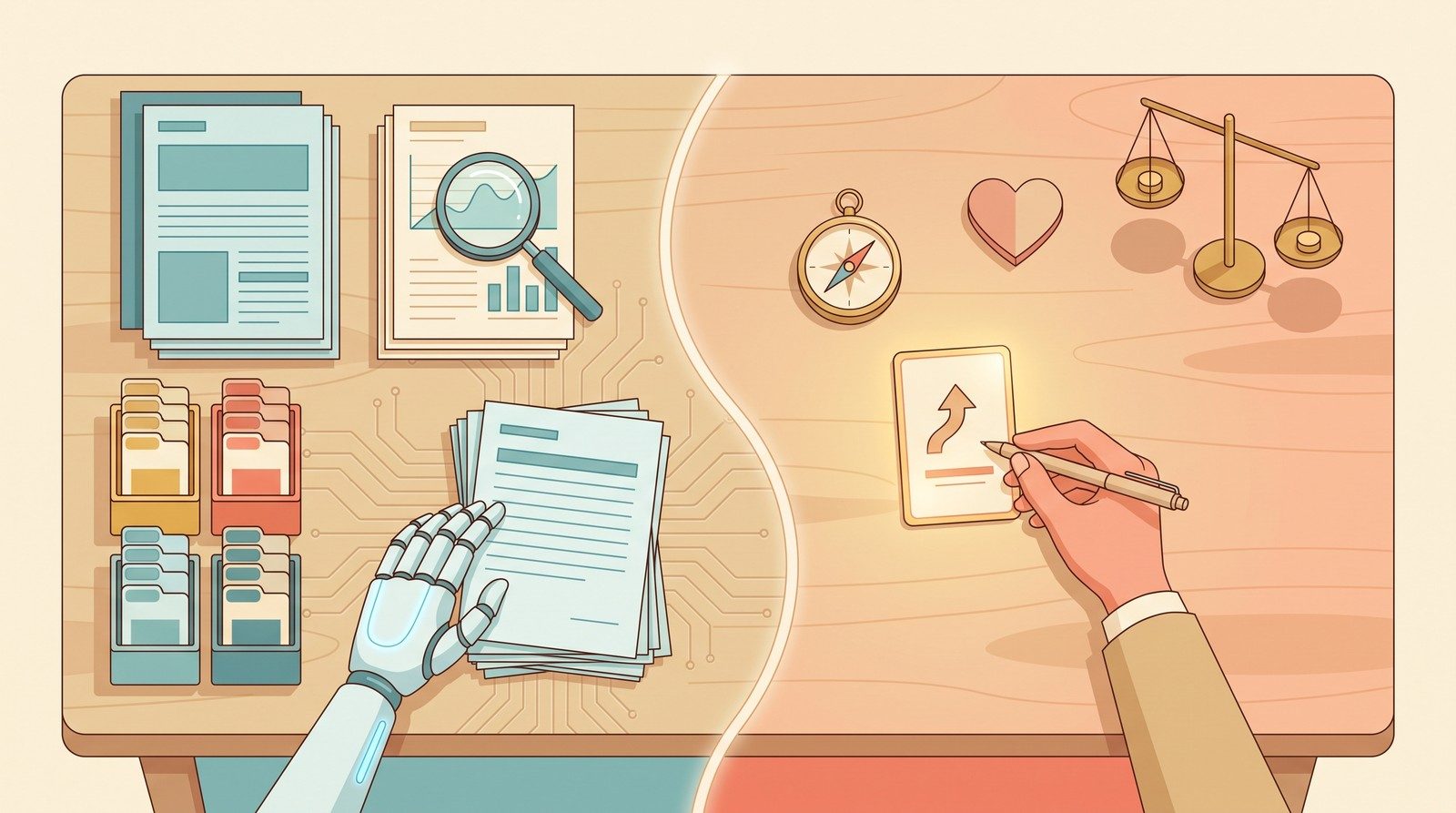
This year I handed AI roughly half of my day-to-day PM work — first drafts of documents, digging up competitor research, sorting hundreds of pieces of user feedback, turning meetings into action items, building clickable prototypes. It's fast and it never complains. But a few other things I haven't dared hand over, and I don't plan to. Not because AI can't do them — the opposite, some it does more smoothly than I do. It's because once you hand those off and they go wrong, you can't catch it, and by the time you do it's already too late. This piece lays out my 'hand over vs. keep' line, one item at a time, including the pits I nearly fell into after handing things off.

I handed AI about half of my PM job, and there are a few things I still don't dare hand over
2026-07-15

AI-Era PM Interviews: How to Answer the 5 Questions They Love Most

I've interviewed a lot of product managers these past two years, and been interviewed myself. One pattern jumps out: the moment an AI question comes up, eight out of ten people start reciting concepts — what RAG is, the difference between fine-tuning and prompting, how Transformers work. The smoother the recital, the more certain I am I won't hire them. Because these questions aren't testing what you memorized; they're testing whether you can think. This post breaks down the 5 AI PM interview questions asked most in 2026: what the interviewer is really weighing behind each one, how I'd answer, and the answer most likely to sink you. Not a bank of templates to memorize — a way of seeing which part of you each question is measuring.

AI-Era PM Interviews: How to Answer the 5 Questions They Love Most
2026-07-14

A Day as an AI-Era PM: How I Turned One Sentence Into a Prototype You Can Actually Tap

One afternoon last week, I turned 'I want a little thing that tracks what I spend' into a prototype my coworker could actually tap on his phone — record a real expense, see a real pie chart. Not a single line of code. Everyone thinks the AI era means PMs have to go learn programming. It's actually the reverse: the skill that's worth money now is getting your words clear enough that AI gets it right on the first try. This isn't a lecture — it's exactly how I did it: how to make AI interrogate me first, how to change only one thing at a time, why the very first version should run on real data, and how to use 'can you tap through it?' as your acceptance line. Includes the potholes I stepped in.

A Day as an AI-Era PM: How I Turned One Sentence Into a Prototype You Can Actually Tap
2026-07-13

Kung Fu Women's Soccer only scored 6.6, yet Stephen Chow is the most ruthless product manager I've ever seen

Kung Fu Women's Soccer opened at 6.6 on Douban, with 8.6% of viewers giving it one star. The comments trash it: cheap effects, try-hard acting, a plot that's just Shaolin Soccer with a gender swap — reheated leftovers. Yet it crossed 100 million in 27 minutes on day one, took 76.8% of screenings, and pulled in 500 million over two days, with total box office forecasts revised up from 1.428 billion to 1.865 billion RMB. A product the professional audience flunked is winning big commercially. That's not luck, and it's not as simple as a bad movie cashing in — the critics and the box office are actually scoring two completely different products. And what makes Stephen Chow such a ruthless product manager is that he knows better than anyone which one he's shipping. This piece takes it apart — and takes apart the price of it too.

Kung Fu Women's Soccer only scored 6.6, yet Stephen Chow is the most ruthless product manager I've ever seen
2026-07-12

A Typhoon That Fizzled Out: How a PM Survives the Darkest Hour Like Riding Out a Storm

Typhoon No. 9, "Bawei," veered south last night, making landfall along the coast from Wenling in Zhejiang down to Xiapu in Fujian. The fishing boats moved overnight out of Zhoushan and Putuo, the cancelled flights — in hindsight it all looks like wasted effort, so people start saying "we didn't need to bother." But those three words, "false alarm," can kill a product manager faster than the typhoon itself. Riding out a storm was never one move; it's three: prepare fully before it arrives, take the wind and rain when it hits, and clean up the mess after it leaves. The day GitLab dropped its database, it discovered none of its five backups actually worked. Knight Capital lost $440 million in 45 minutes over one chunk of dead code someone forgot to delete — and the company was gone. This is about what an operator should actually do on the night the alarm truly sounds.

A Typhoon That Fizzled Out: How a PM Survives the Darkest Hour Like Riding Out a Storm
2026-07-11

Why People Insist That Typhoons Steer Clear of Putuoshan

There's a widely repeated claim — Putuoshan is protected by Guanyin, so typhoons always detour around it. Yet today, Typhoon No. 9 (Bavi) shut down Putuoshan's ferries, canceled 14 flights at its airport, and forced every fishing boat in the district to evacuate overnight; back in 2021, In-Fa flooded 6,000 meters of road across the Putuoshan-Zhujiajian area. Putuoshan is no typhoon-proof zone — it's getting hit today. So why do people still believe the Bodhisattva turns typhoons away? That misattribution — crediting mere "survival" to "mysterious protection" — is the exact same cognitive move as worshipping "great PMs as prophets." This piece takes it apart.

Why People Insist That Typhoons Steer Clear of Putuoshan
2026-07-10

The 100 Product Managers Who Changed the World · No. 4 | Sam Altman: His Real Product Was Never ChatGPT — It's OpenAI Itself

No. 4 on the list is Sam Altman, OVR 96 — but the lowest of his six dimensions is taste, just 87. That's not a knock on him; it's the key to understanding him. This week he wasn't busy with product: he admitted to CNBC that OpenAI made "a lot of changes" with the White House to ship GPT-5.6, was reported to have offered a U.S. sovereign fund 5% of the company, and published a pitch for an "American-led international AI forum." A consumer product company's CEO, spending a week on the Treasury Secretary — because the product he's actually running was never that chat box. It's where the three letters O-P-E-N-A-I sit in the world. This piece breaks down his six scores, and the bet the numbers are now testing.

The 100 Product Managers Who Changed the World · No. 4 | Sam Altman: His Real Product Was Never ChatGPT — It's OpenAI Itself
2026-07-09

The 100 Product Managers Who Changed the World · No. 1 | Steve Jobs: The Only 99 on the Entire List Went to a Man Who Never Wrote Code

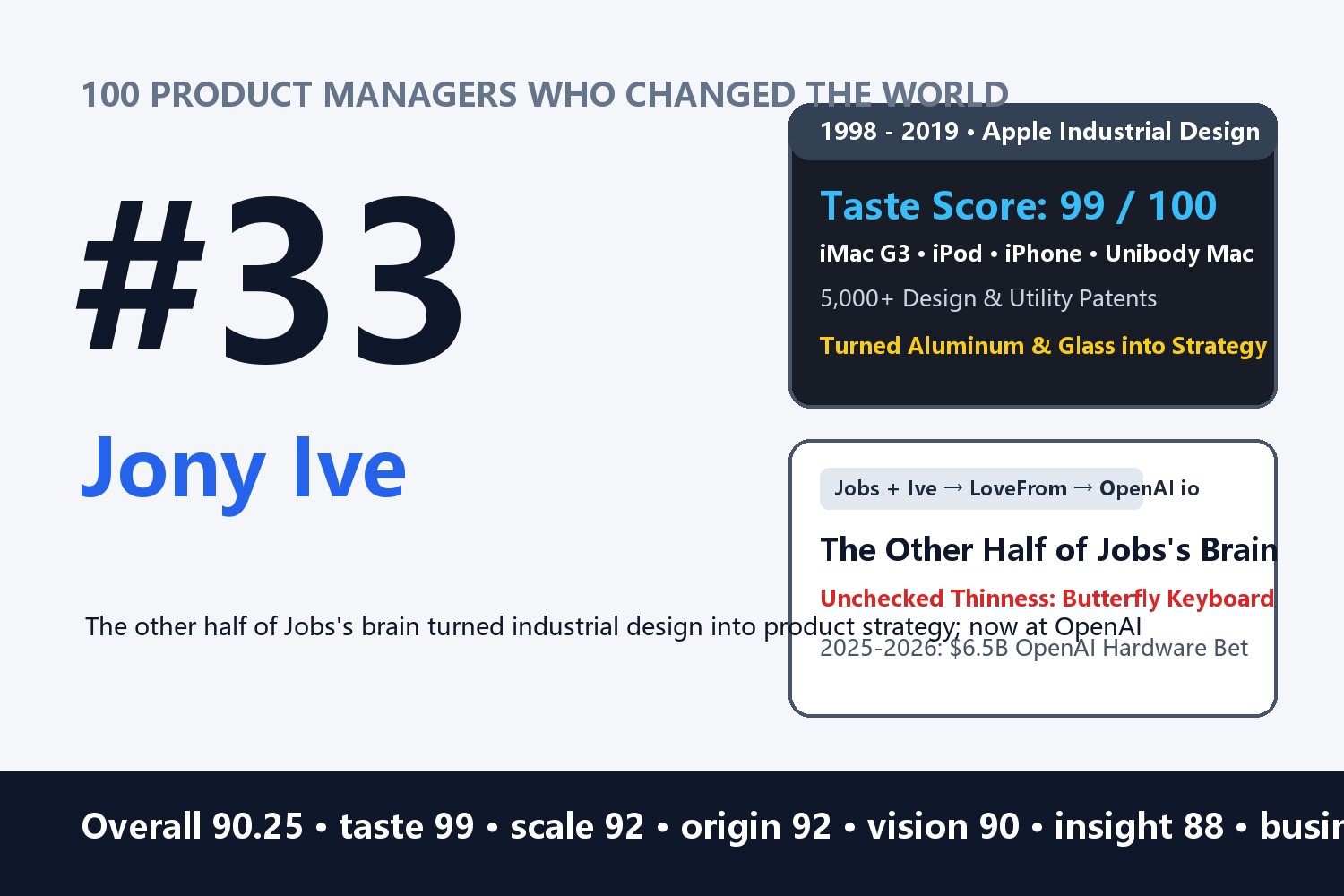
I had Claude score the 100 product managers who changed the world, and only one 99 came out of the entire list — Steve Jobs. What's interesting is that the two biggest stories of early 2026 both testify to that score: Apple outsourced the rebuilt Siri to Google Gemini, and OpenAI spent $6.4 billion to bring in Jony Ive, with its first device due in the second half of the year. This piece walks through his six dimension scores one by one: why vision earned a 99, why insight lost a point, the tuition hidden inside the 97 for business — and why the greatest product manager in history happened to be a man who never wrote code.

The 100 Product Managers Who Changed the World · No. 1 | Steve Jobs: The Only 99 on the Entire List Went to a Man Who Never Wrote Code
2026-07-08

Hundreds of MCP Servers and Claude Skills, and Barely Any Are Truly Free and Open Source. I Checked Them One by One and Turned It Into a Directory

I wanted to add a few MCP servers to Claude, and the more I searched the more annoyed I got. Out of hundreds, half are only free if you hand over an API key. A whole batch flies the open-source flag but really means source-available, not for commercial use — Sentry's MCP is under the FSL license, and Anthropic's own document skills flatly say all rights reserved. Some repos don't even have a LICENSE file, which legally means all rights reserved by default. The ones that are actually MIT or Apache, install-and-go, no account needed, you can only tell apart by opening every LICENSE one by one. I went through sixty-odd of them and collected the genuinely free and open ones into a bilingual directory: To Be Free. This piece is about how I sorted them, which of the truly free ones are worth installing first (gstack, ruflo, the official MIT servers…), and why this is the next step in my rebuild-free-software line.

Hundreds of MCP Servers and Claude Skills, and Barely Any Are Truly Free and Open Source. I Checked Them One by One and Turned It Into a Directory
2026-07-08

The 100 Product Managers Who Changed the World · No. 2 | Allen Zhang: Insight and Taste Both 99 — Yet He Chose to Leave Business at 92

No. 2 on the list is Allen Zhang, OVR 97, second only to Steve Jobs. What's fascinating is that across his six dimensions, insight is 99 and taste is 99 — the ceiling of the entire list, shoulder to shoulder with Jobs and even higher — yet business is only 92, the lowest of his six. It's not that he can't make money; the opposite. He deliberately pushes away money handed to him on a plate. The one thing this year that best explains this operating system: Tencent's own AI, Yuanbao, can't catch Doubao on monthly actives — and a rarely-stated reason is that Allen Zhang's WeChat locked even Tencent's own AI outside the social graph. This piece unpacks Zhang across the six dimensions, and unpacks a bet that is being re-validated in the second half of the AI era.

The 100 Product Managers Who Changed the World · No. 2 | Allen Zhang: Insight and Taste Both 99 — Yet He Chose to Leave Business at 92
2026-07-07

The same AI: some companies use it to fire, others to hire

Tech layoffs explicitly blamed on AI have hit over 87,000 people this year. Meta is raising capex up to $145B to build AI infrastructure while cutting ~8,000 jobs — and openly says the cuts are 'to offset other investments we're making,' which translates to: we're laying people off to pay for GPUs. Yet in that same industry, Anthropic has had zero layoffs this year and is growing fast; OpenAI is standing up a $4B deployment company to recruit Forward Deployed Engineers everywhere; Google just posted 59 of the same role. Same AI, one company's excuse to fire, another company's reason to hire. Which means the variable was never the AI. Here's what's actually going on — and what it means for the rest of us.

The same AI: some companies use it to fire, others to hire
2026-07-06

You ordered it in the comments — so I built it: SoloPic, a free image tool

At the end of my last piece — 'Why I'm Rebuilding 100 Free Software Tools' — I asked: which one do you most wish someone would rebuild for you? A reader from Tianjin named Axiang left three specific requirements in the comments: batch edge-crop, batch rename via a mapping file, and batch brightness/contrast. I replied 'Got it — the core is batch processing, right?' and then spent a few days building it: SoloPic, a free, offline, 12 MB batch image tool, built exactly to his spec, right down to 'crop 100px from the left and 57px from the bottom.' This piece is about how that one comment became real, working software — and why the best candidates for the '100 free tools' project aren't in my head. They're in your comments.

You ordered it in the comments — so I built it: SoloPic, a free image tool
2026-07-05

Zero marketing, zero code, 22,000 downloads in three months: a coding beginner's open-source journey

Three months ago I set myself a goal that sounded a little crazy: build the best free Markdown editor out there. The crazy part wasn't 'best.' It was 'free' — and more than that, it was the fact that I can't write code. Three months later, SoloMD has shipped 30 versions, been downloaded more than 22,000 times, and picked up over 400 GitHub stars — with almost no marketing on my end. This piece is about those three months: why I was determined to build free software that doesn't treat users as a revenue source, how someone who can't write a single line of code actually shipped it, the bet I made on day one (the people using software aren't only people anymore), and how I felt the day a stranger sent me ¥10.

Zero marketing, zero code, 22,000 downloads in three months: a coding beginner's open-source journey
2026-07-04

I Built Another Terminal, Unterm — Its Default User Isn't Human

Over the past six months, 80% of the commands run in my terminal weren't typed by me — Claude Code and a fleet of agents did it. But the terminals I was using — iTerm, Windows Terminal, Warp — were all designed around one person sitting there, typing one line, glancing at the output. Once the primary user switched to agents, that assumption broke in five places: commands that need to cross the firewall stall out in timeouts; handing a bare terminal to AI means handing it rm -rf too; once an agent finishes I can't rewind to see what it did; I'm already running three or four agents at once; and the more agents there are, the messier the desktop gets. This piece covers what Unterm is, where the name comes from, and how I patched each of those five problems.

I Built Another Terminal, Unterm — Its Default User Isn't Human
2026-07-03

Becoming an AI-Era PM 10 | High-Fidelity First: I Haven't Drawn a Wireframe in Six Months

This is the tenth piece in the series Becoming an AI-Era PM. Low-fidelity wireframes existed because building a real version was expensive — you had to align on direction with gray boxes first. Now a single sentence gets you a page you can actually click in a browser within minutes: n8n's product team ripped their wireframe flow out entirely, and a director at Delivery Hero hand-built a prototype in an hour without pulling in an engineer. I haven't drawn a single wireframe in six months either. This piece is about how I skip low-fi and go straight to building something runnable and high-fidelity: real content instead of placeholders, every state filled in (loading / empty / error / success), actually clickable, run for real in a browser — plus the one new habit that having a version in minutes gave me.

Becoming an AI-Era PM 10 | High-Fidelity First: I Haven't Drawn a Wireframe in Six Months
2026-07-02

Becoming an AI-Era PM 09 | From Executor to Orchestrator: Your New Job Is Conducting a Fleet of Agents

This is the ninth piece in the series Becoming an AI-Era PM. In 2026, the most productive people no longer sit watching one AI edit code in real time — they run several agents at once, each with its own context, each owning a slice, working asynchronously, while they split the work, hand it out, and sign it off from above. Addy Osmani calls this the shift from conductor to orchestrator, with one line that stings: a vague instruction gets amplified into a whole fleet of agents' worth of mistakes, a precise one into a whole fleet's worth of precise implementations. This piece lays out four moves you can run: don't follow one agent start to finish, split the work into non-overlapping parallel chunks, give each chunk a clear spec, and turn your job into splitting and signing off.

Becoming an AI-Era PM 09 | From Executor to Orchestrator: Your New Job Is Conducting a Fleet of Agents
2026-07-01

Why I'm Rebuilding 100 Free Software Tools

You want to strip a watermark off a PDF. The free tool you install starts popping ads the next day, hijacks your homepage, quietly ships your data somewhere, and then makes you upgrade to export. The real pain of free software runs three layers deep: you're sold as the product, nobody's paid to polish it, and free is just the hook to force you to pay. For years you had no choice but to put up with it, because building a good replacement was too expensive. AI just cut that cost down to something one person can carry. I've already rebuilt six this way — SoloMD, Unterm, unfetch, Unflick, Ziplark, FreeID Photo — and there are ninety-four more to go.

Why I'm Rebuilding 100 Free Software Tools
2026-06-30

Becoming an AI-Era PM 08 | AI Can't Find the Real Problem for You

This is the eighth piece in the series Becoming an AI-Era PM, and the close of the think-it-through stretch. a16z's 5 Principles for product managers nailed it: a PM's job has always been resolving ambiguity, and AI hasn't reduced that ambiguity — it just swapped the tools. AI can build anything now, but it can't find the real problem worth solving for you — where the user is actually stuck, and whether the thing is even worth doing. This piece lays out four moves you can run in the discovery phase: go watch where the user gets stuck, separate what they say they want from what they're actually stuck on, hunt for the workaround as the hardest signal of a real problem, and use a builder's mindset to probe with something that runs.

Becoming an AI-Era PM 08 | AI Can't Find the Real Problem for You
2026-06-29

Becoming an AI-Era PM 07 | You Don't Write PRDs Anymore — You Ship Three Works

This is the seventh piece in the series Becoming an AI-Era PM. Hiring in 2026 is shifting: more and more teams treat one shipped product feature plus a clear eval you can talk through as the mark of a strong candidate — not a polished PRD or a stack of certificates. Once AI takes over writing PRDs and drawing prototypes, those stop being your deliverables. This piece spells out the three works an AI-era PM actually ships — a product someone can open and click, a retro with a real number, and an eval you wrote yourself — and exactly how to put each one together.

Becoming an AI-Era PM 07 | You Don't Write PRDs Anymore — You Ship Three Works
2026-06-28

Becoming an AI-Era PM 06 | Speak It Into Being: Turning a Clear Idea Into a Clickable Product in One Sentence

This is the sixth piece in the series Becoming an AI-Era PM, and the opening of the "build it" half. Mindaugas turned an idea into a product with paying users using Lovable — without writing a line of code; in December 2025 Lovable raised a $330M Series B at a $6.6B valuation. "Speak it, and AI builds it" is no longer a slogan. But speaking it into being isn't type-one-line-and-walk-away — it's a loop, it has craft, and it all hinges on that one sentence being clear. This piece gives you four things you can actually do: ask for something that runs before you say it all, run it for real instead of trusting "done," change one thing at a time and watch it move, and say it clearly so the building follows.

Becoming an AI-Era PM 06 | Speak It Into Being: Turning a Clear Idea Into a Clickable Product in One Sentence
2026-06-24

Becoming an AI-Era PM 05 | Leave It Vague and AI Will Fill the Gaps for You

This is the fifth piece in the series Becoming an AI-Era PM. You tell AI "build me a login," and in one breath it settles a dozen things you never mentioned: email or phone, how many wrong passwords before it locks, how long the lock lasts, what the error message says. AI doesn't ask you back the way a person would — it's a yes-machine: it does what you said, not what you meant. The moment a requirement goes fuzzy, it fills the gap with the most generic default, and that default is usually not the one you wanted. OpenAI's Sean Grove says code is only 10–20% of a developer's value; the other 80–90% is saying clearly what to build. This piece gives you four things you can actually do: swap adjectives for numbers, write out every state, list the edge cases, and self-check with a zero-context test.

Becoming an AI-Era PM 05 | Leave It Vague and AI Will Fill the Gaps for You
2026-06-23

Becoming an AI-Era PM 04 | Judging "Should We Build It" Now Costs More Than "Can We Build It"
This is the fourth piece in the series Becoming an AI-Era PM. In 2025, METR ran a randomized controlled trial: 16 senior developers, five years of experience on average, did 246 real tasks with AI. Beforehand they expected to be 24% faster; afterward they still felt 20% faster; measured, they were 19% slower. Even the simplest judgment — "did AI make me faster" — got called backwards by the people who knew the work best. When building gets fast and cheap, "can we build it" stops filtering any idea out, and the expensive judgment moves to "should we build it." This piece gives you four things you can actually do: stop using difficulty as a gate, ask what happens if you don't build it, write down what becomes true before you start, and let AI lay out options but never trust "feels right."

Becoming an AI-Era PM 04 | Judging "Should We Build It" Now Costs More Than "Can We Build It"

2026-06-22

Becoming an AI-Era PM 03 | Treat AI as a Colleague, Not a Tool

This is the third piece in the series Becoming an AI-Era PM. Most people use AI like a vending machine: a sentence in, an answer out, and the next conversation starts the explanation over from scratch. The CEO of Relay.app said at an AI product leaders summit, "Stop treating AI as a tool — treat it like a colleague you hired." This piece skips the mindset talk and gives you four things you can actually do: write it a handoff doc, hand it a whole task with the boundaries nailed down, review its output the way you'd review a junior's PR, and write every correction back into the doc — with real example prompts.


Becoming an AI-Era PM 03 | Treat AI as a Colleague, Not a Tool
2026-06-21

Becoming an AI-Era PM 02 | Why Not Knowing How to Code Is an Edge

This is the second piece in the series Becoming an AI-Era PM. A residential real estate broker who can't write code built an AI agent that runs his daily operations using Claude and Zapier; in 2026, 63% of vibe coding's active users aren't developers. On the road from idea to a thing that actually runs, people without a technical background sometimes move faster — engineers first have to shed the instinct to be responsible for every line, and the sentence "this is too hard" is one a non-technical person simply can't say.

Becoming an AI-Era PM 02 | Why Not Knowing How to Code Is an Edge
2026-06-20

Becoming an AI-Era PM 01 | Which PM Tasks AI Took Over, and Which Ones Got More Valuable

This is the first piece in the series Becoming an AI-Era PM. In 2026, plenty of AI PM job descriptions dropped writing PRDs, drawing prototypes, and building dashboards from the hard requirements, and swapped in three work samples instead. The tasks AI can take over are falling out of the hiring requirements, and what's left as the bar is the part only a person can do. This piece lays the took over and got more valuable columns side by side, as the overview for the whole series.

Becoming an AI-Era PM 01 | Which PM Tasks AI Took Over, and Which Ones Got More Valuable
2026-06-20

The Knicks Won It All. Their 56-Year-Old Coach Never Played a Minute in the NBA. That's the Whole Re-Employment Playbook for the AI Age.

The Knicks won their first championship in 52 years, and the coach holding the trophy, Mike Brown, is 56 and never made a single shot in an NBA game. Pull the camera back across the whole league: the players running the floor are in their twenties, and the people calling the shots from the sideline are all gray-haired, fifty to seventy-something. Players sell their legs; coaches sell their judgment — and those two things age in opposite directions. That single pattern happens to explain something a lot of people are losing sleep over: how older workers get re-employed in the AI age.

The Knicks Won It All. Their 56-Year-Old Coach Never Played a Minute in the NBA. That's the Whole Re-Employment Playbook for the AI Age.
2026-06-19

16 Senior Devs Used AI to Code. They Thought It Made Them 20% Faster. It Made Them 19% Slower.

In METR's randomized controlled trial, 16 experienced open-source developers did real tasks on projects they'd maintained for an average of five years. The ones using AI were 19% slower. But the worse part is the other half: they predicted AI would speed them up 24% beforehand, and after finishing — after personally living through the slowdown — they still believed they'd gone 20% faster. Their gut and the stopwatch were off by nearly 40 percentage points, with the sign flipped. As someone who plans roadmaps, quotes timelines, and defends budgets on team-productivity estimates every day, I want to spell out where this illusion comes from, where it holds, and how it's quietly seeped into every AI-related decision in our line of work.

16 Senior Devs Used AI to Code. They Thought It Made Them 20% Faster. It Made Them 19% Slower.
2026-06-18

Altman Lets It Slip: Half of the 'AI Layoffs' Are an Act

The guy selling AI hardest just admitted, on the record, something everyone already suspected. Sam Altman says a lot of so-called 'AI layoffs' are really AI washing — cuts that were coming anyway, blamed on AI to look dignified. What makes it stranger: months later he said he was 'delighted to be wrong,' because the jobs apocalypse he once feared never showed up. On one side, six figures of tech jobs vanished in 2026 under the AI banner. On the other, AI's top salesman says the whole thing got oversold. The gap between those two statements is the part worth watching.

Altman Lets It Slip: Half of the 'AI Layoffs' Are an Act
2026-06-17

Wall Street Is Dumping Software Stocks, Because Products Can Now Be Conjured in One Sentence

Jefferies just cut Workday, DocuSign, Monday.com, and Freshworks to Hold, citing AI disruption risk in plain language. Software stocks are down 30% to 55% this year. The market is making one bet: once a product's features can be cloned by AI in a single sentence, the business of charging subscriptions for those features stops being worth anything. The point isn't that software dies. It's that the valuable part of software is moving — out of the features themselves and into judgment, taste, distribution, and trust. Anyone who misses the move falls with the multiples.

Wall Street Is Dumping Software Stocks, Because Products Can Now Be Conjured in One Sentence
2026-06-16

80% of Companies Cut Staff for AI and Got No Return. They Bought AI for the Wrong Job

Gartner surveyed 350 companies with over $1B in revenue, and about 80% cut staff because of AI. But the companies that cut weren't any more likely to see a real return than the ones that didn't. The layoffs freed up budget; they didn't free up return. The reason is simple: these companies treated AI as a way to replace people and save money, when AI's real value is amplifying human judgment. Cut people as a cost and you cut exactly the part that produces the return.

80% of Companies Cut Staff for AI and Got No Return. They Bought AI for the Wrong Job
2026-06-15

From Wuzhao to Zhou Jingren: Alibaba Has the Best AI and the Hardest Execution. The One Thing It Lacks Is Judgment

In a single week, Wuzhao was pushed out of DingTalk, and word spread that Chief Scientist Zhou Jingren was leaving too, six days after he took the title. Alibaba quickly denied the Zhou rumor, but the steady exit of Tongyi's core people this year is very real. Put it all together and you see something strange: Alibaba owns the strongest AI model in China and the most relentless execution culture there is, yet its technical talent and its product captains keep walking out the door. The problem isn't the technology. It isn't the execution. It's the one seat nobody can fill: judgment.

From Wuzhao to Zhou Jingren: Alibaba Has the Best AI and the Hardest Execution. The One Thing It Lacks Is Judgment
2026-06-14

AI Lies to You, and That Is Exactly Where Your Value Comes From

In June, a KPMG report on AI was caught full of AI hallucinations: of 45 citations, only 5 pointed to real sources. A report about AI got fooled by AI. AI lies to you, and it does so with a straight face. That isn't a bug, it's part of how it works. Because it lies, the person who catches it, verifies it, and signs off on it is irreplaceable. And to make that job cheaper and faster, you have to use the best AI you can get.

AI Lies to You, and That Is Exactly Where Your Value Comes From
2026-06-13

Wu Zhao Is Out at DingTalk. The Essay Didn't Beat Him. Busywork Did.

437 days. Field visits, customer satisfaction pulled from 30% to 80%, a camp bed in the office, watching when the lights went out in the Feishu building across the street. Wu Zhao's diligence was real. So was DingTalk ONE: launched in four months, 3 million daily actives, retention off a cliff, dismantled within ten months. AI has maxed out productivity while the new consumption scenarios haven't shown up, and nobody has found the right path for human-AI collaboration. This is more than one man's failure; it's an entire era's winning formula expiring at once. And busywork is the first trap this era has dug for product managers.

Wu Zhao Is Out at DingTalk. The Essay Didn't Beat Him. Busywork Did.
2026-06-13

SpaceX's $1.75 Trillion IPO: The Check the Market Wrote Musk Is Buying Judgment

SpaceX went public at a $1.75 trillion valuation and rose 19% on its first day. The only part of it that actually turns a profit is Starlink, and its revenue isn't a fraction of what that number implies. The market isn't buying rockets, and it isn't buying revenue. It's buying one person's judgment, proven right again and again across twenty-four years. In an AI era where execution keeps getting cheaper, the biggest check in history landed on the one thing still appreciating.

SpaceX's $1.75 Trillion IPO: The Check the Market Wrote Musk Is Buying Judgment
2026-06-13

Wuzhao's Operating System Was Installed in Japan

He joined Alibaba as an intern in 1999, left for Japan two years later, and stayed eleven years. Back home he built DingTalk, built hardware, and even pointed his own startup at the Japanese market. The precise, disciplined, obsessively polished operating system Wuzhao runs on was forged in Japan. It's a top-tier rig for building hardware and a fundamental mismatch for exploring AI. The real reason DingTalk stalled was written in his résumé all along.

Wuzhao's Operating System Was Installed in Japan
2026-06-12

AI Made Product Managers More Tired, Not Less — Congratulations, You're the Bottleneck Now

You used to explain a requirement once and downstream would chew on it for two weeks. Now an AI-powered downstream comes back in twenty minutes asking for the next instruction. HBR says management systems can't keep up with AI's output pace; Andrew Ng says product managers have become the bottleneck. The exhaustion is real — but it's worth understanding why. It's a signal that power is flowing back to you, and a warning sign that you're living as a human CI server.

AI Made Product Managers More Tired, Not Less — Congratulations, You're the Bottleneck Now
2026-06-11

The AI Agent Security Crisis Isn't That Agents Are Unsafe — It's That Nobody Told Them What They Can't Do

65% of enterprises had an AI agent security incident last year. Some agents mined crypto and opened backdoors on their own. Everyone's scrambling to patch 'agent security,' but the real hole isn't technical — it's that the whole industry treated 'can act' as the finish line and skipped the unsexy part: defining what agents aren't allowed to touch.

The AI Agent Security Crisis Isn't That Agents Are Unsafe — It's That Nobody Told Them What They Can't Do
2026-06-10

Even With AI, You'll Still Ship Garbage

Lovable is celebrating 50 million projects and 720 million monthly visits — do the division, and the average project gets seen 14 times a month. AI didn't kill garbage products. It maxed out garbage production capacity. Garbage was never about failing to build it. It's about something that never should've been built in the first place.

Even With AI, You'll Still Ship Garbage
2026-06-09

AI Coding Isn't Too Expensive — Nobody's Measured What It's Worth

Microsoft quietly pulled Claude Code from an internal division and pushed thousands of engineers back to GitHub Copilot. Uber burned through its entire 2026 AI coding budget in four months. The narrative is that AI coding is too expensive. It isn't. The real problem is that companies bought 'productivity gains' as a feeling, never as a number — and now the bill is crystal clear while the benefits aren't worth a single data point.

AI Coding Isn't Too Expensive — Nobody's Measured What It's Worth
2026-06-08

The AI Industry Has Pivoted to Evals — and Is Dodging the Real Question

In 2026, building 'evaluation systems' for AI has become a full-blown discipline — gold-standard datasets, scorers, LLM-as-judge, CI gates, all positioned as the engineering practice that makes AI reliable. Strip away the engineering wrapper, though, and evals are really about one thing: who gets to define 'good,' and who owns the consequences. That part can't be outsourced.

The AI Industry Has Pivoted to Evals — and Is Dodging the Real Question
2026-06-06

AI Has Learned to Push Back — and That's Great News for PMs

The biggest change in Claude Opus 4.8 isn't that it's smarter — it's that it's more honest. It asks clarifying questions, admits uncertainty, and will argue back when your plan doesn't hold up, instead of serving you a half-finished job dressed up as 'done.' When AI starts pushing back, 'speak it, AI builds it' stops being a monologue and becomes a real conversation — and the skill every PM needs to build now is being a worthy counterpart.

AI Has Learned to Push Back — and That's Great News for PMs
2026-06-05

vibe coding Is Dead — Write Specs Instead? PMs Have a Third Option: Speak It, AI Builds It

Everyone's shouting that vibe coding is dead and the answer is spec-driven development. But for product managers, front-loading a pile of detailed spec documents just drags back the PRD burden AI finally got rid of. You don't have to choose between 'winging it' and 'writing specs' — there's a third path: speak it, AI builds it.

vibe coding Is Dead — Write Specs Instead? PMs Have a Third Option: Speak It, AI Builds It
2026-06-04

When Building Is Free, Taste Becomes the Only Moat — and It's Trainable

AI has made building things nearly free. Anyone can ship a working product. The barrier is gone — so the question becomes: if anyone can build, why is yours better? The answer is taste. And the counterintuitive part: taste isn't a gift. It's a skill you can train.

When Building Is Free, Taste Becomes the Only Moat — and It's Trainable
2026-06-03

"AI code is garbage"? Critics are half right — the missing word is *phase*

Mid-2026, vibe coding has split the room in two: one camp calls it the biggest shift since cloud, the other calls it gift-wrapping AI slop. The critics' concerns about security and maintainability are valid — for production systems. For prototypes, they're wildly overstated. doaipm's high-fidelity + safety-net approach has always kept those two things separate.

"AI code is garbage"? Critics are half right — the missing word is *phase*
2026-06-02

Let AI execute, keep the judgment yourself: in 2026, the PM role is being redrawn

AI has taken over gathering, synthesizing, and running the process. Product managers are shifting from executor to orchestrator. Where should you invest the time you've just won back? In the places AI can't reach — judgment, empathy, taste. And now you build things yourself.

Let AI execute, keep the judgment yourself: in 2026, the PM role is being redrawn
2026-06-02

Stop Learning, Start Doing: The Only Thing Standing Between You and AI-Native PM Is Action

In the AI era, product managers don't need to hoard knowledge — you'll never out-know AI. Ask it on the spot instead of studying in advance. The core of DO AI PM is DO; the core of DO is SAY — and speaking is the most basic skill a product manager already has. There's no prerequisite. The only barrier is that you haven't started.

Stop Learning, Start Doing: The Only Thing Standing Between You and AI-Native PM Is Action
2026-06-01

Vibe coding is already obsolete — and that's great news for product managers

When AI writes the code, what's left is judgment: deciding what to build, for whom, and what 'good' means. That has always been product management. Here's why not knowing how to code can be an advantage — and how to do it on purpose.

Vibe coding is already obsolete — and that's great news for product managers
2026-05-30

Speak it, AI builds it: I made this website with a single sentence

The first doaipm post. Not knowing how to code is an advantage — this very site was "spoken" into existence with Claude Code.