The Credit Card's Product History, and Why It Ranks 4th
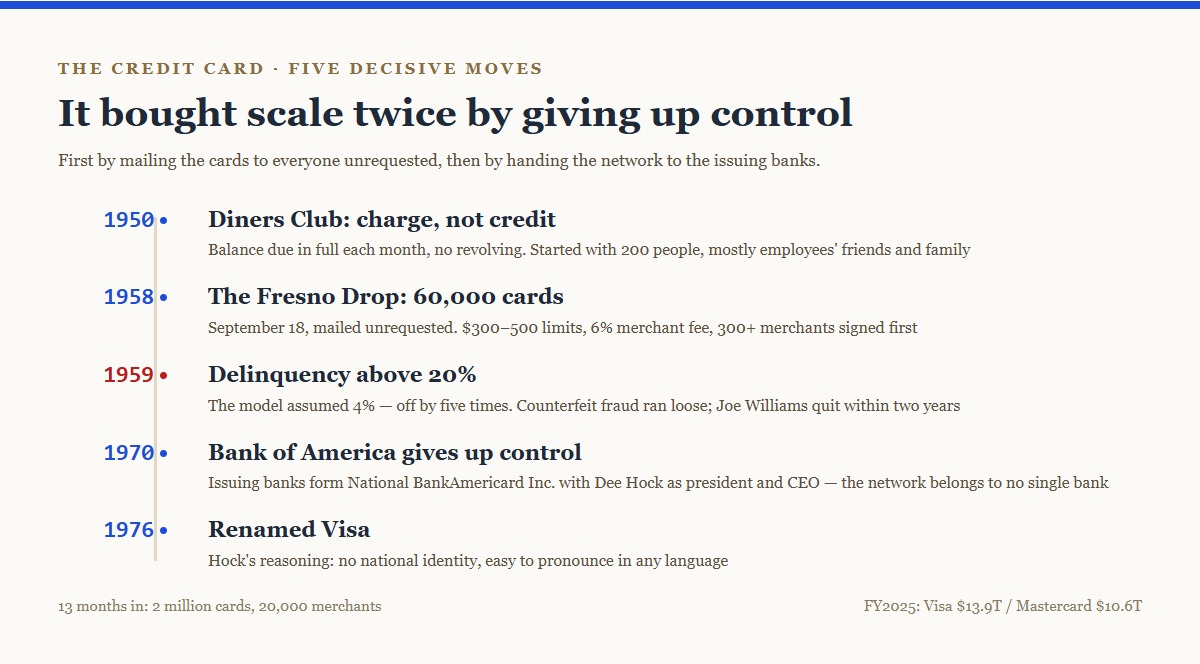
On September 18, 1958, Bank of America mailed 60,000 BankAmericards straight into the mailboxes of Fresno, California. No application form, no interview, no credit check — the recipients were simply depositors at the bank. Fresno had about 250,000 residents at the time, and 45% of its families banked there.
In fiscal 2025, Visa alone processed $13.9 trillion across 257.5 billion transactions.
The credit card ranks 4th on the board with a weighted score of 95.50 — 0.15 behind Coca-Cola at number 3.
Before Fresno: Diners Club sold charging, not credit
On February 8, 1950, Frank McNamara, Ralph Schneider and Matty Simmons put the first card-based meal on account at Major’s Cabin Grill, next door to the Empire State Building. Diners Club started by issuing to just 200 people, mostly employees’ friends and family; it reached 20,000 members by the end of 1950 and 42,000 by the end of 1951.
But Diners Club was a charge card: the statement had to be paid in full, and no balance could roll into the next month.
That distinction is the whole watershed. A charge card solves “I don’t want to carry enough cash,” which is a payment convenience. BankAmericard introduced revolving credit — pay part of it, and the rest carries over with interest.
One sold convenience; the other sold time. The real invention was never the piece of plastic. It was making “spend now, pay later, and pay interest on what you don’t clear” into something an ordinary household could use daily.
September 18, 1958: 60,000 cards straight into the mail
The first version of the product looks crude now, but every choice points at the same judgment: this only works if both sides show up at once.
- Initial limits of $300 to $500 per card
- A 6% merchant fee
- Over 300 merchants signed before launch
Mailing the cards unrequested, with no qualification bar, was the cold-start solution: get the cardholder side to 60,000 in a single stroke, so merchants have a reason to accept it. It is the bluntest and most effective two-sided-market opening the era could produce.
It worked fast. Within three months it expanded to Modesto and Bakersfield; within a year, San Francisco, Sacramento and Los Angeles. Thirteen months after launch: 2 million cards issued and 20,000 merchants onboarded.
Delinquency past 20%: the product nearly died in year one
The project was run by Joe Williams, then 41, who headed a Customer Services Research Department at Bank of America.
His model assumed delinquency would stay under 4%. The actual figure came in above 20%.
Something else was happening in parallel: counterfeits. The cards had almost no anti-forgery features, criminals learned to replicate them quickly, and fraud ran loose.
Less than two years after the Fresno drop, Williams quit.
Expected 4%, actual 20% — off by a factor of five. The bet was that ordinary people would pay on time, and in an era without a credit bureau there was no way to test that in advance. The moment those 60,000 cards went out, the assumption was irreversible.
The product survived and turned profitable within a few years. The price was that the whole industry had to build everything it had launched without: credit assessment, fraud controls, dispute resolution. Most of the machinery that makes card businesses feel bureaucratic today exists because of the hole that 1958 mailing dug.
The 1970 restructuring is where the scale actually came from
From 1966, Bank of America began licensing BankAmericard to other banks. That broke the geographic ceiling of a single bank, and introduced a new problem: a scattering of independent issuers with inconsistent standards and messy settlement.
In 1970, Bank of America handed over control. The issuing banks jointly formed National BankAmericard Inc., with Dee Hock as president and CEO.
This is a rare move in product history: the owner deliberately gave up control in exchange for a shared network everyone was willing to invest in. The card network is not any one bank’s product; it is a clearing and rules layer owned in common by its issuers.
In 1976, NBI was renamed Visa. Hock’s reasoning was direct: the word carries no national identity and is easy to pronounce in any language.
This solves the same class of problem as Coca-Cola’s one-dollar bottling contract of 1899: scale requires other people’s capital and enthusiasm, and other people only commit when they hold something definite. Coca-Cola gave away territory; the card network gave away ownership.
How it arrives at 95.50 across six dimensions
The board weights six dimensions: originality 20%, scale 20%, impact 15%, experience 15%, business 15%, durability 15%. The credit card scores:
| Dimension | Score | Basis |
|---|---|---|
| Originality | 96 | Revolving credit, the two-sided cold start, an issuer-owned network — it defined all three |
| Scale | 98 | Visa alone cleared $13.9T over 257.5B transactions in FY2025; Mastercard added $10.6T |
| Impact | 96 | It changed how ordinary people relate to income they have not earned yet — a behavioral change |
| Experience | 88 | Lowest of the six. The swipe is thin, and all the complexity of statements, interest and installments lands on the user |
| Business | 97 | Interchange plus interest, two revenue legs, behind a very deep network moat |
| Durability | 97 | 68 years; the form went from embossing to magnetic stripe to chip to a number inside a phone, and the business never broke |
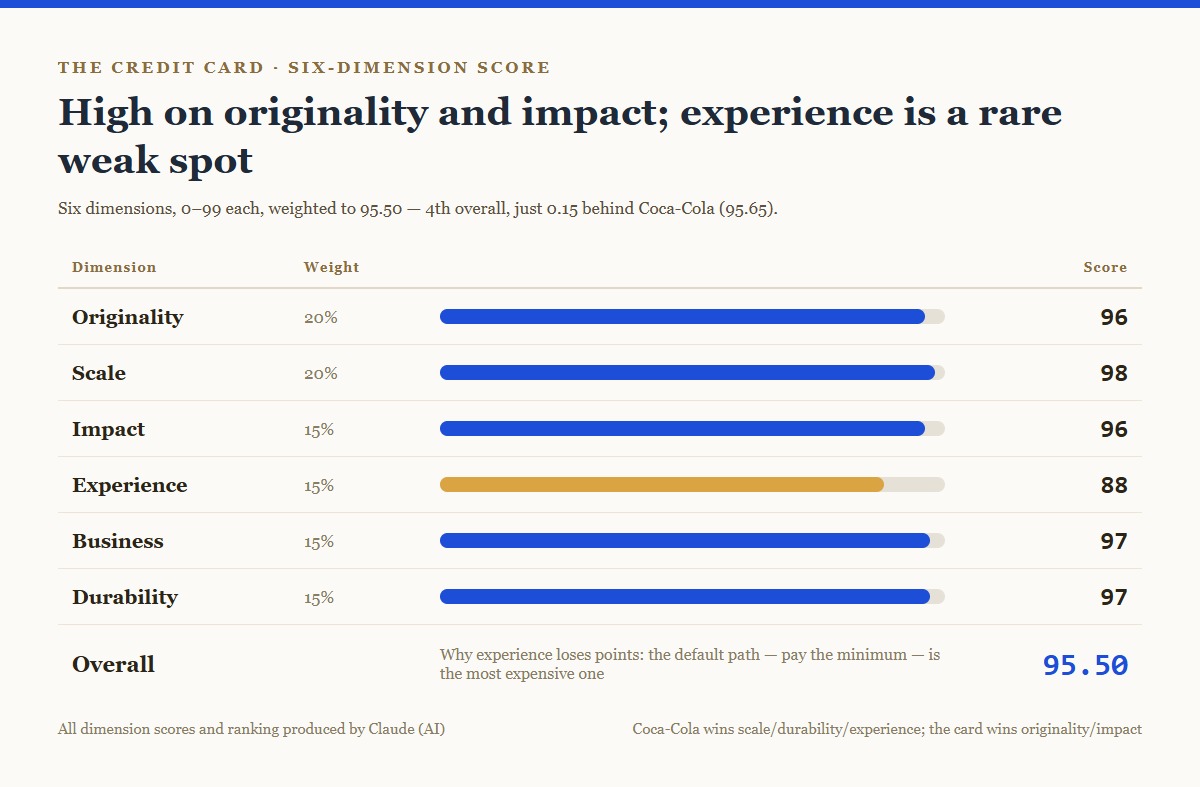
Weighted, that is 95.50 — fourth on the board.
Why 4th, and why only 0.15 behind 3rd
Coca-Cola, one place ahead, scores 95.65. The two are 0.15 apart, and their strengths are almost exactly swapped.
The card wins originality (96 to 95): Coca-Cola originated a commercial structure, the credit card originated a financial behavior. It wins impact by more (96 to 92): Coca-Cola changed what people drink; the credit card changed how people deploy money they do not yet have.
Coca-Cola wins the other three. Scale 99 to 98 — Coke reaches 200+ countries and territories, while cards still face large blank areas in cash economies and in markets where mobile payments took over. Durability 99 to 97 — Coke’s formula has barely moved in 140 years, while the card changed physical form three or four times in 68. Experience 90 to 88, the card’s weakest dimension.
Experience deserves the detail. The swipe itself is smooth, but this product pushed all of its complexity onto the user: minimum payments, revolving interest, grace periods, installment fees, the difference between a statement date and a due date. Its default path — pay the minimum — is the most expensive one available. A product whose default setting is the one worst for the user should not score high on experience.
What keeps it at 4th rather than lower is that 96 on impact. Before it, an ordinary person who wanted something costing more than their cash had to ask a favor or visit a pawnshop; after it, that became a swipe. The change is irreversible, for better and worse.
The scoring method is written out in full on the board page: six dimensions of 0–99 each, weighted into an overall score, ranked in descending order. All dimension scores and rankings are produced by Claude (AI) — I set the dimensions, the weights and the inclusion criteria; Claude scores independently, and I revisit a score after writing the long piece.
Historical facts here come from published BankAmericard and Visa histories, Diners Club’s company history, and Visa’s and Mastercard’s FY2025 disclosures. Reported first-year loss figures vary between sources, so none is cited here.
Discussion