No. 15 on the greatest product managers list: Lei Jun — he never invented a single category
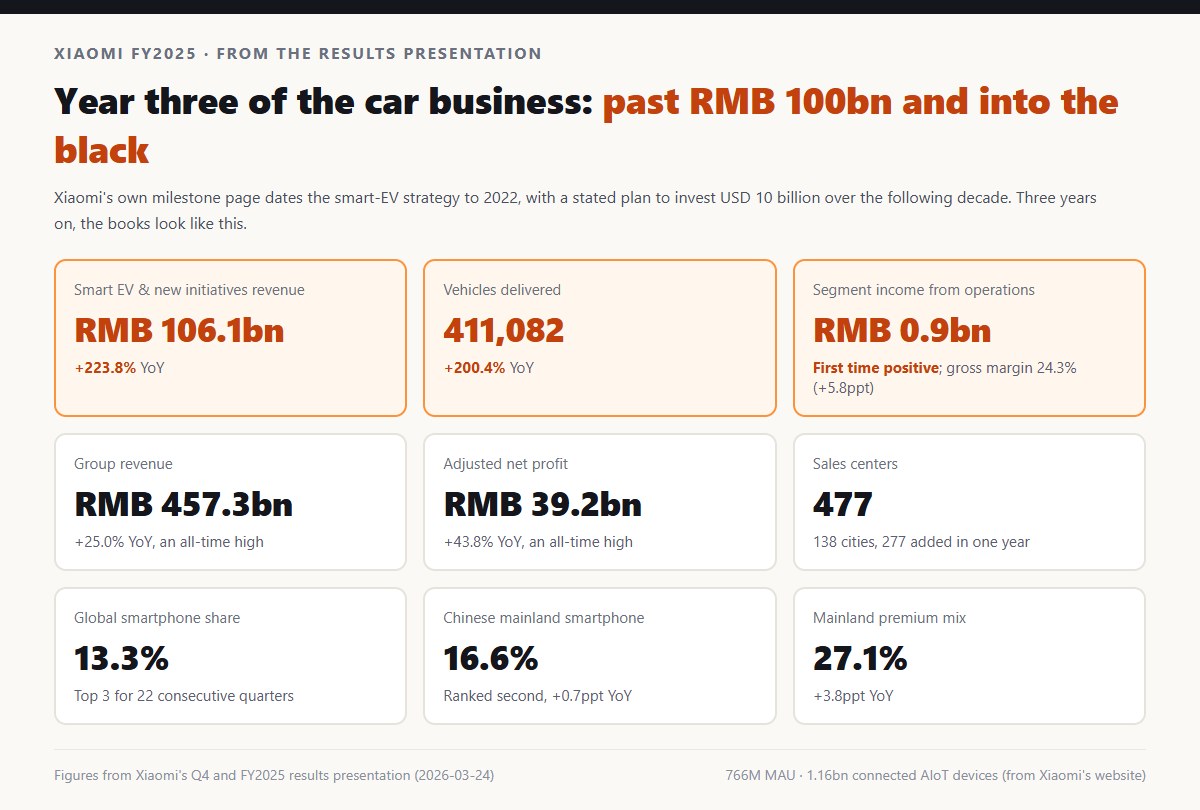
In 2025 Xiaomi delivered 411,082 electric vehicles, up 200.4% year on year.
The smart EV and other new initiatives segment booked RMB 106.1 billion in revenue for the year, up 223.8%, with RMB 0.9 billion in operating profit — positive for the first time.
The same year, group revenue was RMB 457.3 billion and adjusted net profit RMB 39.2 billion. Both are records.
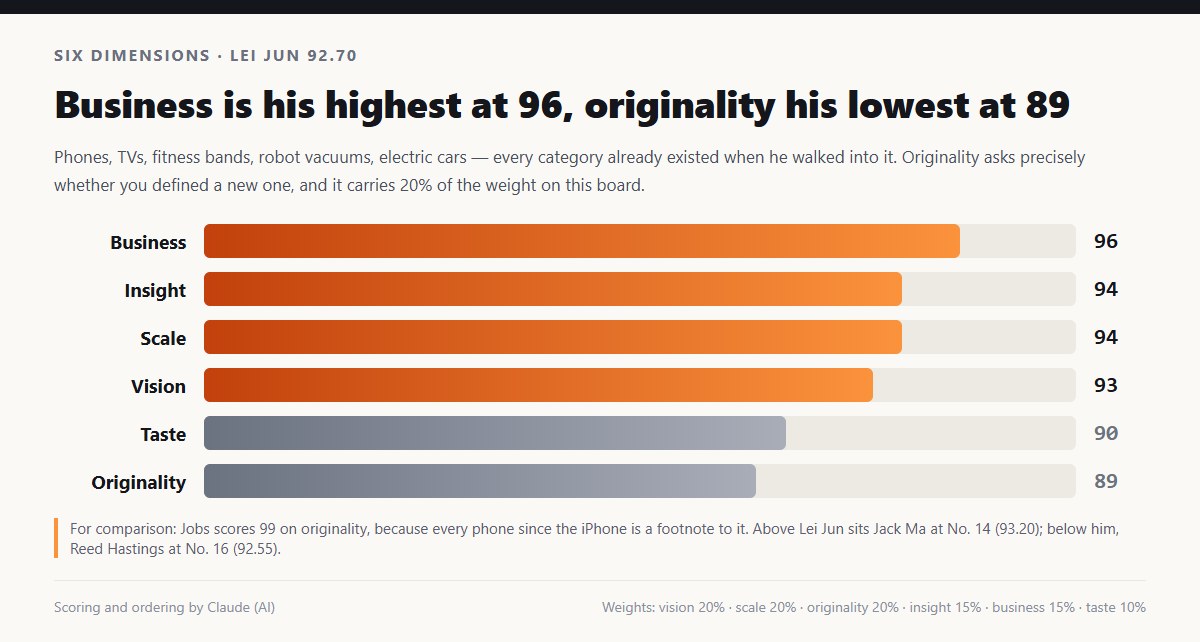
Lei Jun ranks 15th on the board, overall 92.70. Originality 89 is the lowest of his six scores.
He never invented a single category
Phones, televisions, routers, fitness bands, power banks, robot vacuums, electric cars — run down everything Xiaomi has made, and not one of those things was missing from the market when he walked in.
Every one of them had been built by somebody else for years, some for decades.
Originality asks exactly this: did you define a category that did not exist before. Jobs scores 99 on it, because every phone after the iPhone is a footnote to that phone. Lei Jun scores 89.
That is not harshness. It is what the dimension measures.
So what does he actually do
The board’s one-line read on him: he turned the phone into an internet product through “participation,” then copied the same method into a hundred categories and one car.
The second half is the part that matters.
His real product ability is not “thinking up a new thing.” It is walking into a mature category and redoing it with the same playbook — cost-performance pricing, users pulled in to help define the product, a chain of invested companies to blanket the categories.
It ran on phones first, then was carried over unchanged to power banks, fitness bands, air purifiers, televisions. Never an invention, always fast.
That is where business 96, the highest of his six, comes from.
In 2025 the playbook paid off in cars
Xiaomi’s own corporate milestones list the smart EV strategy under 2022, with a stated plan to invest USD 10 billion over ten years.
Three years later, the 2025 results:
- 411,082 vehicles delivered, +200.4%
- Auto segment revenue RMB 106.1 billion, +223.8%
- Segment gross margin 24.3%, 5.8 percentage points above the year before
- Operating profit RMB 0.9 billion, from loss to profit
- 477 sales centres covering 138 cities, 277 of them added in a single year
BYD, Tesla, NIO, XPeng and Li Auto were all building cars before Xiaomi was. Xiaomi was not first, but it is among the fastest to go from announcement to a profitable segment.
A phone company took three years to push an auto segment past RMB 100 billion in revenue and into the black. That does not need the word “originality” to be impressive — it is the ceiling of copying ability, not of original ability.
Insight 94, scale 94, and why taste is only 90
Insight 94 has hard numbers under it: 766 million monthly active users, 1.16 billion devices connected to the AIoT platform, business in more than 100 markets. Selling that many categories to the same people at once only works if you genuinely know what those people want.
Scale 94 the same way: top three in global smartphones for 22 consecutive quarters at 13.3% share; second in the Chinese mainland at 16.6%, up 0.7 percentage points.
Taste 90 is the number worth talking about.
In 2025, premium phones were 27.1% of Xiaomi’s Chinese mainland smartphone mix, 3.8 percentage points higher than the year before — the move upmarket is working. Read the other way: fifteen years in, nearly three out of every four phones still are not premium.
Taste weighs judgment about product detail and experience. Xiaomi’s investment in industrial design, system experience and imaging over these years is real — the Leica partnership, the in-house XRING O1 chip, the SU7 Ultra’s lap record at the Nürburgring — but the mental habit left by opening with “cost-performance” does not get overturned by a few years of premiumisation.
A product’s pricing strategy ends up defining what kind of products it is able to make. That is the most expensive part of the cost-performance route, and it is not on the income statement.
Why 15th and not higher
Above him is Jack Ma at 14th (93.20), below him Reed Hastings at 16th (92.55). Three people packed into 0.65 of a point.
One thing holds Lei Jun where he is: originality 89.
And that dimension carries 20% weight on this board, tied with vision and scale for the highest. It is not a minor counterweight.
Put it another way: set originality to 10% and he moves up several places. But this board is built on “defined a new category” being worth 20%, so a man who never defines a new category can only sit here.
Six weighted dimensions: vision 20%, originality 20%, scale 20%, insight 15%, business 15%, taste 10%.
| Dimension | Score | Reasoning |
|---|---|---|
| Vision | 93 | Called the phone as the internet’s entry point back in 2010; set a ten-year, USD 10 billion EV strategy in 2022 and had the segment profitable three years later |
| Insight | 94 | 766 million MAU, 1.16 billion connected AIoT devices, a hundred-plus categories sold to the same set of people |
| Taste | 90 | Second lowest of the six. Premiumisation is advancing (27.1% premium mix in the Chinese mainland, +3.8ppt), but the mental habit from the cost-performance opening is still there |
| Business | 96 | Highest of the six. 2025 group revenue RMB 457.3 billion, adjusted net profit RMB 39.2 billion, off one playbook reused across a hundred-plus categories |
| Scale | 94 | Top three in global smartphones for 22 consecutive quarters at 13.3% share, second in the Chinese mainland at 16.6%, present in over 100 markets |
| Originality | 89 | Lowest of the six. Phones, TVs, fitness bands, robot vacuums, electric cars — every one of those categories already existed when he entered it |
Weighted, that comes to 92.70 — 15th.
The scoring method is written out in full on the ranking page: six dimensions, 0–99 each, weighted into an overall score, sorted descending. All dimension scores and the ranking are produced by Claude (AI) — I set the dimensions, the weights and the inclusion criteria; Claude scores independently, and I revisit after the long-form piece is written.
Financial and operating figures here come from Xiaomi Group’s Q4 and full-year 2025 results presentation (published on the investor relations site on 24 March 2026); user and device numbers and the corporate milestones come from Xiaomi’s own site.
Discussion