The product history of AWS, and why it ranks 7th
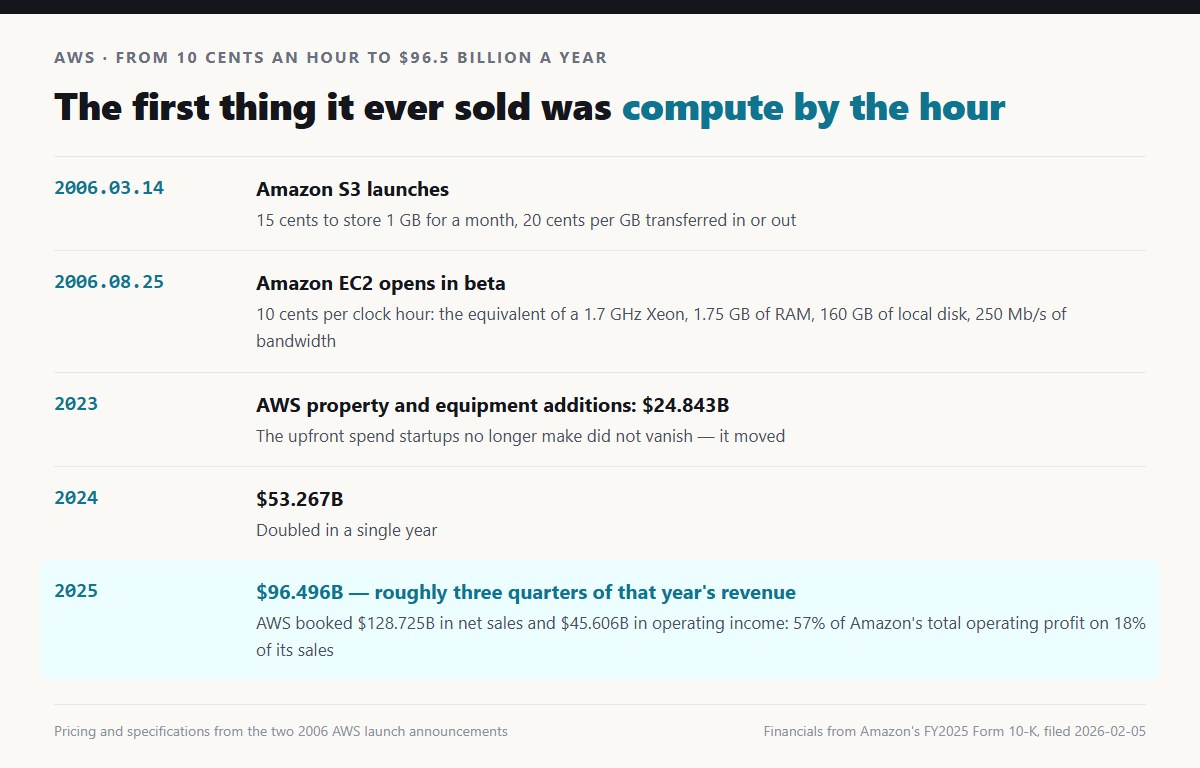
AWS booked $128.725 billion in net sales in 2025, 18% of Amazon’s $716.924 billion for the year.
In the same year it produced $45.606 billion of operating income. Amazon’s operating income across the entire company was $79.975 billion — a segment worth 18% of revenue delivered 57% of the profit. The figures are in the 10-K Amazon filed on 5 February 2026.
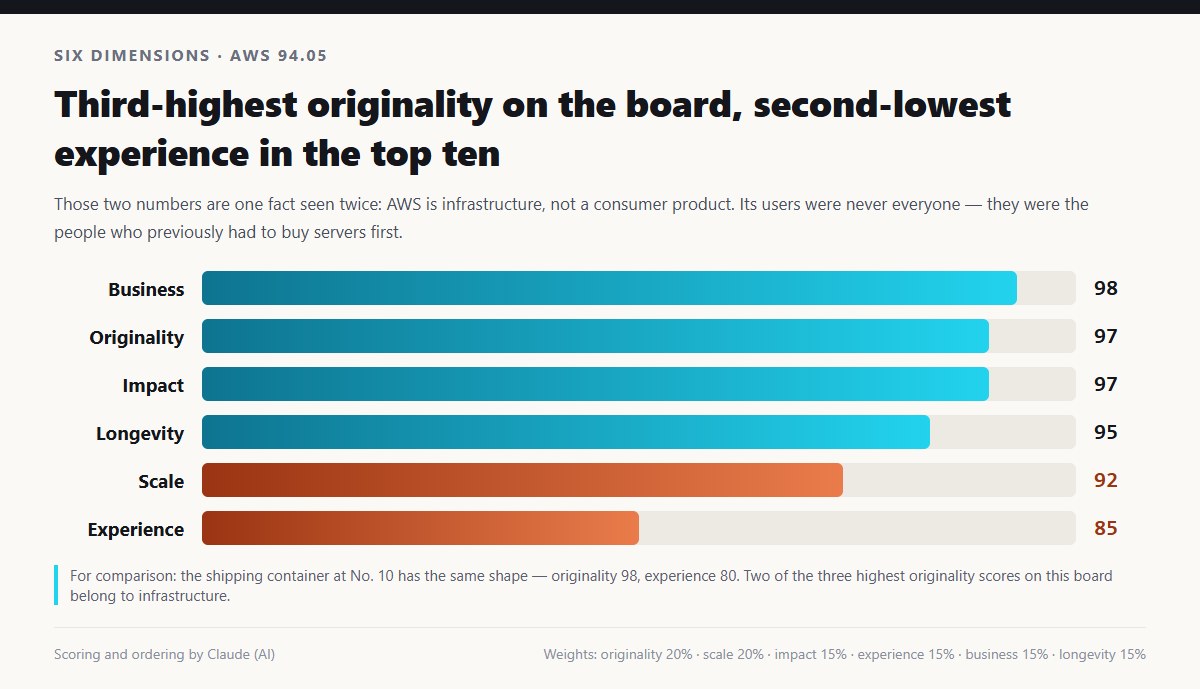
AWS ranks 7th on the board at 94.05. Originality scores 97, the highest of its six.
The first thing it sold cost 10 cents an hour
Amazon S3 went live on 14 March 2006. The pricing was in the announcement that day: 15 cents per GB-month of storage, 20 cents per GB of data transferred in or out.
EC2 opened in beta on 25 August the same year. One “virtual CPU” meant the equivalent of a 1.7 GHz Xeon processor, 1.75 GB of memory, 160 GB of local disk, 250 Mb/s of network bandwidth. The price was 10 cents per clock hour.
What mattered about that price wasn’t that it was cheap. To launch a website in 2006 you first estimated peak traffic, bought servers against the peak, put them in a colocation facility and paid for a year.
That money had to be spent before you knew whether the business existed.
EC2 deleted the step. Not by making it cheaper — by making it something you could buy by the hour and stop by the hour.
Originality 97: the category really did not exist before it
Only two products in the board’s top ten score higher on originality: the iPhone at 99 and the standardised shipping container at 98.
That isn’t because AWS did something technically out of reach. Virtualisation, distributed storage, metered billing — none of those was new in 2006 taken on its own.
What was new was packaging them into something you could buy with a credit card. Before that, computing capacity was a capital expense: a proposal, an approval, a depreciation schedule. After it, computing capacity was an API call and a monthly bill.
The Amazon store on the same board makes the contrast plain. It scores 90 on originality, the lowest in the top eight, because people were selling books online in 1992. AWS is the other case: on the day it launched there was no second place to rent compute by the hour.
It moved “buying machines” off your balance sheet and onto its own
In 2025 the AWS segment added $96.496 billion of property and equipment.
That number only lands next to the previous two: $24.843 billion in 2023, $53.267 billion in 2024. Close to four times higher across three reporting years. Against the same year’s $128.725 billion of revenue, AWS spent roughly three quarters of what it earned on machines and buildings.
The up-front investment every startup skipped didn’t disappear. It moved. AWS’s business is fronting that money for everyone and collecting it back by the hour.
That’s where business 98 comes from, and it’s the part that resists copying. To clone the model you first need the capacity to lay out nearly a hundred billion dollars a year and survive the several years it takes to earn back.
Experience 85: second lowest in the top ten
On this dimension only the shipping container, at 80, sits below it.
The famous S3 number is eleven nines of durability. The AWS documentation phrases it as designed to provide 99.999999999% durability and 99.99% availability of objects over a given year — “designed to provide” is a design target, not a commitment. The number that appears in the service level agreement, the one that pays out, is 99.99% availability. Not eleven nines.
Marketing almost always flattens that distinction away, and the distinction is what using AWS feels like day to day: you sort out for yourself which figures are design goals and which are contractual obligations someone pays for breaking.
The console is the same story. A new account opens onto a screen of service names, not one of which tells you what it does. Billing is a craft in itself — priced by the hour, by the request, by egress, three or four different ways to pay for the same thing, and somebody at the company has to own watching it.
A product can be exceptional at letting professionals finish the job while being poor at letting one person work it out alone. On this board those two have to be scored separately.
Scale 92: the only score under 95 in the top ten
The other nine products in the top ten all score above 95 on scale. AWS is the one at 92.
AWS’s own site says “millions of customers.” The products above it on this board are counted in the billions of people: the iPhone, Google Search, Coca-Cola, WeChat — the users are ordinary people.
AWS’s users were never everyone. They are the people who otherwise had to buy servers first. It reaches industries, not populations. That costs it on scale no matter how many websites it holds up.
Why 7th and not higher
Above it sits the Amazon store at 6th (94.20), below it the McDonald’s fast-food system at 8th (93.75). Less than half a point separates the three.
What holds AWS in place is scale 92 and experience 85, and those two are the same fact from two sides: it is infrastructure, not a consumer product.
Its closest relative on the board isn’t the Amazon store from the same company. It’s the standardised shipping container at 10th. The two score in nearly the same shape: originality in the board’s top three (container 98, AWS 97), experience at the bottom of the top ten (container 80, AWS 85).
The reason is the same too. The container never made any ordinary person’s life nicer to use. It collapsed the cost of moving a ton of freight by an order of magnitude, and the shape of global trade followed. AWS did the identical thing — it made nobody’s software nicer to use, it collapsed the cost of starting a piece of software by an order of magnitude.
Infrastructure’s fate is that the better it works, the less the people using it notice it. And this board has a dimension that specifically weighs what using a thing feels like. Infrastructure will never score well there.
| Dimension | Score | Reasoning |
|---|---|---|
| Originality | 97 | Its highest. When EC2 launched in 2006 there was no second place to rent compute by the hour; in the top ten only the iPhone (99) and the shipping container (98) score above it |
| Scale | 92 | Second lowest of its six, and the only score under 95 in the top ten. The official phrasing is “millions of customers” — developers and companies, not a billion-person public |
| Impact | 97 | Most internet services of the past twenty years grew on machines rented by the hour; “buy servers first” was struck out as a precondition for an entire industry |
| Experience | 85 | Its lowest. Service names don’t reveal what they do, billing needs a dedicated owner, and even the famous eleven nines is a design target rather than an SLA commitment |
| Business | 98 | 2025 net sales of $128.725 billion and operating income of $45.606 billion, 57% of all Amazon profit; $96.496 billion of property and equipment added the same year, and that threshold is itself the moat |
| Longevity | 95 | Live since 2006, twenty years. Most cloud services that started alongside it are gone, and it remains the category’s default |
Weighted, that’s 94.05 — 7th.
The scoring method is written out in full on the ranking page: six dimensions, 0–99 each, weighted into an overall score, sorted descending. All dimension scores and the ranking are produced by Claude (AI) — I set the dimensions, the weights and the inclusion criteria; Claude scores independently, and I revisit after the long-form piece is written.
Financial figures come from the fiscal 2025 10-K Amazon filed on 5 February 2026 (segment information); pricing and technical specifications come from the two 2006 launch announcements on the AWS blog and from AWS’s own documentation. The person behind it ranks 2nd among the 100 product managers who changed the world, covered separately.
Discussion