Pokémon: Turning a Link Cable into History's Highest-Grossing IP — How Red & Green's Missing 11 Creatures Rewrote Product Design
On February 27, 1996, two unassuming gray cartridges quietly arrived on Japanese store shelves.
By early 1996, Sony’s PlayStation and Sega’s Saturn had already ushered video games into the era of 3D polygons and CD-ROMs. Yet these two cartridges—Pocket Monsters Red and Pocket Monsters Green—were built for the Game Boy, a seven-year-old monochrome handheld with a blurry pea-soup screen and no backlight. First-week sales were modest. Almost no one in the mainstream press paid attention.
Within months, however, schoolyards across Japan looked different. During ten-minute recess breaks, elementary school kids were pulling a short gray cord—the Game Link Cable—out of their backpacks, plugging two Game Boys together, and swapping tiny pixelated creatures back and forth.
Thirty years later, those pixelated creatures have generated well over $100 billion in lifetime revenue—more than Mickey Mouse, Star Wars, Hello Kitty, or the Marvel Cinematic Universe—making Pokémon the highest-grossing media franchise in human history.
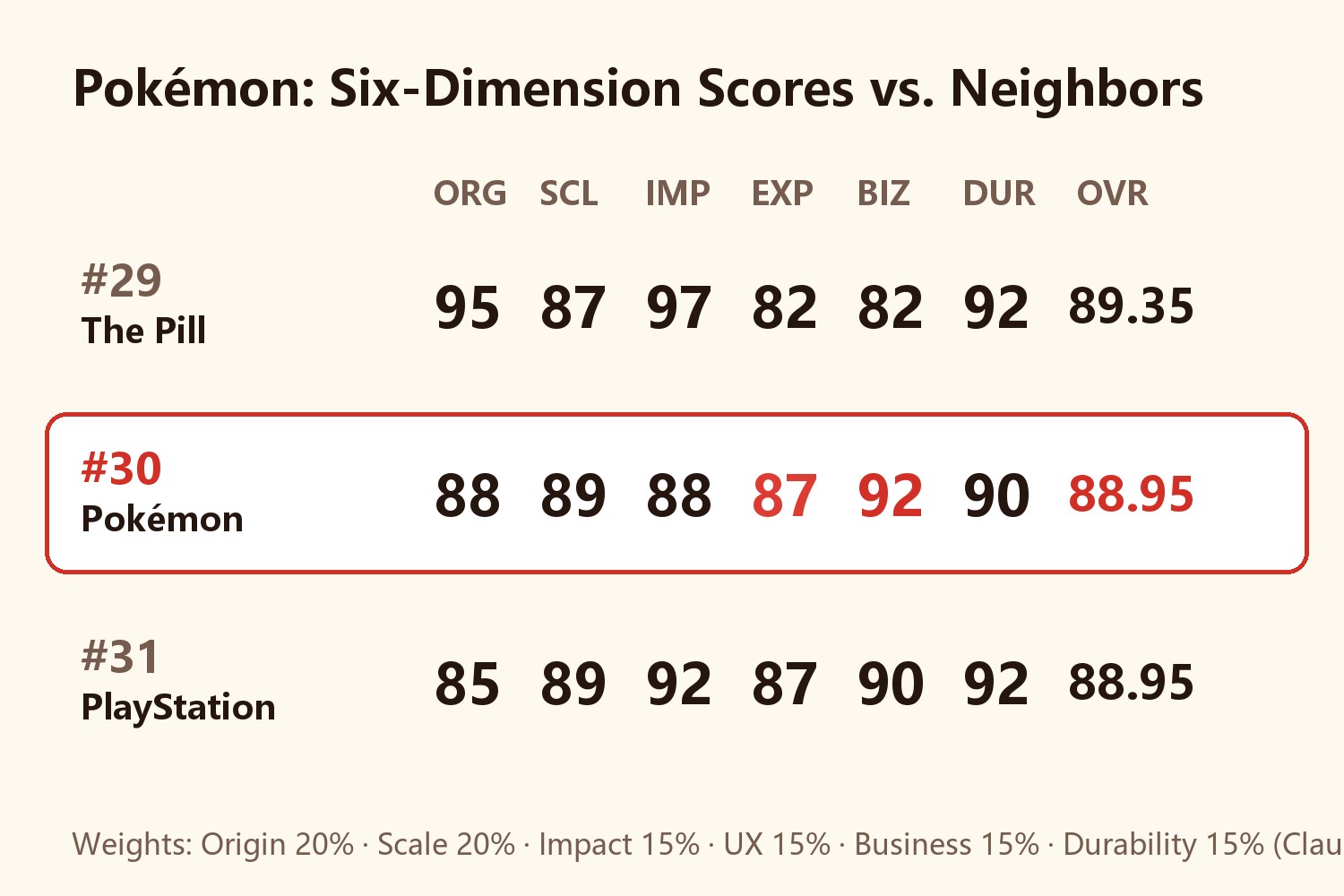
On our 100 Products That Changed the World ranking, Pokémon (1996) ranks #30 with an overall score of 88.95 (evaluated by Claude AI across six weighted dimensions): Business 92, Durability 90, Scale 89, Originality 88, Impact 88, and Experience 87.
It sits right behind #29 The Pill (OVR 89.35) and ties at 88.95 with #31 PlayStation (1994). Seeing #30 Pokémon and #31 PlayStation side by side captures one of the greatest plot twists in business history: just as Sony’s 3D powerhouse was stealing older gamers away from Nintendo, a tiny studio called Game Freak kept Nintendo’s handheld empire invincible—not with better silicon, but with a single product rule: two versions, and you cannot finish alone.
1. The Vanishing Woods of Machida and the Misunderstood Link Cable
To understand how Pokémon was born, you have to look at two things: a boy who loved catching beetles, and a serial cable that every other game designer used the wrong way.
Pokémon’s creator, Satoshi Tajiri, grew up in Machida, a suburb on the outskirts of Tokyo. In the 1970s, Machida was still full of rice paddies, ponds, and woods. Tajiri spent his childhood flipping rocks to catch rhinoceros beetles, stag beetles, and crawfish, earning the nickname “Dr. Bug” among his classmates.
By the 1980s, Tokyo’s suburban sprawl had paved over Machida’s forests and turned its ponds into apartment complexes and parking lots. Kids moved indoors. Tajiri became obsessed with a simple question: could he build a forest inside a video game, giving city children back the visceral thrill of spotting a rare creature rustling in the tall grass?
In 1989, Nintendo released Gunpei Yokoi’s Game Boy. When Tajiri saw the port on the side of the handheld for the Game Link Cable, it hit him like lightning.
Until then, nearly every developer saw the Link Cable as a conduit for zero-sum competition—two players connecting for Tetris or a fighting game where one player wins and the other loses.
Tajiri saw something completely different: what if information moved across the wire not to defeat your friend, but to trade living creatures with them? If I have two rhinoceros beetles and you have two stag beetles, and we swap one across the cable, we both unplug richer than when we started.
As a product insight, the difference between battling and trading is profound: losing a match makes the loser want to unplug; completing a trade is a positive-sum interaction that makes both players immediately look for the next friend.
2. Miyamoto’s Bet and the Masterstroke: Splitting One Game into Red and Green
In 1990, Tajiri pitched his hand-drawn concept, Capsule Monsters, to Nintendo.
Most executives didn’t quite get the slow-paced RPG concept, but Shigeru Miyamoto immediately recognized the power of collecting and trading, stepping in as producer and mentor.
What followed was a brutal six-year development marathon that nearly bankrupted Game Freak. For months, Tajiri took no salary and lived off his father’s support while five programmers quit in exhaustion. Yet out of those six years came one of the smartest structural product decisions ever made.
The problem was behavioral: how do you make sure kids actually plug in the Link Cable instead of just grinding alone?
If all 151 Pokémon existed on a single cartridge—even if some had a 1% encounter rate—players would simply grind solo in their bedrooms for twenty hours rather than walk across the classroom to talk to someone.
Together, Miyamoto and Tajiri arrived at the solution: split the game into two separate retail SKUs—Red and Green—and make each one deliberately incomplete.
They hard-coded four rules into the game’s economy:
- 11 Version Exclusives per Cartridge: Red players could never catch Bellsprout, Meowth, or Vulpix in the wild; Green players could never catch Oddish, Mankey, or Growlithe. Without a friend holding the other color cartridge, your Pokédex would remain permanently incomplete.
- Irreversible One-of-a-Kind Choices: At the start of the game, Professor Oak lets you pick only one of three starters (Bulbasaur, Charmander, or Squirtle); in Mt. Moon, you can take only one of two fossils.
- Trade-Only Evolutions: Four iconic Pokémon—Haunter, Kadabra, Machoke, and Graveler—would never evolve into Gengar, Alakazam, Machamp, or Golem no matter how much you leveled them up alone. They only evolved the instant they traveled through the Link Cable to a friend’s Game Boy.
- Coordinated Buying: Brothers, sisters, and best friends naturally coordinated before going to the toy store—if you bought Red, I bought Green.
Most products treat “social” as a coat of paint added at the end of development (a share button or a leaderboard). Pokémon did the opposite: it deliberately carved a hole in the single-player loop so that another human being became a required piece of hardware.
3. Hidden in the Last 300 Bytes: How “Mew” Turned a Slow Launch into a National Frenzy
Even with that brilliant design, Red and Green started off slowly in February 1996. The spark that turned a word-of-mouth hit into a cultural tsunami came from an unauthorized Easter egg slipped in by programmer Shigeki Morimoto.
At the very end of development, once the team stripped out their internal debugging tools to prepare the final ROM for manufacturing, exactly 300 bytes of free space remained on the cartridge.
Without telling Nintendo, Morimoto quietly used those 300 bytes to tuck in the sprite, cry, and stats of creature #151: Mew. Mew was never meant to be encountered in normal play; it existed only for post-launch events.
Then players stumbled across memory-overflow glitches that caused Mew to appear in the wild. Overnight, a playground legend was born: there is a secret 151st Pokémon hidden inside your cartridge, and nobody knows how to get it. When CoroCoro Comic ran a mail-in contest offering to load Mew onto 20 winners’ cartridges, 78,000 postcards flooded in. Without spending a fortune on TV ads, Pokémon had engineered the most potent viral loop of the 1990s.
And when Game Freak later struggled to fit the sequel (Gold & Silver) onto a cartridge and localize the tangled Japanese source code of Red & Green for Western markets, HAL Laboratory president Satoru Iwata stepped in personally—reading the assembly code himself to unblock the global release of Red & Blue, and writing the compression tools that allowed Gold & Silver to hold both Johto and the entire original Kanto region.
4. Why Pokémon Scores a 92 in Business: A Database Disguised as a Story
Why did Pokémon out-earn Mickey Mouse, Star Wars, and Mario to score 92 in Business and 90 in Durability?
Because structurally, Pokémon is not a hero narrative—it is a numbered, relational database (#001 to #1025) where every row is a merchandisable character.
- Infinite SKU Surface Area: Super Mario revolves around one plumber; Pokémon gives every child on earth a different favorite among over a thousand creatures, turning plushies, apparel, and collectibles into a long-tail goldmine.
- Native Fit for Trading Cards (PTCG): Because the video game was already built on turn-based math, elemental rock-paper-scissors, and evolution chains, the Pokémon Trading Card Game (launched in October 1996) required zero conceptual translation—and has since sold over 60 billion cards.
- A Three-Year Generational Flywheel: New game generation → new anime arc → new card expansions → new plushies → Pokémon GO (2016), which finally turned the real streets of the world into Satoshi Tajiri’s childhood woods of Machida.
5. Three Takeaways for Product Builders Today
- Real viral loops live inside the core mechanic, not in a “Share” button. Withholding 11 creatures per cartridge did more for network effects than any referral banner ever designed.
- Lateral use of old technology beats raw specs. While the industry obsessed over 32-bit 3D graphics in 1996, Tajiri won the decade with a seven-year-old serial cable.
- Intentional incompleteness creates human connection. A self-sufficient cartridge ends the day you beat the final boss; an incomplete cartridge forces you to make a friend.
Discussion