Satoru Iwata: 'President on My Card, Coder in My Head, Gamer at Heart'—How Nintendo's Programmer-CEO Put Grandma and Grandson on the Same Console
In March 2005, on the main stage of the Game Developers Conference (GDC) in San Francisco, 45-year-old Nintendo president Satoru Iwata adjusted his wire-rimmed glasses and opened his keynote with three sentences that became immortal in Silicon Valley and Kyoto alike:
“On my business card, I am a corporate president. In my mind, I am a game developer. But in my heart, I am a gamer.”
Plenty of tech CEOs claim to be builders at heart. Iwata was one of the vanishingly rare Fortune 500 chief executives who could literally walk into a struggling engineering war room over the weekend, read raw assembly code, and rewrite the compression engine himself to ship the product on time.
When Nintendo’s iron-fisted patriarch Hiroshi Yamauchi stepped down in May 2002 after 53 years at the helm, he bypassed his own family to appoint the 42-year-old Iwata—making him the first president from outside the Yamauchi bloodline since Nintendo was founded in 1889.
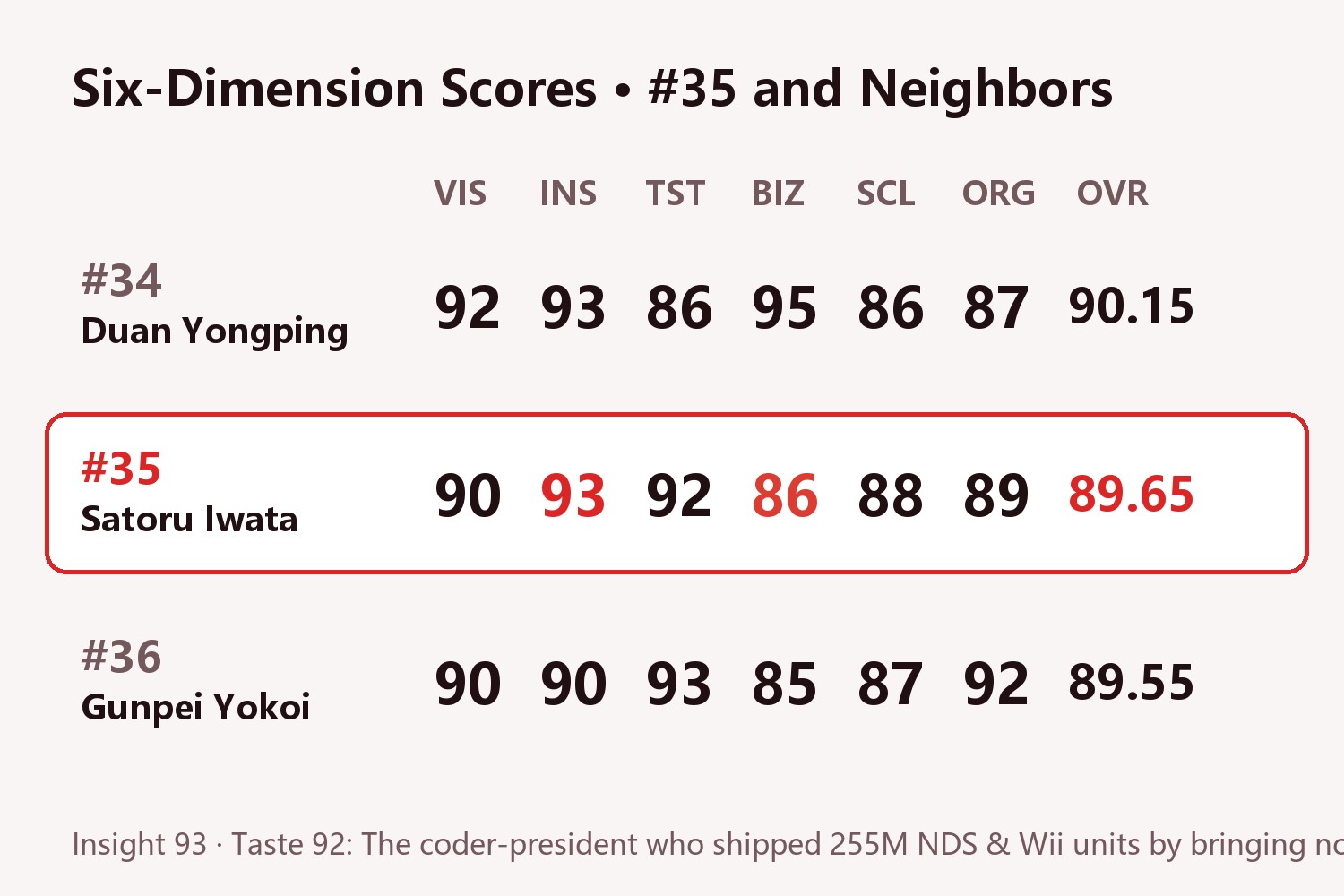
In our ranking of the 100 Product Managers Who Changed the World, Satoru Iwata stands at #35 with an overall score of 89.65 (scored by Claude AI under our unified six-dimension framework): 93 in Insight, 92 in Taste, 90 in Vision, 89 in Originality, 88 in Scale, and 86 in Business.
While Sony’s PlayStation and Microsoft’s Xbox locked horns in a multi-billion-dollar arms race over teraflops and photorealistic shaders, Iwata pivoted Nintendo ninety degrees into the Blue Ocean. Armed with a stylus (Nintendo DS, 154 million sold) and a motion wand shaped like a TV remote (Wii, 101.6 million sold), he turned hundreds of millions of mothers, commuters, and nursing-home grandparents into gamers.
1. The Miracle Coder: “Using What You Have Takes Two Years; Doing It From Scratch Takes Me Six Months”
Before he ever sat in the president’s office in Kyoto, Iwata was a legendary programmer and turnaround CEO at HAL Laboratory.
Most product managers are at the mercy of engineering estimates when a codebase tangles. Iwata was the programmer other programmers called when a project was clinically dead:
- Saving EarthBound / Mother 2 (1994): Shigesato Itoi’s ambitious RPG had been stuck in development hell for four years and was on the verge of cancellation. Iwata inspected the spaghetti code and delivered his famous ultimatum: “If we use what you have now, it will take two years. If you let me start over from scratch, I’ll do it in half a year.” Within one month, Iwata had the rebuilt engine running; within six months, a masterpiece was born;
- Fitting Two Whole Worlds into Pokémon Gold & Silver (1999): When Game Freak ran out of space on the Game Boy cartridge after building the new Johto region, Iwata wrote a custom graphics compression algorithm that freed up so much memory the team was able to pack the entire original Kanto region into the post-game—creating the most beloved plot twist in Pokémon history;
- Porting Pokémon Stadium in Three Weeks Without Documentation (1998) and debugging Super Smash Bros. Melee (2001): Even after joining Nintendo’s corporate executive ranks, Iwata spent nights reading raw battle code line by line so Melee wouldn’t miss the GameCube’s launch window.
Because he had written 6502 assembly code on bare metal and personally paid off HAL Laboratory’s 1.5 billion yen bankruptcy debt in the 1990s, Iwata carried a rare dual instinct: he knew exactly how much magic could be squeezed out of modest silicon, and he knew that technical arrogance divorced from human joy kills companies.
| Defining Campaign | Industry Consensus & Crisis | Iwata’s Counter-Intuitive Bet | Historical Outcome |
|---|---|---|---|
| Saving EarthBound & Pokémon Gold/Silver (1994–1999) | Tangled codebase; Game Boy ROM completely full | Personally rewrote game engine & custom compression tools | Delivered two regions in one cartridge; rescued flagship franchises |
| Nintendo DS (2004) | Sony’s powerhouse PSP threatened to end Nintendo’s handheld reign | Dual screens + touch stylus + microphone + Brain Age for non-gamers | 154.02M units sold (crushing PSP by 70M+); best-selling handheld in history |
| Nintendo Wii (2006) | GameCube finished dead last (21.7M); PS3 & Xbox 360 bet everything on HD | Abandoned the HD GPU arms race; designed a one-handed TV-remote controller | 101.63M units sold; brought bowling and tennis into nursing homes worldwide |
| The 50% Pay Cut & Project NX / Switch (2011–2015) | 3DS launch stumble & Wii U flop; Wall Street demanded mass layoffs | Refused to fire a single employee, cut own pay by 50%, and greenlit the hybrid Switch | Preserved R&D morale; posthumous Switch sold 150M+ units |
2. Why He Answered Sony and Microsoft’s Supercomputers With a TV Remote
When Iwata took over as president in 2002, Nintendo’s home-console business was in free fall. Market share had shrunk from 80%+ in the NES era to a distant third place with the GameCube (21.74 million units) versus Sony’s juggernaut PlayStation 2 (160 million units).
Every analyst on earth agreed on the prescription: build a brawnier box with more polygons and darker, grittier games.
Iwata looked at the living rooms of ordinary families and diagnosed the exact opposite illness: controllers had grown so intimidating—bristling with dual analog sticks and fourteen buttons—that anyone who wasn’t a teenage boy felt unwelcome picking one up. In millions of households, the game console was a source of family friction between kids who wanted the TV and parents who hated the clutter.
Iwata formulated his Blue Ocean “Gaming Population Expansion” strategy: stop fighting Sony for the same twenty million hardcore players, and instead build hardware that invites the five hundred million people who currently hate or fear video games.
- The Nintendo DS (2004): When Sony unveiled the sleek, widescreen PSP, critics mocked Nintendo’s clunky two-screen DS as a gimmick. Yet by replacing complex button combos with a familiar stylus pen and voice microphone—paired with titles like Nintendogs and Dr. Kawashima’s Brain Training—Iwata turned commuters in their fifties into daily handheld players, moving 154 million units;
- The Wii (2006): For Nintendo’s next home console, Iwata issued three heretical constraints: the box could be no thicker than three DVD cases stacked together, it had to run whisper-quiet on minimal wattage, and anyone from a five-year-old child to an eighty-year-old grandmother had to understand the controller within तीन seconds of seeing it.
By modeling the Wii Remote on a television remote control that every human already knew how to hold in one hand—and bundling Wii Sports in the box—Iwata erased the learning curve of gaming overnight. The Wii sold 101.63 million units, turning living rooms and senior centers into bowling alleys.
3. “Layoffs Impress Wall Street for a Quarter, Readily Destroying Morale for a Decade”
What elevated Iwata from a brilliant strategist to a beloved cultural icon was how he behaved when the tide turned against him.
In 2011–2013, the overpriced launch of the 3DS and the commercial failure of the Wii U (13.56 million units) pushed Nintendo into its first annual operating loss in over thirty years.
At tense shareholder meetings, activist investors demanded two immediate concessions: fire thousands of employees to pad operating margins, and abandon dedicated hardware to slap Mario onto iPhones as free-to-play gacha games.
Iwata refused both. On predatory mobile monetization, he warned that strip-mining Nintendo’s characters for quick microtransactions would destroy decades of family trust. And on layoffs, he delivered a rebuke that still echoes across the tech industry:
“If we reduce the number of employees for better short-term financial results, employee morale will decrease. I sincerely doubt employees who fear that they may be laid off will be able to develop software titles that could impress people around the world.”
Instead of handing out pink slips, Iwata cut his own salary by 50% twice (in 2011 and 2014), while fellow executives like Shigeru Miyamoto took 30% cuts.
Even after being diagnosed with bile duct cancer in 2014, a visibly gaunt Iwata hosted Nintendo Direct broadcasts to speak directly to fans without media filters, poured his product philosophy into the Iwata Asks interview archives, and worked from his hospital bed to architect “Project NX”—the radical hybrid console that merged Nintendo’s handheld and home divisions into one device.
On July 11, 2015, Satoru Iwata passed away at age 55. That afternoon, a real rainbow arched directly over Nintendo’s white headquarters in Kyoto. Less than two years later, his final blueprint launched as the Nintendo Switch, selling over 150 million units and ushering in the most profitable era in Nintendo’s history.
4. Six-Dimension Breakdown: Why the Gamer-President Ranks #35
Under the unified six-dimension framework of 100 Product Managers Who Changed the World (Vision 20%, Insight 20%, Taste 15%, Business 15%, Scale 15%, Originality 15%), Satoru Iwata scores as follows:
| Dimension | Weight | Score | Key Rationale |
|---|---|---|---|
| Vision | 20% | 90 | Rejecting the teraflop wars to pioneer the Blue Ocean “Gaming Population Expansion” and greenlighting the hybrid Switch |
| Insight | 20% | 93 | Saw that controller intimidation—not graphics—was the true barrier keeping 80% of humanity away from games |
| Taste | 15% | 92 | From EarthBound’s warmth to Mii avatars and the Wii Plaza, championed joyful, friction-free human interfaces |
| Business | 15% | 86 | Drove Nintendo to historic profit peaks during the DS/Wii era, tempered by the Wii U transition slump |
| Scale | 15% | 88 | Over 255M DS and Wii consoles sold under his direct watch, plus 150M+ on the Switch architecture he initiated |
| Originality | 15% | 89 | Co-created dual-screen touch gaming, living-room motion control, and the direct-to-fan Nintendo Direct format |
| Overall (OVR) | 100% | 89.65 | Ranked #35 Overall (just behind #34 Duan Yongping at 90.15, ahead of #36 Gunpei Yokoi at 89.55) |
In an industry that too often treats users as “monetizable eyeballs” and engineers as disposable line items on a quarterly spreadsheet, Satoru Iwata left behind a permanent north star: protect the people who build the magic, remove the fear from the interface, and never forget that in your heart, you are building for joy.
Discussion