Gunpei Yokoi: 'Lateral Thinking With Withered Technology'—How a Factory Repairman Built the Game Boy and Beat Every High-Spec Rival
One day in 1979, 38-year-old Nintendo R&D director Gunpei Yokoi was riding the Shinkansen bullet train home to Kyoto.
Across the aisle sat a bored Japanese salaryman in a business suit. With nothing to read and nowhere to go, the commuter was staring down at a pocket LCD calculator, absentmindedly mashing its buttons with his thumb just to pass the time.
Most engineers would have looked away. In Yokoi’s mind, that single mundane gesture ignited a multi-billion-dollar revelation:
What if you took the dirt-cheap liquid-crystal display of a pocket calculator and turned it into a miniature game machine the size of a business card—one an adult could play discreetly on a crowded train without anyone noticing?
That flash of insight produced the 43.4-million-selling Game & Watch series, gave birth to the cross-shaped directional pad (D-Pad) used on virtually every controller on earth, and laid the direct foundation for the 118.69-million-selling Game Boy.
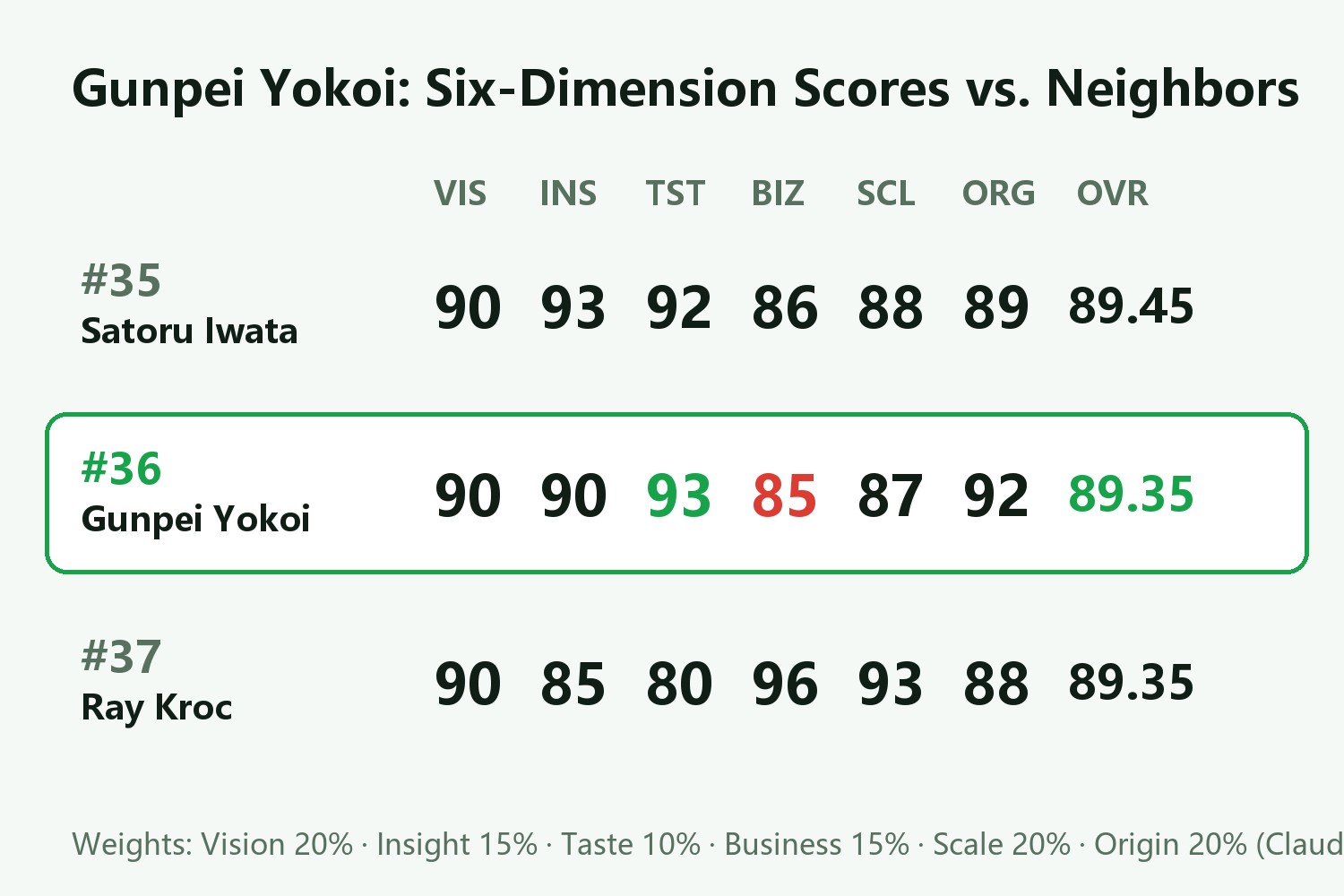
In our ranking of the 100 Product Managers Who Changed the World, Gunpei Yokoi stands at #36 with an overall score of 89.35 (scored by Claude AI under our unified six-dimension framework): 93 in Taste, 92 in Originality, 90 in Vision, 90 in Insight, 87 in Scale, and 85 in Business.
If Shigeru Miyamoto (#10) is Nintendo’s master storyteller and Satoru Iwata (#35) was its programmer-statesman, Gunpei Yokoi was the founding philosopher of Nintendo hardware—the man who personally mentored a young Miyamoto and coined the doctrine that guided Nintendo for half a century: “Lateral Thinking with Withered Technology” (Kareta Gijutsu no Suihei Shikō).
1. From Playing-Card Machine Mechanic to Toymaker: The 1.2-Million-Selling Office Contraption
When Yokoi graduated from Doshisha University in 1965 with a degree in electronics, his grades were unimpressive. While his classmates joined prestigious electronics giants like Sharp and Matsushita (Panasonic), the 24-year-old Yokoi took a humble maintenance job at a local Kyoto playing-card factory: Nintendo.
At the time, Nintendo had zero presence in electronics. It was a struggling card manufacturer whose stock had just collapsed after the Disney character-card boom faded.
In 1966, Nintendo’s iron-willed president Hiroshi Yamauchi toured the Uji plant and discovered that Yokoi had been using the company lathe in his spare time to build an extendable wooden lattice claw for his own amusement.
Summoned to the president’s office, Yokoi expected to be fired on the spot. Instead, Yamauchi told him: “Stop fixing machines. Turn that contraption into a Christmas product.”
Renamed the Ultra Hand and priced at 800 yen, Yokoi’s extendable grabber sold 1.2 million units during the 1966 holiday season, rescuing Nintendo’s balance sheet and launching its first dedicated R&D division—with Yokoi as its sole engineer.
Over the next fifteen years, Yokoi turned discarded components from other industries into cultural phenomena:
- Solar Cells into the Laser Clay Shooting System (1970–1973): Partnering with Sharp engineer Masayuki Uemura (who later designed the Famicom/NES), Yokoi repurposed industrial optoelectronic sensors into light guns that converted abandoned bowling alleys across Japan into virtual shooting ranges;
- Surplus Calculator Screens into Game & Watch and the Cross D-Pad (1980–1982): Because Japan’s calculator price war had left Sharp with massive overcapacity in monochrome LCD segments and button batteries, Yokoi bought those commodity parts for pennies. When adapting Donkey Kong into a clamshell dual-screen unit in 1982, a traditional joystick wouldn’t let the lid close—so Yokoi invented the flat cross-shaped D-Pad (US Patent 4,687,200), winning a Technology & Engineering Emmy Award and defining game input forever.
| Defining Creation | The “Withered” Commodity Tech | Yokoi’s Lateral Leap | Historical Outcome |
|---|---|---|---|
| Ultra Hand (1966) | Pantograph wooden linkage & simple rivets | Added target balls to turn a mechanical reacher into a skill game | 1.2M units sold; transformed Nintendo from a card printer into a toy innovator |
| Game & Watch & Cross D-Pad (1980–1982) | Overcapacity calculator LCDs & watch batteries | Pocket-sized commuter toy + built-in clock + flat cross D-Pad for clamshell folding | 43.4M units sold; D-Pad became the universal directional input standard |
| Game Boy (1989) | Unbacklit monochrome STN LCD + 8-bit Sharp LR35902 | Rejected power-hungry color screens for 30-hour battery life + bundled Tetris | 118.69M units sold; outlasted Sega Game Gear, Atari Lynx & NEC TurboExpress |
| Virtual Boy (1995) | Red monochrome LED array + oscillating mirrors | Attempted premature 3D VR hardware before display tech was mature | Discontinued at 770K units; the one time Yokoi violated his own “withered tech” rule |
2. Why a Blurry Pea-Green Screen Crushed Every Full-Color Handheld on Earth
When Yokoi unveiled the Game Boy in April 1989, tech journalists and rival executives treated it like a punchline.
Look at the competition lining up against Nintendo that year:
- Atari Lynx (1989) boasted a backlit 4,096-color screen and 16-bit hardware sprite scaling;
- Sega Game Gear (1990) packed a vibrant full-color backlit display and an optional TV tuner;
- NEC’s TurboExpress (1990) literally played full-blown home-console HuCard games in color on the go.
And what did Gunpei Yokoi ship? A chunky grey brick with no color, no backlight, four shades of murky olive-green on a reflective STN screen, and noticeable motion blur. Even engineers inside Nintendo rebelled, begging Yokoi to switch to a color LCD before Nintendo became a laughingstock.
Yokoi refused to budge. While his rivals optimized for trade-show spec sheets, Yokoi optimized for how a ten-year-old child actually lives:
- Battery Life Was the Real Bottleneck: In 1989, a color backlit screen was a battery furnace. Sega’s Game Gear and Atari’s Lynx devoured six AA batteries in just 3 to 4 hours, weighed half a kilogram, and cost $149–$179. Yokoi’s unbacklit monochrome Game Boy ran for up to 30 hours on four cheap AA batteries and launched at $89.99 (12,500 yen);
- Indestructibility as a Feature: Because it used mature, rock-solid components, a Game Boy could survive being dropped off a school bus—or famously surviving a barracks bombing during the 1991 Gulf War with its plastic shell melted to a crisp while still booting Tetris on the original motherboard;
- The Tetris Bundle: Paired with Tetris—a game whose high-contrast falling blocks looked crystal-clear on a four-shade monochrome grid—the Game Boy transcended kids’ bedrooms and hooked millions of adult travellers.
The market verdict was merciless. Atari Lynx sold roughly 3 million units; Sega Game Gear sold 10.62 million; Gunpei Yokoi’s “outdated” monochrome Game Boy line sold 118.69 million units.
That was the triumph of “Lateral Thinking with Withered Technology”: wait until a technology is so mature, cheap, and reliable that engineers consider it boring—then apply lateral imagination to solve a human problem that bleeding-edge silicon is too expensive and fragile to touch.
3. The Tragic Final Act: Virtual Boy and a Highway in Ishikawa
In a twist worthy of Greek tragedy, the man who preached never using immature technology was ultimately brought down by the one project that broke his own commandment.
In the mid-1990s, pressured to demonstrate 3D innovation while the Nintendo 64 was delayed, Yokoi spearheaded the Virtual Boy (1995)—a stereoscopic 3D console using oscillating mirrors and red LEDs.
Unlike calculators in 1980, head-mounted 3D optics in 1995 were nowhere near “withered.” High-resolution color LEDs were prohibitively expensive, forcing Yokoi to use jarring red-on-black visuals. Legal fears over children walking around blindfolded or straining their necks forced Nintendo to mount the visor on a rigid tabletop stand, forcing players to hunch over a desk in solitary isolation.
Yokoi himself felt the unit wasn’t ready, but commercial schedules pushed it onto shelves in July 1995. It sold just 770,000 units before being pulled.
On August 15, 1996, Yokoi resigned from Nintendo after 31 years, founded Koto Laboratory in Kyoto, and immediately began designing the clever dual-orientation WonderSwan handheld for Bandai (named in tribute to him).
He never saw it launch. On the morning of October 4, 1997, after a minor fender-bender on the Hokuriku Expressway in Ishikawa Prefecture, the 56-year-old Yokoi stepped out of his car to inspect the damage and was fatally struck by a passing vehicle.
4. Why Gunpei Yokoi Ranks #36 (OVR 89.35)
In our 100 Product Managers Who Changed the World framework, Yokoi’s scores reflect the purest hardware-experience craftsman in gaming history:
- Taste 93 & Originality 92 (Twin Peaks): Inventing the Cross D-Pad, the portable handheld category, and Metroid—while having the discipline to choose 30 hours of battery life over flashy color pixels—represents world-class product judgment;
- Vision 90 & Insight 90: His “Withered Technology” doctrine directly shaped the DS, the Wii, and the Nintendo Switch decades after his death;
- Scale 87 & Business 85 (Why #36 vs. #35 Iwata at 89.45 and #37 Ray Kroc at 89.35): Yokoi ties Ray Kroc at 89.35 raw OVR on completely opposite strengths (Kroc’s Business 96 & Scale 93 vs. Yokoi’s Taste 93 & Originality 92), and sits 0.10 behind Satoru Iwata, who carried Yokoi’s philosophy onto the global CEO stage.
Explore Gunpei Yokoi’s full profile on the live leaderboard: Top 100 Product Managers (#36 · Gunpei Yokoi), alongside his protege Shigeru Miyamoto (#10) and successor Satoru Iwata (#35).
Discussion