The Pill: How the Only Medicine That Needs No Name Redrew the Curve of Women in Universities and the Workforce
Walk into any pharmacy in the English-speaking world and ask for “The Pill.”
You don’t need to specify a chemical compound, a dosage, or a pharmaceutical brand. Out of tens of thousands of prescription drugs invented in human history, only one is universally identified by a capitalized definite article.
At the end of 1999, when The Economist surveyed the past thousand years to name the single most consequential technological innovation of the millennium, it passed over the steam engine, the transistor, and the personal computer—and put Enovid, the first oral contraceptive pill approved by the US Food and Drug Administration on May 9, 1960, on the cover.
Why would economists rank a tiny hormone tablet alongside the printing press?
Because for all of recorded history prior to 1960, half of the human race could not reliably schedule the next five years of their lives. A twenty-two-year-old woman could not confidently commit to a four-year medical degree and a three-year residency—nor would law firms and corporations invest in promoting her—when a single unplanned pregnancy could end her career overnight.
The Pill did something no law or protest had ever accomplished: it turned childbearing from an unpredictable stroke of fate into a schedulable human decision.
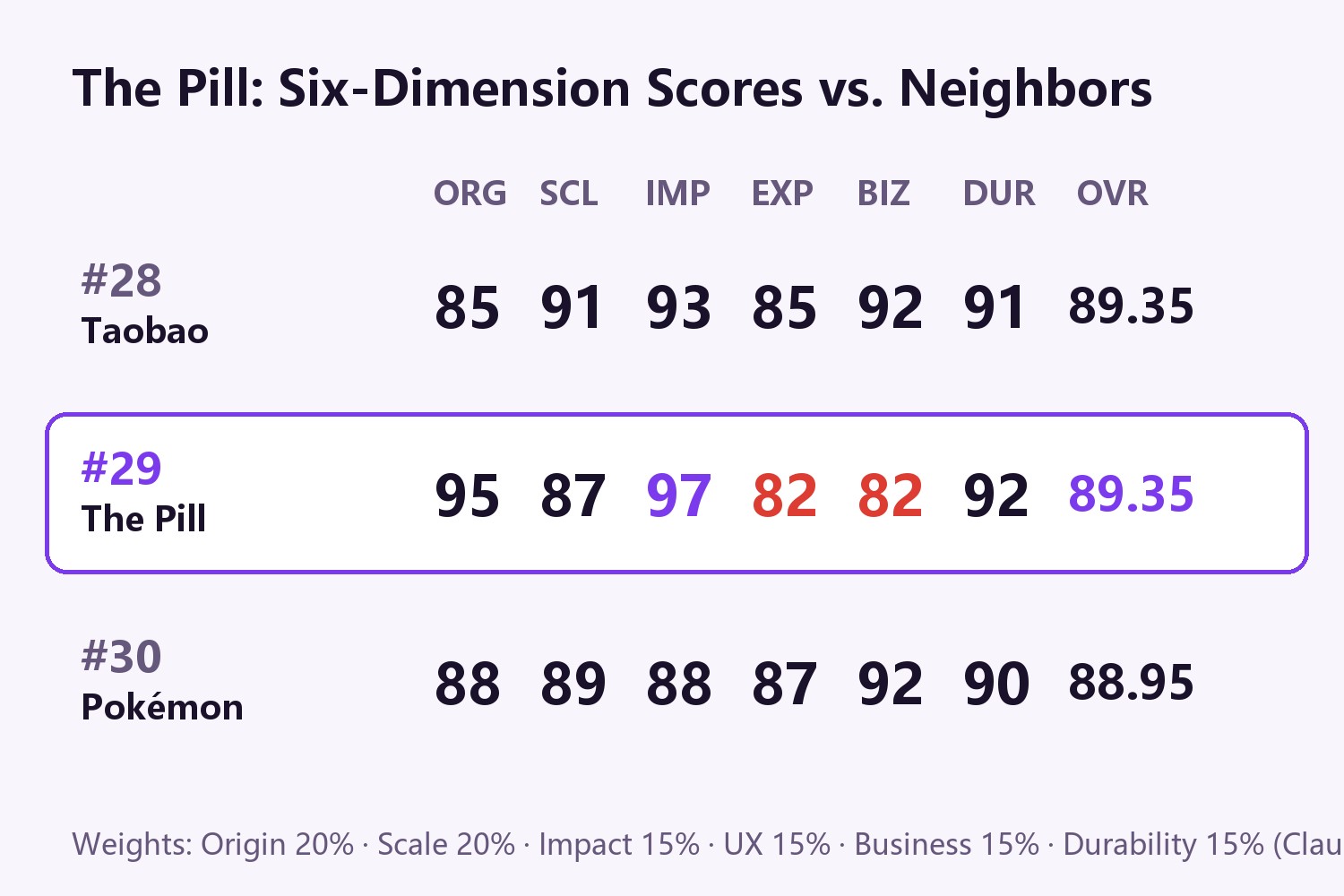
In our ranking of the 100 Products That Changed the World, The Pill stands at #29 with an overall score of 89.35 (scored by Claude AI under our unified six-dimension framework): 97 in Impact, 95 in Originality, 92 in Durability, 87 in Scale, 82 in Experience, and 82 in Business.
1. The Four Outsiders: How a $2 Million Personal Check Built What Big Pharma Refused to Touch
By standard business logic, a blockbuster product destined for ratusan of millions of daily users should have been developed by Pfizer or Merck.
In reality, in 1950 not a single major pharmaceutical company or US government agency dared touch oral contraception. Thirty American states still enforced 19th-century Comstock Laws that classified distributing birth-control information—or even a doctor prescribing it—as a felony offense. Drug executives were terrified of Catholic boycotts and criminal prosecution.
Instead, The Pill was willed into existence by an improbable alliance of four outsiders:
- The Product Visionary—Margaret Sanger (Age 71): After decades of arrests fighting for reproductive clinics, Sanger realized in 1950 that barrier methods failed because they required preparation in the heat of the moment. She defined the exact product brief: women needed a systemic tablet taken with morning orange juice, completely separated from the act itself;
- The Sole Angel Investor—Katharine Dexter McCormick (Age 75): Only the second woman ever to graduate from MIT with a biology degree (Class of 1904) and heir to the International Harvester fortune. When every foundation and drug company refused to fund the research, McCormick pulled out her personal checkbook in 1953 and wrote $2 million in personal checks (over $23 million today)—funding practically the entire development of The Pill out of her own pocket;
- The Exiled Biologist—Gregory Pincus & Min Chueh Chang: Fired by Harvard in the 1930s after the press sensationalized his early in vitro fertilization experiments on rabbits, Pincus worked out of a converted carriage house in Worcester, Massachusetts. Together with reproductive biologist M. C. Chang, he proved that synthetic progestins (first synthesized from Mexican wild yams by Carl Djerassi at Syntex and Frank Colton at Searle) reliably halted ovulation;
- The Devout Catholic Obstetrician—Dr. John Rock: A revered Harvard clinician and daily communicant who ran the human trials under the legal umbrella of treating infertility and menstrual disorders, and insisted on a 21-days-on, 7-days-off regimen so the drug mimicked a natural monthly cycle.
| Milestone | The Regulatory & Human Bottleneck | The Counter-Intuitive Product Move | Historical Outcome |
|---|---|---|---|
| 1951–1953 Funding Freeze | Comstock Laws criminalized contraception; NIH & Big Pharma refused funding | MIT alumna Katharine McCormick personally funded $2M (~100% of R&D) | The most consequential single-angel venture bet in medical history |
| 1957 Regulatory Trojan Horse | Direct contraceptive approval was politically explosive | Approved by FDA in 1957 for “severe menstrual disorders” with a warning that it prevented ovulation | Hundreds of thousands of American women suddenly reported “severe menstrual disorders” overnight |
| May 9, 1960 FDA Approval | Fierce institutional resistance to approving a drug for healthy patients | G.D. Searle submitted massive trial data; FDA approved Enovid for contraception | 1.2M users within 2 years; 6.5M American women within 5 years |
| 1962 The Dialpak Dispenser | ”Take 21 days, pause 7 days” caused widespread missed-day confusion | Engineer David Wagner invented the day-of-the-week rotary compact + 7 placebo sugar pills | Created the universal 28-day habit-loop packaging still used worldwide |
2. The Greatest UX Fix in Medicine: Why a 28-Day Pack Contains 7 Sugar Pills That Do Nothing
From a purely pharmacological standpoint, The Pill’s instructions were a user-experience nightmare: take one white tablet for 21 consecutive days, stop for 7 days, and restart on day 29.
When Enovid first shipped in 1960, it came in an ordinary brown glass bottle filled with loose pills. Every morning, millions of women stared at the bottle in panic: “Did I already take today’s pill before making coffee, or was that yesterday? And what day of the week did my 7-day break start?”
In 1962, an Illinois mechanical engineer named David Wagner heard his wife Doris worry that she had lost count of her Enovid schedule. At his kitchen table, Wagner sketched US Patent 3,136,412—the Dialpak rotary blister dispenser:
- Externalizing Memory onto the Packaging: By arranging 21 pills in a circular wheel printed with the days of the week (
SUN, MON, TUE...), the package itself became a state machine. A single glance told the user whether Tuesday’s pill had been popped; - The 7-Placebo Habit Loop: Soon after, pharmaceutical designers added 7 inert iron or sugar pills in a contrasting color at the end of the cycle. Why pay to manufacture and package seven pills with zero active medicine? Because building a daily habit (“take one pill every morning, 365 days a year”) is infinitely easier for the human brain than counting a 7-day gap.
That combination—day-of-the-week blister indexing plus placebo continuity—remains one of the greatest industrial-design triumphs in healthcare.
3. Claudia Goldin’s Curve: How One Tablet Transformed Law Schools, Medical Schools, and Marriage
In their landmark study “The Power of the Pill,” Harvard economist Claudia Goldin (winner of the 2023 Nobel Prize in Economics) and Lawrence Katz traced what happened when US states lowered the age of majority in the late 1960s and early 1970s, giving unmarried college-age women legal access to The Pill:
- The Professional School Inflection Point: Until 1969, women made up fewer than 5% to 9% of first-year students in American law, medical, dental, and MBA programs. Almost immediately after young women gained access to The Pill, female enrollment surged vertically toward 35%–50%;
- Eliminating the Career Penalty of Early Marriage: Because women no longer had to choose between abstinence and the risk of an career-ending early pregnancy, the median age of first marriage rose by several years—the exact window required to complete advanced professional training.
4. Why The Pill Ranks #29 (OVR 89.35)
In our 100 Products That Changed the World framework, The Pill’s scores reflect its civilizational weight:
- Impact 97, Originality 95, Durability 92: An Impact score of 97 puts it in the top ten across all 99 products on our board. Sixty-six years after Enovid, over 150 million women worldwide still take oral contraceptives daily;
- Scale 87: Because its direct user base is bounded by sex and reproductive age, its raw population reach sits at 87 compared to universal commodities like Aspirin (#26, Scale 96);
- Experience 82 & Business 82 (Why #29): First-generation pills carried hormone doses nearly ten times higher than modern formulations, causing side effects from nausea to thromboembolism (Experience 82), and off-patent generics keep margins modest (Business 82)—placing it in an exact 89.35 OVR tie with #28 Taobao (Business 92, Experience 85).
See The Pill’s live ranking on our board: 100 Products That Changed the World (#29 · The Pill), alongside #26 Aspirin.
Discussion