Ingvar Kamprad: Selling 'Turning Screws' as a Weekend Ritual — How a Swedish Farm Boy Built IKEA with Sawed-Off Table Legs and a $1 Hot Dog
Late one afternoon in 1956 outside a photo studio in Älmhult, Sweden, a 27-year-old draftsman named Gillis Lundgren was staring in frustration at the trunk of his car.
He had just finished photographing a new three-legged leaf-shaped side table called LÖVET for a fledgling mail-order company named IKEA. No matter how he angled the table, its three sticking-out wooden legs refused to fit inside the car without snapping.
Exasperated, Lundgren grabbed a saw: “Oh God, then let’s pull off the legs and put them underneath.”
When he showed his 30-year-old boss, Ingvar Kamprad, what he had done, Kamprad didn’t just see a clever way to load a Ford sedan. Raised on a stony farm where every penny was counted twice, Kamprad immediately saw the structural flaw that had made furniture prohibitively expensive for centuries:
Traditional furniture companies weren’t just selling wood—they were charging customers a fortune to ship empty air between the table legs.
If IKEA packed furniture flat in cardboard boxes and handed the customer a tiny hex key to screw the legs on at home, shipping volume would drop by 80%, transit damage would vanish, and assembly labor costs would fall to zero.
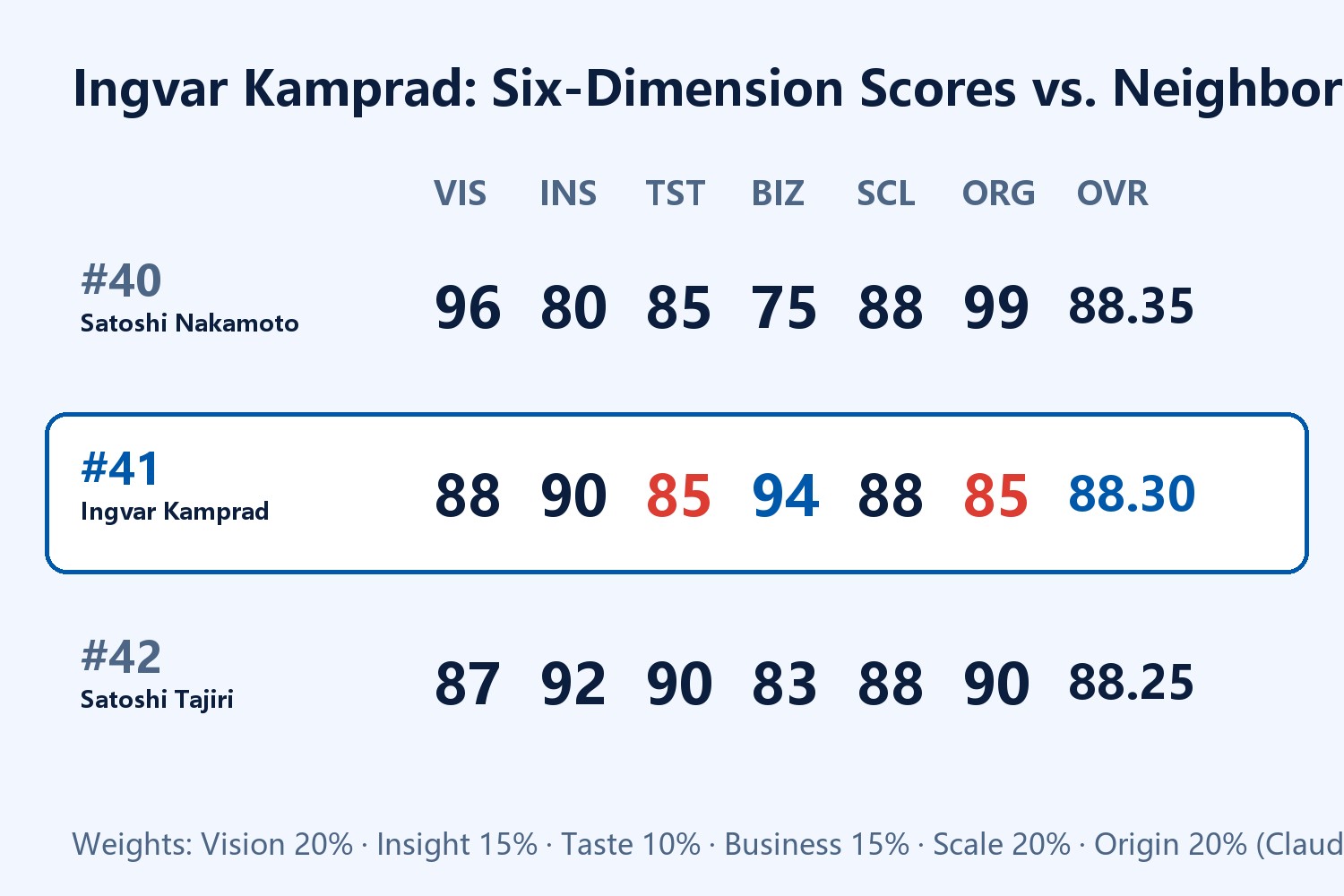
On our 100 Product Managers Who Changed the World ranking, Ingvar Kamprad ranks #41 with an overall score of 88.30 (evaluated by Claude AI across six weighted dimensions): Business 94, Insight 90, Vision 88, Scale 88, Taste 85, and Origin 85.
He sits right behind #40 Satoshi Nakamoto (OVR 88.35) and right ahead of #42 Satoshi Tajiri (creator of Pokémon, OVR 88.25). Just as Satoshi deleted the central bank from money, Kamprad deleted the factory assembler, the warehouse picker, and the delivery driver from furniture retail—and somehow convinced hundreds of millions of middle-class families that doing manual labor on their living room floor was a fun Saturday afternoon.
1. The Stony Soil of Småland and Four Initials at Age 17
To understand IKEA’s fanatical obsession with cost, you have to start in Småland, a rocky, forested province in southern Sweden so poor that locals joked the soil produced more boulders than potatoes.
Born in 1926, Kamprad started trading at age five. Discovering he could buy matches in bulk from Stockholm for less than a cent a box and sell them individually to neighbors on his bicycle for two cents, he learned his lifelong commercial creed before entering first grade: high volume plus radical price cuts equals unstoppable market share.
In 1943, when Ingvar was 17, his father gave him a small cash reward for succeeding in school despite severe dyslexia. He used it to register a tiny mail-order business named after four initials:
- Ingvar
- Kamprad
- Elmtaryd (the family farm where he grew up)
- Agunnaryd (his home parish in Småland)
For its first five years, IKEA sold pens, wallets, picture frames, and nylon stockings. Only in 1948 did Kamprad add locally made wooden chairs to his catalog—and watch orders explode.
2. Boycotted by the Entire Industry: How a Cartel Forced IKEA to Invent Its Moat
Kamprad’s prices were 30% to 50% lower than Sweden’s established furniture stores. Outraged, the national association of Swedish furniture retailers organized a ruthless cartel boycott against him.
Theybanned IKEA from taking orders at Stockholm’s trade fairs and threatened every Swedish sawmill and furniture factory: sell a single plank of wood to Ingvar Kamprad, and we will blacklist you nationwide.
That cartel boycott should have killed IKEA. Instead, it forced Kamprad to make the three decisions that turned a provincial mail-order shop into a global juggernaut:
- In-House Design: Since traditional manufacturers wouldn’t sell him their designs, Kamprad hired his own designers to engineer furniture specifically for low-cost manufacturing.
- Cross-Border Supply Chains (Poland, 1961): Cut off by Swedish factories, Kamprad crossed the Baltic Sea into Cold War Poland in 1961, contracting directly with Polish state factories at half the Swedish cost.
- Flat-Pack Boxes: Packing disassembled parts into flat cartons allowed a single freight car or shipping container to carry six to ten times as many tables while eliminating broken legs in transit.
3. “Design the Price Tag First, Then the Table”
In almost every company, product development works forward: designers sketch a product, engineers spec the materials, accountants add up the cost, and sales tacks on a margin.
Kamprad inverted the entire sequence: at IKEA, you design the price tag first.
If IKEA decided a young couple moving into their first apartment needed a side table for $5 (or €5), the $5 price tag was locked before a single line was drawn. Working backward from $5, engineers realized solid wood was too heavy and expensive—so they adapted honeycombed paper-core door construction (board-on-frame) to create the iconic LACK side table, light enough to lift with two fingers and cheap enough for anyone on earth to buy.
Even IKEA’s famous Swedish product names (BILLY bookcases, POÄNG armchairs, MALM beds) came directly from Kamprad’s dyslexia. Because he struggled to remember six-digit inventory numbers like 402-638, he created a naming taxonomy: living-room furniture got Swedish place names, beds and wardrobes got Norwegian place names, desks and chairs got men’s names, and bathroom items got Scandinavian lakes. A founder’s learning disability accidentally humanized millions of mass-produced SKUs.
4. The One-Way Maze, the “IKEA Effect,” and the $1 Hot Dog at the Exit
Why does Kamprad score a 94 in Business and a 90 in Insight? Because he engineered the physical retail store like a behavioral psychology lab:
1. The One-Way Showroom Maze
Traditional stores use a grid layout so you can grab one item and leave. IKEA stores route every shopper through a winding, one-way path across dozens of fully staged rooms. You walk in for a $4 toilet brush and emerge an hour later with tealights, throw pillows, wine glasses, and a potted plant.
2. The Self-Serve Warehouse and the “IKEA Effect”
When IKEA opened its massive Kungens Kurva flagship outside Stockholm in 1965, 30,000 shoppers overwhelmed the staff waiting for warehouse retrieval. In desperation, managers threw open the warehouse doors and let customers pull their own flat-pack boxes off the racks.
Behavioral economists Michael Norton, Daniel Mochon, and Dan Ariely later coined the term “The IKEA Effect” to describe what happens next: humans place disproportionately high value on products they partially created with their own hands. By outsourcing assembly to the buyer, Kamprad didn’t just slash labor costs—he made customers fall in love with the furniture they sweated over.
3. The Unchanging Hot Dog and the Peak-End Rule
Why did Kamprad insist on selling hot dogs and soft-serve ice cream right after the cash registers at prices so low they barely broke even?
Because checking out with a $600 credit card bill and facing a heavy cart of cardboard boxes is painful. Handing the customer a 5-kronor ($1) hot dog as their final interaction before walking to the parking lot hijacks the brain’s Peak-End Rule: the customer drives home thinking not about the $600 sofa, but about how astonishingly cheap IKEA is.
Discussion