Ray Kroc: Making 'Consistency' the Product—How a 52-Year-Old Milkshake-Mixer Salesman Built the 40,000-Store McDonald's Machine
In the summer of 1954, Ray Kroc was 52 years old, suffered from diabetes and incipient arthritis, had already lost his gallbladder and most of his thyroid gland, and was watching his livelihood evaporate.
A high-school dropout from Oak Park, Illinois, Kroc had spent seventeen years selling paper cups and another decade peddling the Prince Castle Multimixer—a heavy metal contraption that could blend five milkshakes at once. By 1954, suburban competition was killing neighborhood soda fountains, and Kroc’s sales were in free fall.
Except for one baffling anomaly: a tiny, octagonal drive-in hamburger stand in dusty San Bernardino, California, run by two brothers named Dick and Mac McDonald, had somehow bought eight Multimixers—enough to spin forty milkshakes simultaneously.
Kroc flew to California to see the operation with his own eyes. Standing outside that San Bernardino window at lunchtime, he witnessed a miracle that the McDonald brothers had invented but had no desire to scale:
The product wasn’t the 15-cent hamburger. The product was the kitchen behind the glass—an assembly line that applied Henry Ford’s factory floor to hot food and delivered a bag of burgers, fries, and a shake in 15 seconds flat.
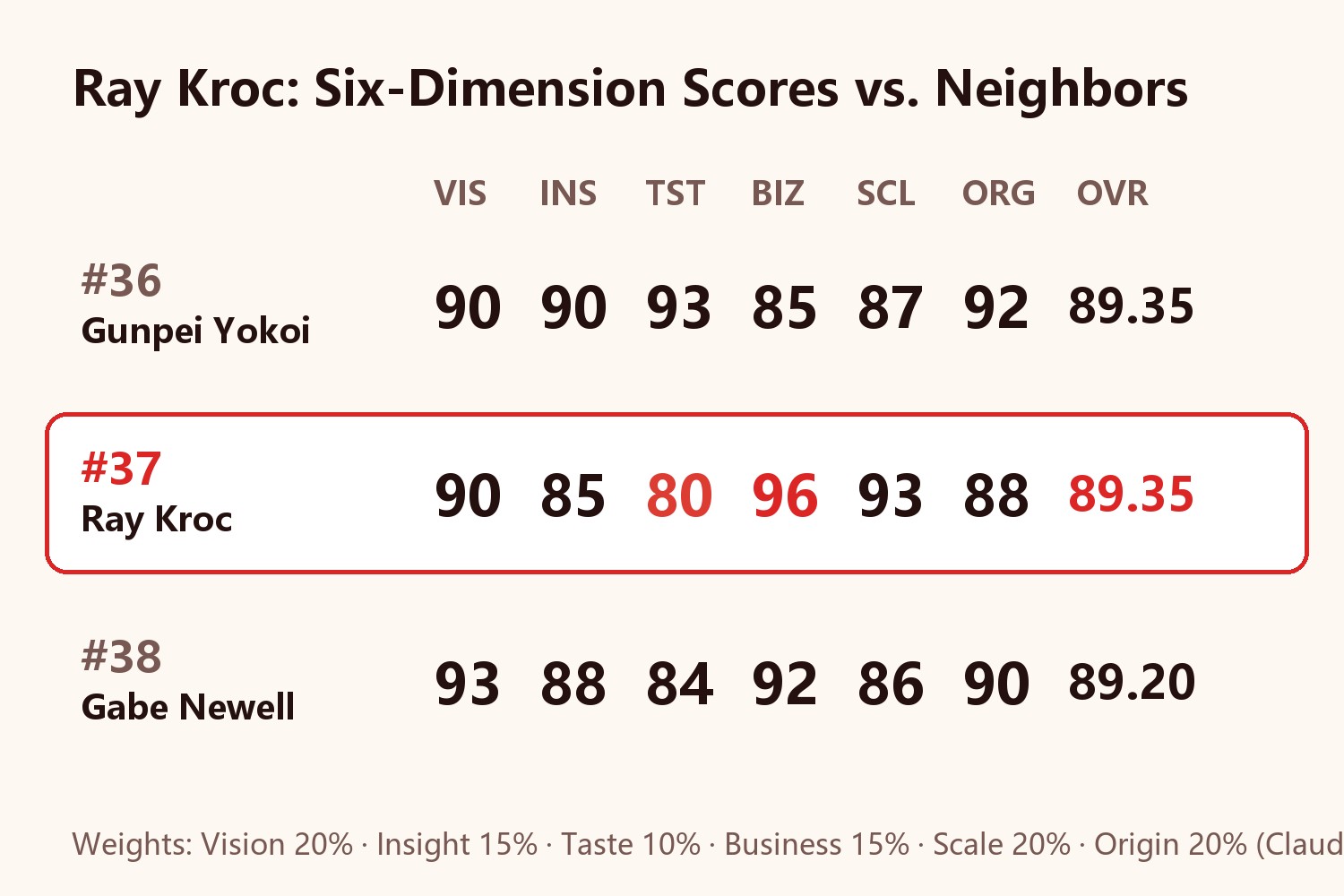
In our ranking of the 100 Product Managers Who Changed the World, Ray Kroc stands at #37 with an overall score of 89.35 (scored by Claude AI under our unified six-dimension framework): 96 in Business, 93 in Scale, 90 in Vision, 88 in Originality, 85 in Insight, and 80 in Taste.
He ties Game Boy creator Gunpei Yokoi (#36, OVR 89.35) to the second decimal place on the exact opposite dimensional shape: where Yokoi scored 93 in Taste and 85 in Business, Kroc scored 96 in Business and 80 in Taste—turning the systematic elimination of culinary variance into a 40,000-store global empire.
1. The Brothers Wanted a Quiet Porch; Kroc Wanted Ten Thousand Stores
When Kroc watched the San Bernardino stand in 1954, he saw why 1950s American drive-ins were broken. Traditional drive-ins employed rollerskating carhops, offered 30-item menus, took half an hour to serve lukewarm food on china plates that customers stole, and attracted teenage loiterers.
Dick and Mac McDonald had engineered the Speedee Service System through radical subtraction:
- Slashed 87% of the Menu: Realizing that hamburgers accounted for over 80% of sales, the brothers axed barbecue, tamales, and chili, shrinking the menu to nine items centered on burgers, fries, and shakes;
- Eliminated Waitresses and Dishwashers: Replaced china and silverware with paper wrappers, asking customers to walk up to the window themselves;
- Replaced “Cooks” with a Choreographed Line: Having drawn the kitchen layout in chalk on a tennis court behind their house, the brothers broke burger assembly into repeatable stations—one grill man, one dresser with custom sauce dispensers that squirted an exact dollop of ketchup and mustard in a single click, one fry man.
Yet when Kroc asked why they hadn’t blanketed America with hundreds of stores, Dick McDonald pointed to their mansion on the hill and said: “We’re making $100,000 a year, Mr. Kroc. If we open more, we’ll never have a moment’s peace.”
The brothers were brilliant 0-to-1 inventors who hated travel and management. Kroc walked out with a franchise agreement that gave him a razor-thin 1.9% cut of gross sales (0.5% of which went straight to the McDonald brothers) and opened his first model store in Des Plaines, Illinois, on April 15, 1955.
| Pillar of the Kroc Machine | Why 1950s Franchising Was Broken | Kroc’s Productized Architecture | Global Outcome |
|---|---|---|---|
| The 985-Page Manual & Hamburger U. (1958–1961) | Franchisees cut corners on meat and added random local dishes | Codified patty weight, onion dice size & oil recovery curves; founded Hamburger University | Identical burger and fry experience across 40,000+ stores in 100+ countries |
| Single-Store Licensing & Zero Equipment Kickbacks (1955) | Rival chains sold whole states upfront and gouged franchisees on kitchen gear | Refused equipment markups; granted only one store at a time until the operator proved QSC compliance | Aligned incentives; franchisees invented the Big Mac, Egg McMuffin & Filet-O-Fish |
| Franchise Realty Corp. (1956) | A 1.4% net royalty left Kroc’s headquarters with just $90,000 in cash | Leased/bought land, built the store, and subleased to franchisees at a markup + % of sales | Solved cash flow overnight and turned McDonald’s into a global real-estate colossus |
| The $2.7M Buyout & Frozen Fry Engineering (1961–1966) | McDonald brothers vetoed kitchen changes; fresh potatoes varied by season | Borrowed $2.7M at brutal interest to buy out the brothers; partnered with Simplot on frozen par-fried Russets | Unlocked global supply-chain scaling while keeping fry crispness invariant |
2. Why McDonald’s True Product Was a 985-Page Spec Sheet
Before software engineers wrote cross-platform operating systems, Ray Kroc wrote the McDonald’s Operations and Training Manual—begun in 1958 by Fred Turner at 75 pages and eventually expanded past 750–985 pages.
To Kroc, a hamburger wasn’t cuisine; it was an industrial component with tolerances as tight as a piston ring:
- The Patty: Exactly 1.6 ounces (10 to a pound), 3.875 inches in diameter, with fat content locked between 19% and 20.5%, dressed with 0.25 oz of rehydrated onions, a 0.75-inch dollop of mustard, 0.5 oz of ketchup, and a single pickle slice;
- The Science of the French Fry: Why did McDonald’s fries taste better than everyone else’s? Kroc sent field engineers with hydrometers and thermometers into potato curing sheds and fry vats. They discovered that Russet Burbank potatoes had to be cured for three weeks to convert sugars to starch, blanched at 325°F, and pulled the exact moment the vat temperature recovered by 3 degrees Fahrenheit. Kroc commissioned custom electric fryers with automatic timers so a 17-year-old part-timer in Ohio could replicate the exact crispness of San Bernardino without thinking;
- The 10-Minute Trash Rule: Any burger sitting on the warming rack longer than ten minutes—or fries older than সাত-to-ten minutes—had to be thrown out immediately.
In February 1961, Kroc opened Hamburger University in the basement of the Elk Grove Village restaurant, awarding graduates a degree in “Bachelor of Hamburgerology.”
Kroc understood a profound product truth: people do not stop at McDonald’s on the interstate hoping for a culinary surprise; they stop because they want zero risk. The Golden Arches promised that whether you were in Peoria, Tokyo, or Frankfurt, the bathroom would be clean, the coffee would be hot, and the fry would taste exactly like childhood.
3. “You Are Not in the Burger Business; You Are in the Real Estate Business”
By 1956, Kroc had a fatal problem: his stores were packed, his franchisees were getting rich, and McDonald’s Corporation was going broke—with barely $90,000 in the bank.
Because Kroc refused tofollow the sleazy industry norm of marking up milkshakes and kitchen stoves sold to franchisees, his 1.4% net royalty couldn’t cover national expansion.
Enter financial wizard Harry Sonneborn, former VP of Finance at Tastee-Freez, who looked at Kroc’s books and delivered the most famous pivot in retail history:
“Ray, you’re not in the hamburger business. You’re in the real estate business.”
Together they formed Franchise Realty Corporation (1956):
- Instead of letting franchisees find their own lots, McDonald’s leased or bought the land at major suburban intersections and erected the building;
- McDonald’s then subleased the turnkey restaurant to the franchisee at a 20%–40% markup over its own mortgage/lease cost, OR 5%–8.5% of gross sales—whichever was higher;
- Even better, tying the franchisee’s lease to the operating manual gave Kroc the ultimate enforcement lever: if a franchisee refused to clean the restrooms or watered down the shake mix, Kroc could evict them as their landlord.
In 1961, tired of the McDonald brothers blocking every operational tweak, Kroc borrowed $2.7 million in cash from college endowment funds (a loan that ultimately cost $14 million with interest) to buy the brothers out completely—and then famously opened a Ray Kroc McDonald’s directly across the street from the brothers’ renamed San Bernardino stand until it closed.
4. Why Ray Kroc Ranks #37 (OVR 89.35)
In our 100 Product Managers Who Changed the World framework, Kroc’s six-dimension breakdown explains the mechanics of mass standardization:
- Business 96 & Scale 93 (Twin Peaks): Kroc’s “three-legged stool” (McDonald’s, franchisees, and dedicated suppliers like Simplot and OSI) created the blueprint for modern franchising—where the franchisor only wins after the franchisee succeeds;
- Vision 90, Originality 88, Insight 85: Because the McDonald brothers invented the original Speedee kitchen, Kroc’s Originality sits at 88; his genius was seeing that the kitchen itself was a replicable product;
- Taste 80 (Why #37): Just like Henry Ford (#12, Taste 80) and Jack Ma (#14, Taste 80), industrializing a product for billions requires stripping away artisanal nuance—putting Kroc in a dead-heat 89.35 tie with #36 Gunpei Yokoi (Taste 93, Business 85).
See Ray Kroc’s full ranking on the live leaderboard: Top 100 Product Managers (#37 · Ray Kroc), and read our companion deep dive on the system itself: 100 Products That Changed the World (#8 · The McDonald’s System).
Discussion