Satoshi Nakamoto: Deleting the Founder from the Product — The Ghost Who Wrote a 9-Page Paper, Shipped 30,000 Lines of Code, and Vanished
On April 23, 2011, software developer Mike Hearn received a brief email.
It was from Satoshi Nakamoto. In two calm sentences, the creator of Bitcoin wrote: “I’ve moved on to other things. It’s in good hands with Gavin and everyone.”
From that day forward, Satoshi Nakamoto ceased to exist on the internet. There was no farewell keynote, no IPO bell, no memoir, and no victory lap. Even the roughly 1.1 million bitcoins he mined in the network’s earliest days—worth tens of billions of dollars today—have sat untouched on the public ledger for seventeen years, like a treasure chest welded shut at the bottom of the ocean.
In almost every story we tell about product builders, greatness looks like presence: Steve Jobs commanding a stage, Elon Musk dominating a feed, or Marc Benioff (#39) staging fake protests outside a rival’s conference. Founders spend their lives binding their personal identity to their product.
Satoshi did the exact opposite. His greatest product decision was not writing the nine-page white paper—it was recognizing that for decentralized money to survive, the founder himself was the ultimate single point of failure, and deleting himself from the system.
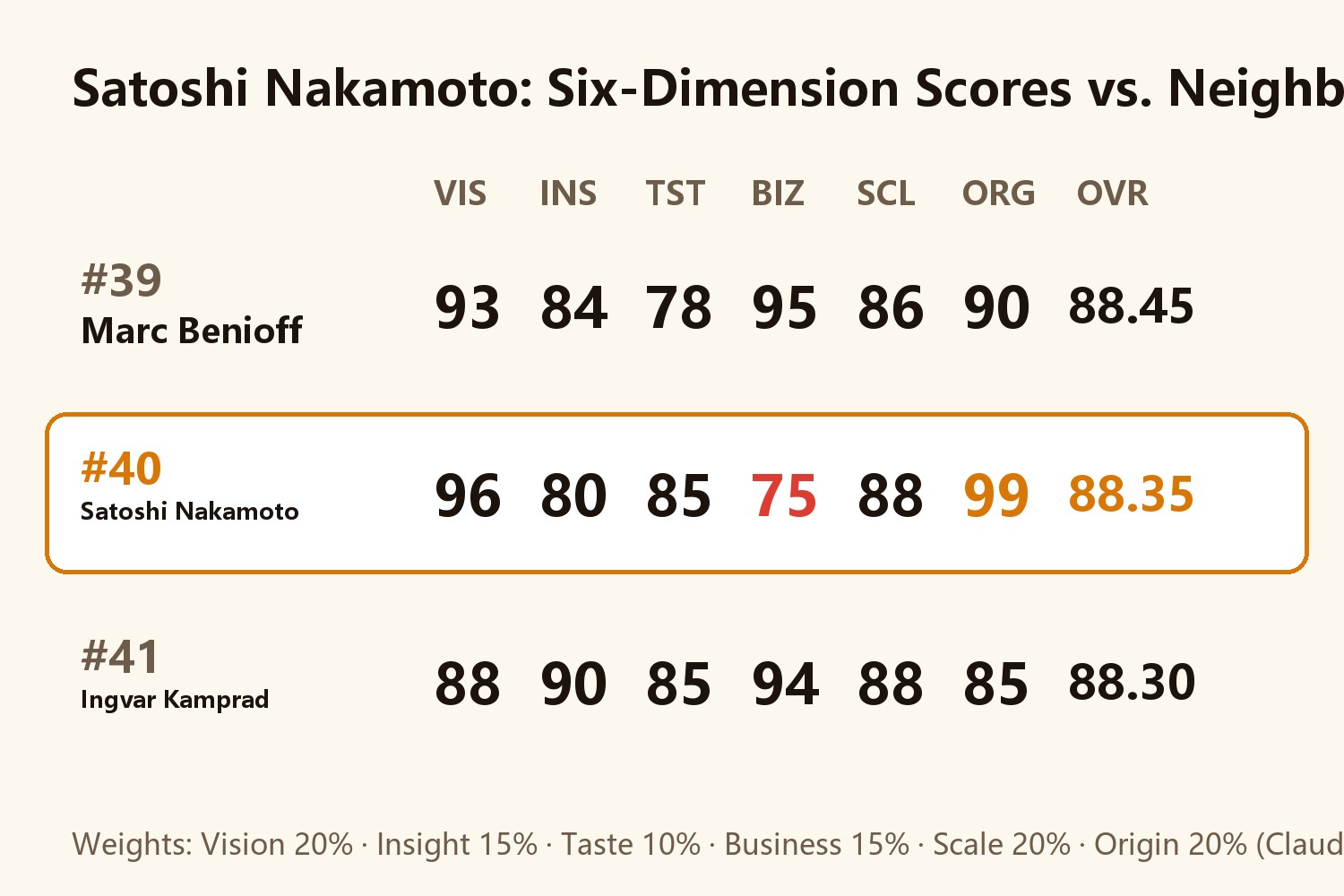
On our 100 Product Managers Who Changed the World ranking, Satoshi Nakamoto ranks #40 with an overall score of 88.35 (evaluated by Claude AI across six weighted dimensions): Origin 99 (tied for the highest possible tier on the board), Vision 96, Scale 88, Taste 85, Insight 80, and Business 75.
He sits right behind #39 Marc Benioff (OVR 88.45) and right ahead of #41 Ingvar Kamprad (founder of IKEA, OVR 88.30). Benioff and Satoshi form a striking conceptual mirror: Benioff perfected the centralized cloud corporation—recurring subscriptions, customer success teams, and enterprise SLAs—while Satoshi, separated by just 0.10 points, built a trillion-dollar monetary network with no company, no CEO, no support desk, and no server room.
1. Halloween 2008: Nine Pages, Zero New Primitives, and One Unsolved Problem
On the afternoon of October 31, 2008, an obscure post appeared on the Metzdowd Cryptography Mailing List:
“I’ve been working on a new electronic cash system that’s fully peer-to-peer, with no trusted third party.”
Attached was a nine-page PDF titled Bitcoin: A Peer-to-Peer Electronic Cash System.
Popular mythology treats Satoshi as a lone mathematician who conjured blockchain out of thin air. Yet if you inspect the original Bitcoin codebase as a product engineer, a surprising truth jumps out: Satoshi did not invent a single underlying cryptographic primitive.
- Public-key cryptography and digital signatures dated back to the 1970s;
- Merkle trees were patented by Ralph Merkle in 1979;
- Cryptographically linked timestamp chains were published by Stuart Haber and W. Scott Stornetta in 1991;
- Proof-of-Work was invented by Adam Back (Hashcash, 1997) to fight email spam.
For twenty years before Satoshi, brilliant cryptographers—David Chaum (DigiCash), Wei Dai (b-money), Nick Szabo (Bit Gold), Hal Finney (RPOW)—had tried to build digital cash. Every single attempt crashed into the same wall: the Double-Spending Problem.
If I hand you a physical dollar bill, I no longer have it. Digital files, by contrast, exist to be copied. Without a central bank maintaining the master ledger, how do you stop someone from copying a digital coin and spending it twice?
For two decades, computer scientists tried to solve double-spending with pure cryptography, always falling back on a central mint or clearinghouse—which governments or lawsuits inevitably shut down.
Satoshi earned a 99 in Origin because he stepped outside pure cryptography and solved a computer science deadlock with economic mechanism design:
He turned ledger bookkeeping into an open global lottery powered by electricity (Proof-of-Work) and paid honest bookkeepers in newly minted coins (the block reward). Instead of assuming network participants would be altruistic, he wired the rules so that greed itself secured the ledger: playing by the rules pays you in valuable coins, whereas spending millions on electricity to attack the ledger destroys the value of the very coins you hold.
2. “Write the Code First, Then the Paper”: An Engineer’s Product Taste
Why does Satoshi score an 85 in Taste? Look at how he shipped between 2008 and 2010.
The cryptography mailing list was full of armchair theorists who wrote manifestos and never shipped working code. When skeptics poked at edge cases in Satoshi’s nine-page paper, he responded by dropping over 30,000 lines of working C++ code.
As he famously explained: “I had to write all the code before I could convince myself that I could solve every problem, then I wrote the paper.”
Three product details inside that initial release show extraordinary craft:
1. The London Times Headline in the Genesis Block
On January 3, 2009, Satoshi mined Block 0—the Genesis Block. Embedded inside its coinbase parameter was a plain-text string:
“The Times 03/Jan/2009 Chancellor on brink of second bailout for banks”
In 69 characters, that string accomplished two things simultaneously: it served as an indisputable cryptographic proof that no blocks had been secretly pre-mined before January 3, and it etched Bitcoin’s founding why—the 2008 financial crisis bailouts—directly into the first stone of the ledger.
2. The 21 Million Cap and the Two-Week Difficulty Thermostat
Central banks inflate money supplies at will. Satoshi hard-coded a 50-coin block subsidy that halves every 210,000 blocks (~four years), asymptotically capping total supply at 21 million coins.
Even more impressive was the difficulty adjustment algorithm: every 2,016 blocks (~two weeks), the protocol automatically recalibrates how hard it is to find a block so that whether the network is running on three laptops in 2009 or millions of ASIC rigs in 2026, blocks continue to arrive like a heartbeat roughly once every 10 minutes.
3. Eight Decimal Places from Day One
In 2009, a bitcoin was worth fractions of a cent; in May 2010, Laszlo Hanyecz famously paid 10,000 BTC for two Papa John’s pizzas.
Yet in the very first release of the code, Satoshi divided each bitcoin into $10^8$ base units (0.00000001 BTC, now called a satoshi). When his creation was still worthless, he had already engineered the unit precision for a future in which a single coin would be worth $100,000.
3. Why His “Business” Score Is Only 75
Satoshi’s lowest score is Business (75).
By conventional standards, Satoshi built zero revenue capture for himself or an entity: no corporation, no equity, no protocol tax, and not a single cashed-out coin from his ~1.1M BTC stash.
Had he sold even 1% of those early coins to buy a mansion, two things would have happened: bank KYC trails would have unmasked his identity, and the world would have dismissed Bitcoin as a founder enrichment scheme. By taking 0% personal monetization, he bought 100% institutional credibility for the protocol.
4. December 2010: Why Disappearing Completed the Product
In December 2010, after WikiLeaks was cut off by Visa, MasterCard, and PayPal, forum users urged WikiLeaks to accept Bitcoin donations to bring global publicity.
Satoshi stepped in with a rare, urgent warning:
“No, don’t ‘bring it on.’ The project needs to grow gradually so the software can be strengthened along the way. I make this appeal to WikiLeaks not to try to use Bitcoin. Bitcoin is a small beta community in its infancy.”
Days later, realizing the spotlight was arriving faster than expected, Satoshi posted his final software patch, removed his name from the project’s copyright notice, handed the repository keys to Gavin Andresen, and walked into the mist.
When Gavin was invited to speak at the CIA headquarters in Spring 2011, Satoshi’s final move made complete sense. A living founder can be subpoenaed, pressured, or co-opted; a headless protocol with no leader and an untouched genesis fortune becomes a force of nature—like TCP/IP or prime numbers.
Discussion