Gabe Newell: 'Piracy Is a Service Problem'—How a Microsoft Veteran Endured Ten Years of Hate for a Forced Updater and Won PC Gaming with Convenience
Around 2003, PC gamers around the world shared one common annoyance.
It was a small piece of software called Steam. To play Counter-Strike you had to install it. To patch the game you had to go through it. And when you bought Half-Life 2 in 2004, the disc in the box wasn’t enough—you had to log in and activate it online first. The forums erupted: Who wants a mandatory updater? I bought a game, not an account!
Many of the people complaining would go on to spend more hours inside that client than inside any single game.
The man behind it was Gabe Newell. He wasn’t a showman or a prophet. He was closer to an old-school product manager who kept asking one question: while the whole industry tried to lock down piracy, why was the legitimate copy harder to use than the pirated one?
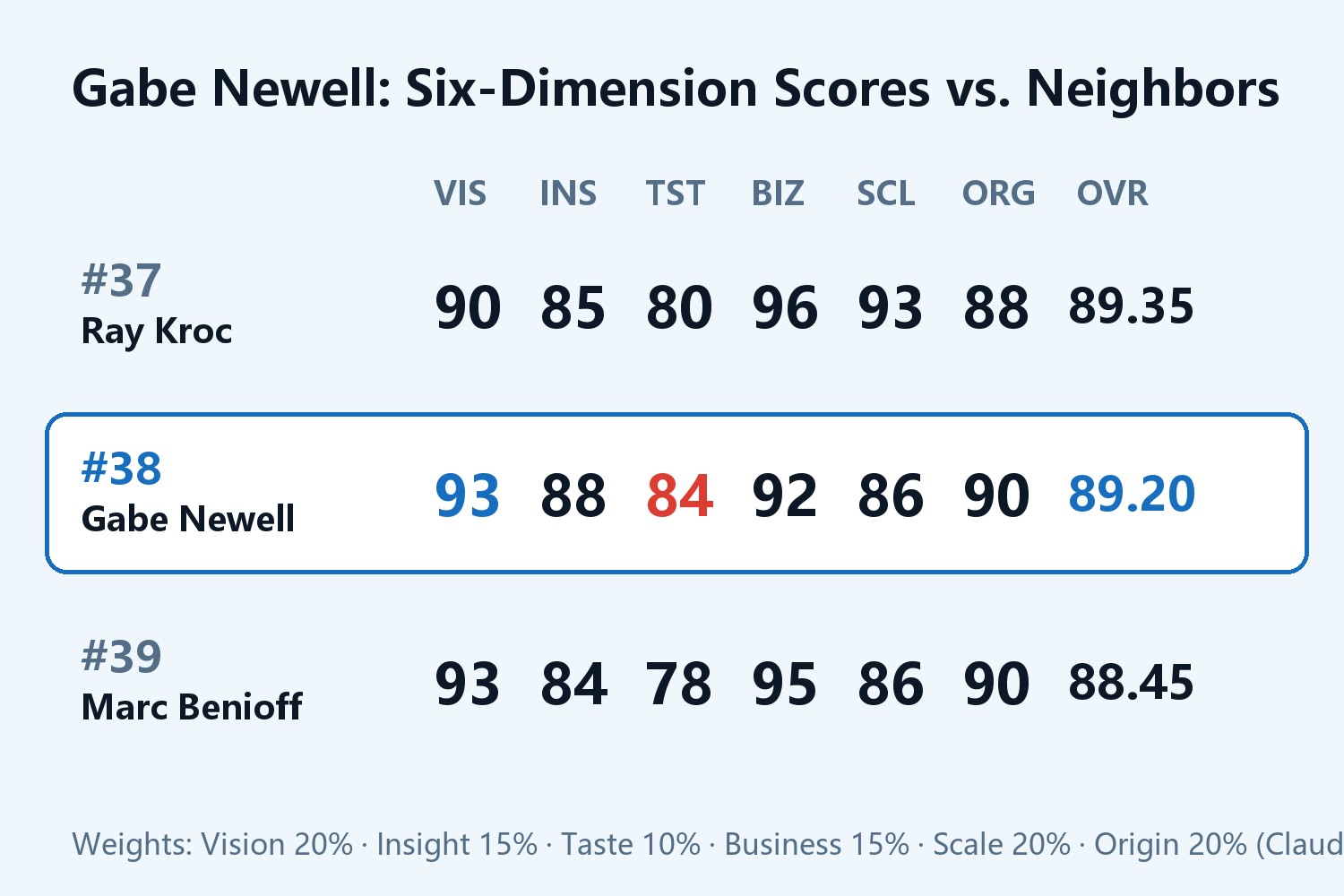
In our ranking of the 100 Product Managers Who Changed the World, Gabe Newell stands at #38 with an overall score of 89.20 (scored by Claude AI under our unified six-dimension framework): 93 in Vision, 92 in Business, 90 in Organization, 88 in Insight, 86 in Scale, and 84 in Taste.
He sits just 0.15 points behind Ray Kroc (#37, OVR 89.35), and the two make a neat mirror: Kroc made consistency the product; Newell made convenience the product. Each built a toll road through a part of the industry others overlooked.
1. Thirteen Years at Microsoft: Not an Outsider
Newell was born in 1962 in Colorado and left Harvard before graduating to join Microsoft. People often forget this: he did not grow up inside the games scene. He was a roughly thirteen-year Microsoft veteran who worked on Windows during its formative years.
That tenure gave him two things.
First, an instinct for platforms. He watched Windows become the center of the PC and saw how developers, users, and hardware makers formed one interdependent community around it. Steam is that same logic moved from the operating system to game distribution: whoever owns the door users open every day sets the rules.
Second, enough money to act independently. In 1996 Newell and colleague Mike Harrington left Microsoft and founded Valve in Washington state. Funded by what they had earned there, they developed their first game without begging a publisher for an advance.
From day one, Valve had no outside boss. It has remained a private company—never listed, never acquired—which is why it could take the long, slow bets that public companies rarely survive.
2. Half-Life: Prove You Understand Games First
In 1998 Valve shipped Half-Life. Built on a heavily modified Quake engine, it did something few shooters then attempted: it told its entire story from the player’s own eyes, with no cutscenes taking control away.
That is common practice today; at the time it was a bold narrative experiment. Half-Life collected a long list of game-of-the-year awards and became one of the most influential PC games ever.
More interesting for product people is the mod ecosystem around it. Players built their own versions, and one of them—Counter-Strike, made by two community developers—was brought into Valve in 2000 and released as an official product.
That became a Valve habit: absorb outside creativity rather than resist it. Team Fortress, Dota 2, and the Steam Workshop all extend that line. Newell’s bet was that a product’s best features are often built by its users and then adopted by the company.
And Counter-Strike became the direct trigger for Steam.
3. 2003: Why Build a ‘Forced Updater’?
To understand Steam, start with the problem developers faced: patching online games was a mess.
You had to find the patch on a website, download it, install it yourself—and anyone who hadn’t updated couldn’t play with those who had. For a game like Counter-Strike with huge concurrent audiences, fragmentation was brutal.
Valve’s answer was a client that updated games automatically. Steam launched in 2003, modestly positioned as the updater for Valve’s own games.
It was not lovable at first:
- Players were required to install it;
- Early versions were unreliable;
- Half-Life 2 in 2004 required Steam activation, which drew a great deal of complaint.
Newell’s stance, judging by what followed, was clear: he was willing to absorb a period of hostility for a better long-term outcome. That is a hard call for any product manager, because today’s bad reviews are real while tomorrow’s payoff is invisible.
Then Steam did something almost nobody had planned: it started selling other people’s games.
From around 2005, third-party titles appeared on Steam. It stopped being an updater and became a storefront—no shipping, no retail shelf, never out of stock. For small independent developers it was the first chance to reach players worldwide without first persuading a publisher.
4. ‘Piracy Is a Service Problem’: Turning the Rival into Requirements
Newell’s most widely quoted view, which he has voiced publicly on several occasions, is roughly: piracy is almost always a service problem, not a pricing problem.
Read it against the 2000s. The industry’s response to piracy was containment: stricter copy protection, legal threats, more invasive verification. What those measures shared was that they mostly punished paying customers.
Newell saw it the other way. People often pirated not because they couldn’t afford the game but because the pirated version was easier: no waiting, no hunting for discs, no region locks, no broken updates.
So the answer was not a stronger lock but better service:
- One-click purchase and instant download—no store trip, no shipping;
- Automatic updates happening quietly in the background;
- Cloud saves and accounts—change PCs and your library and progress follow;
- One global store and community with reviews, friends, achievements, and Workshop in one place.
He converted the competitor’s advantages into his own product backlog. Once the legitimate option is easier than the pirated one, piracy loses its natural pull. This is the cleanest piece of product thinking in the story: don’t destroy the rival—close the gap the rival exploits.
Another signature Steam design is the sale. The big summer and winter discount events became a ritual in the player community—so much so that “the backlog of unplayed games” became a running joke. Commercially, they reset what players expect PC games to cost, lowering unit prices while raising volume.
5. A Company with Almost No Bosses: Valve’s Organizational Experiment
Another often-cited reason Valve could do all this is how it is organized.
The company has publicly shared a new-employee handbook describing no traditional reporting hierarchy. Desks have wheels so people can roll them next to whatever project they want to join; anyone can start a project and recruit colleagues; whether it happens depends on whether enough peers sign on.
The benefits are clear:
- Information moves quickly, without layers of approval;
- People answer for what they ship, not to a manager;
- Good ideas attract people who want to work on them.
So are the costs: that freedom is hard on newcomers and on people who struggle with self-direction, and decisions about what to build and when often lack a shared cadence. Valve has long been teased for slow output, and the next Half-Life became an enduring community joke.
But that is Newell’s trade-off: he would rather Valve be slower than become a company that can do everything and does it all mediocrely. It is a big part of the 90 in Organization—he built not just products but an environment that keeps producing them.
6. From Software to Hardware: Steam Deck and a Series of Experiments
One of Newell’s most admirable traits is that he doesn’t fear failure, even public failure.
Valve’s hardware record is mixed:
- Steam Machines (the living-room PC concept launched around 2015) landed flat and quietly faded;
- The Steam Controller was not a big seller and was later discontinued;
- The Vive, built with HTC in 2016, and Valve’s own Index left a real mark on VR and led in 2020 to the flagship VR game Half-Life: Alyx.
What turned those experiments into a win was the Steam Deck. Announced in 2021 and shipping from 2022, this handheld runs the PC game library on the go. Its real secret weapon isn’t the specs but Valve’s years of investment in Linux: the Proton compatibility layer lets large numbers of Windows-only games run on the Deck’s operating system.
That answers a lesson Newell saw at Microsoft: don’t bet your whole business on someone else’s platform. The long Linux investment is Valve’s insurance—if Windows ever diverges from its interests, Steam has somewhere to go.
That long-horizon thinking is where the 93 in Vision comes from: the hardware experiments look like burned cash but are really options purchased on a ten-year-out possibility.
7. Why Gabe Newell Ranks #38 (OVR 89.20)
In our ranking, Newell’s six-dimension profile is an unusually high plateau:
- Vision 93 (his top score): when most people still thought of PC games as discs in boxes, he was designing a continuously updated, continuously consumed service; both the platform logic he saw at Microsoft and the later Linux bet were long-horizon moves;
- Business 92: Steam’s platform revenue-share model made Valve a private company with exceptional output per employee; each new game listed adds value to the storefront—a classic toll-road flywheel;
- Organization 90: a nearly flat structure that has kept producing Steam, Dota 2, Steam Deck, and more—not just one hit;
- Insight 88: “piracy is a service problem” turned the industry’s biggest headache into an actionable product backlog;
- Scale 86: Steam is one of the dominant digital storefronts for PC games, touching countless developers and players, but its reach is still centered on PC gamers rather than the whole world as with Kroc’s physical system;
- Taste 84 (his relative low): Steam’s interface was never famed for elegance; it is closer to a feature-rich, ever-growing toolbox. It wins on convenience rather than beauty—consistent with his service-first philosophy.
Compared with #37 Kroc, Newell doesn’t lack product ability; he lacks Kroc’s extreme Business and Scale—Kroc scores 96 and 93 there, while Newell edges ahead in Vision and Organization.
The lesson for product managers is simple: when your users pick a “wrong” alternative, don’t rush to scold them. First ask where your legitimate product is harder than theirs.
See his full position on the live leaderboard: Top Product Manager Rankings (#38 · Gabe Newell); and the platform he built on the product list: 100 Products That Changed the World.
Discussion