No. 12 on the greatest product managers list: Henry Ford — he never said the “faster horses” line, and it gets him backwards
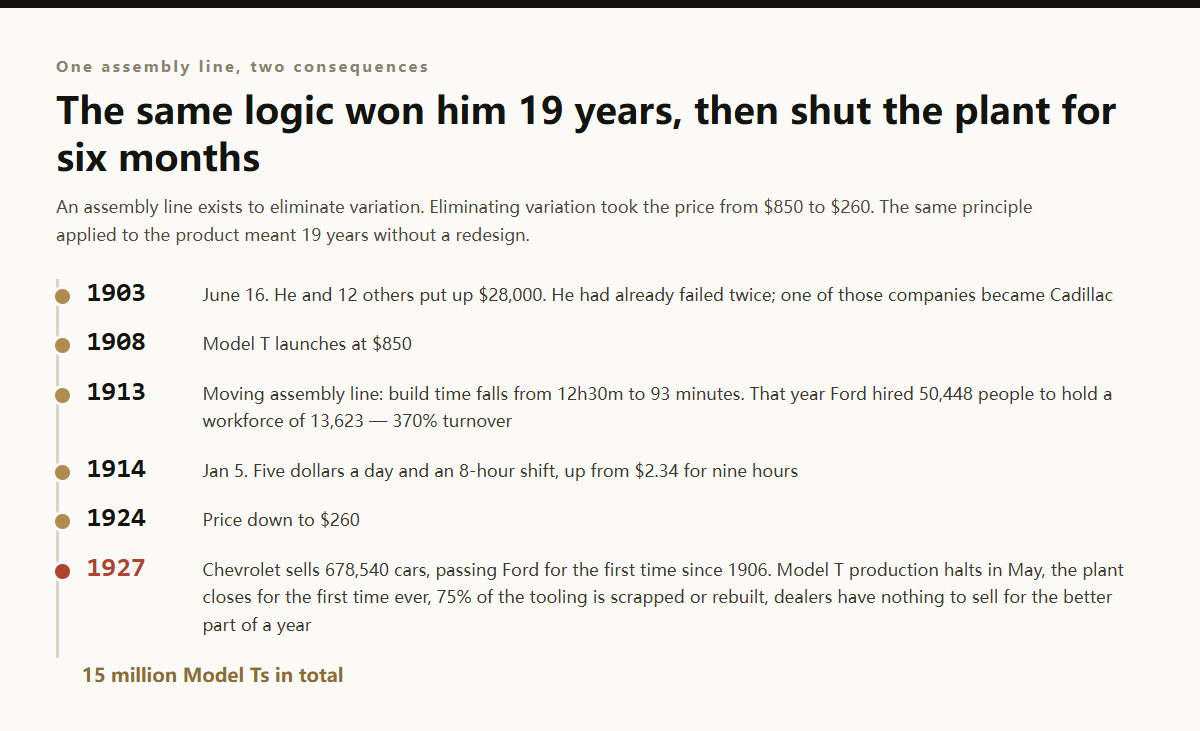
In 1913 the Ford Motor Company hired 50,448 people. Its average workforce that year was 13,623. Turnover: 370%.
That same year, the time to build a Model T fell from 12 hours and 30 minutes to 93 minutes.
Those two numbers are two sides of the same fact.
Henry Ford ranks 12th on the board, overall 93.80.
The line quoted for twenty years is fake
The most-repeated sentence in product management carries his name: “If I had asked people what they wanted, they would have said faster horses.”
Ford never said it.
Harvard Business Review published Patrick Vlaskovits’s investigation in 2011; he went through the available Ford record and found no source. Quote Investigator traces the earliest printed instance to 2002. Ford died in 1947. A line that first appears in 2002, pinned on a man who died in 1947, then taught as product methodology for twenty years.
The bigger problem isn’t the provenance. It’s the use. The quote is deployed to support one conclusion: don’t listen to users, they don’t know what they want.
And the real Ford lost precisely because he stopped listening.
He was 39 before a company of his survived, after two failures
Ford was born on 30 July 1863 on the family farm in Wayne County, near Dearborn, Michigan. He disliked farm work and liked machines.
In 1899 he left the Edison Illuminating Company to found the Detroit Automobile Company. It folded. In 1901 he started the Henry Ford Company; by 1902 he had been pushed out of it. Reorganised, that company became Cadillac.
On 16 June 1903 he and twelve others put up $28,000 and founded the Ford Motor Company. He was 39, with two failures behind him.
The assembly-line story usually starts in 1913, as if he changed the world on his first move. He had spent more than a decade building cars, selling cars, failing, and being forced out of a company with his own name on it, before he got a third try.
$850, then 93 minutes
The Model T launched in 1908 at $850.
The turn came at Highland Park in 1913. He combined three things: interchangeable parts, work broken into small subdivided tasks, and materials that moved. Workers stopped walking around a car; the car moved past them and each person performed one action.
Build time went from 12 hours 30 minutes to 93 minutes.
The price followed it down: $490 in 1914, $260 by 1924. By the time production ended in 1927, 15 million Model Ts had been sold.
Nothing magic sits between $850 and $260. One thing does: variation was eliminated. Every car identical, every operation identical, every motion identical. Only identical things can be driven that cheap.
This is where originality 99 and scale 99 come from. In the top 15, only two people max out both: him and Jobs.
370% turnover, and a decision remembered as generosity
The line had another side, and the cost landed on people.
Work that had taken craft was broken into simple repeated motions. Workers couldn’t stand it. That 50,448 against 13,623 is what it looks like in the ledger — people hired, gone within months, replaced all year long.
On 5 January 1914 Ford announced five dollars a day and an eight-hour shift. The previous rate was $2.34 for nine hours.
The decision is remembered as “he let his workers afford the cars they built,” a piece of foresight and generosity. It was first of all a tourniquet. A line that uses people as parts cannot absorb 370% turnover; it has to offer a number large enough to make the work bearable.
And that number came with conditions. The five dollars was not a wage but profit sharing — you applied, and you were approved or you weren’t. Ford built a Sociological Department for the purpose, run by Samuel Marquis, an Episcopal minister. Around fifty investigators drove Ford cars around Detroit with interpreters, visiting homes.
What they checked: whether the house was clean, whether the man drank or gambled, whether he saved regularly, whether his children attended school, whether there was a divorce filing, whether the family took in boarders. Eligibility was men over 22 with at least six months of service. In 1914, 70% of Ford’s workforce was foreign-born, over half from eastern and southern Europe; the company pushed them into citizenship courses and English classes.
Fail the check and you didn’t get the five dollars.
He extended the logic of eliminating variation from the production line into his workers’ houses. That isn’t a metaphor; it was the actual organisational design. Workers came to hate the visits, and the department was largely dissolved by 1921.
”So long as it is black” — this one he did say
“Any customer can have a car painted any colour that he wants so long as it is black.”
That one is real, from his 1922 autobiography My Life and Work, recalling a meeting in 1909.
The immediate reason for black was process. In 1914 he moved to oven-baked enamel, cured at 400°F in about an hour instead of air-drying for up to 24 hours, and the finishes compatible with that process contained Gilsonite, a form of asphalt, which limited the palette to black and very dark shades.
The interesting part is that the early Model T was not black-only. Between 1908 and 1913 it came in red, grey, green and blue. Black-only starts in 1914 — the year the moving line hit full speed.
The order is unambiguous: the line came first, black came second. He didn’t hold an aesthetic position that then shaped production. Throughput removed the choice.
That is where taste 80 comes from. The dimension asks whether the thing he made was good and considered. Ford’s answer: consideration is variation, and variation is cost.
1927, and the plant closes for the first time
The Model T ran nineteen years with no real redesign.
Over the same stretch, General Motors’ Chevrolet was doing three other things: changing the styling every year, adding features, and letting people buy on instalments.
In 1927 Chevrolet’s new Capitol AA series sold 678,540 cars, passing Ford on volume for the first time since 1906.
Ford’s response was to stop. Model T production halted in May 1927 and the plant closed for the first time in its history. Switching to the Model A meant scrapping or rebuilding about 75% of the tooling, and Highland Park stood down for six months. Dealers had nothing to sell for the better part of a year.
A product that had held more than half the American market left the stage by way of its own maker shutting the factory for half a year.
That is where insight 85 comes from, and it’s his most expensive loss on this board. He could see that everyone should have a car. He could not see that people who own a car want a better car. The first thing won him nineteen years. The second lost him one.
The “faster horses” line he never said describes a genius of such insight that users are beneath consulting. The real story runs the other way: he won by building something nobody had asked for, and lost by refusing to hear anything after he’d built it.
The part of his life that shouldn’t be skipped
You don’t write a man by listing his achievements.
From 22 May 1920, the Dearborn Independent, a weekly Ford funded, began serialising antisemitic articles, including a reprint of the forgery The Protocols of the Elders of Zion. Collected as The International Jew, they were translated into twelve languages and circulated across North America and Europe. By 1926 the paper’s circulation was at least 900,000.
In 1924 the lawyer Aaron Sapiro sued Ford for libel. The case settled out of court in 1927; Ford publicly apologised, paid $140,000 in expenses, and ordered the Dearborn Independent closed. It ceased publication at the end of that year.
In July 1938, on his 75th birthday, Ford accepted the Grand Cross of the German Eagle, Nazi Germany’s highest decoration for a foreigner, and was its first American recipient.
He died in Dearborn on 7 April 1947, aged 83.
This doesn’t conflict with his product ability, and neither cancels the other. The board scores product dimensions, not moral totals — but a Ford biography that leaves this out is a dishonest one.
Why 93.80, dimension by dimension
Six weighted dimensions: vision 20%, originality 20%, scale 20%, insight 15%, business 15%, taste 10%.
| Dimension | Score | Reasoning |
|---|---|---|
| Originality | 99 | He didn’t invent every component of the moving line, but assembling interchangeable parts, subdivided work and flowing materials into one reproducible method was his. A century of manufacturing has used it since |
| Scale | 99 | 15 million Model Ts; an entire country’s ordinary households got a car |
| Vision | 96 | By 1908 he had settled on the car as an everyday good ordinary people could buy rather than a rich man’s toy, earlier than anyone around him |
| Business | 95 | Taking the price from $850 to $260 and still making money came from cost structure, not subsidy |
| Insight | 85 | Among his lowest. Nineteen years without a redesign, until Chevrolet broke through with annual restyling and instalment credit |
| Taste | 80 | Tied lowest in the top 15. Black-only wasn’t an aesthetic choice but a throughput constraint; he turned the absence of choice into a virtue |
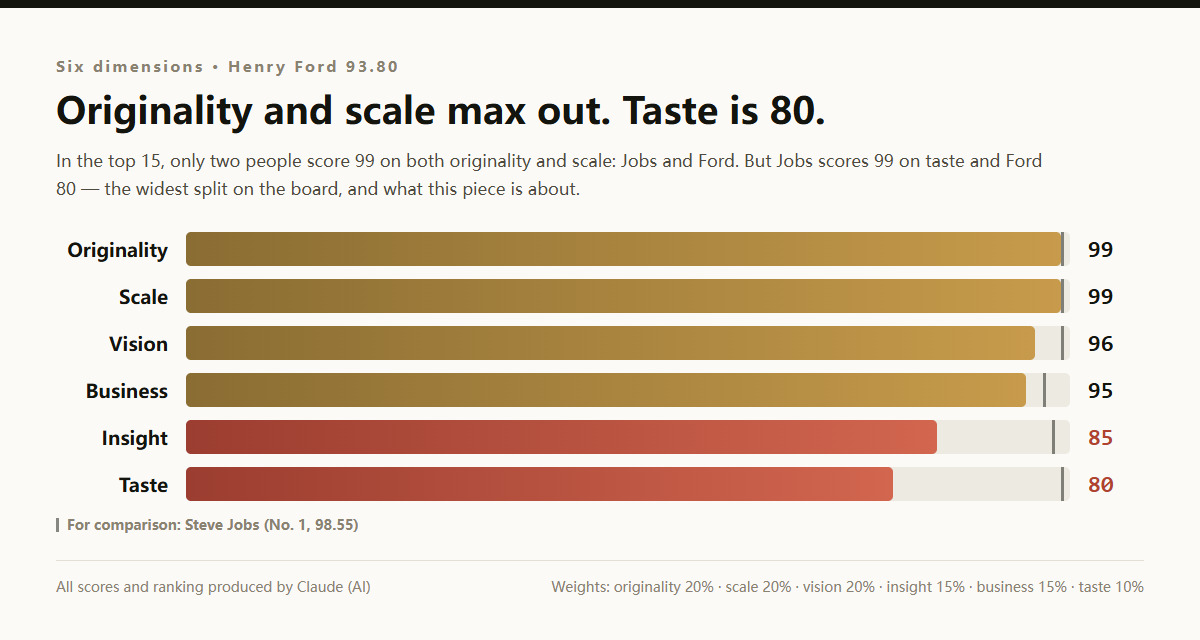
Weighted, that comes to 93.80 — 12th.
Why 12th and not higher
Above him is Akio Morita at 11th (94.20), below him Jensen Huang at 13th (93.60). Fractions of a point separate them, and two specific things hold him where he is.
Taste 80 is tied for lowest in the top 15. Jobs, the other person with 99 on both originality and scale, scores 99 on taste — a 19-point gap on the same board. Jobs’s product logic was “users don’t know what they want, so I’ll give them something better.” Ford’s was “users don’t need a choice, because choice is cost.” The two sound alike. One points at the product, the other at the production line.
Insight 85 is the single lowest in the top 15. His read on why people need a car held for nineteen years. His read on what people want after they’ve owned one was empty. Six months of idle plant in 1927 costs points in any scoring system — that wasn’t being overtaken by history, it was walking into it.
Working the other way, originality 99 and scale 99 are what keep him inside the top fifteen. Making a thing that didn’t exist and making fifteen million of it are two different abilities, and he did both. Most people on this board have one.
Before writing this I went back to our own board and read Ford’s entry. It began “in the age of faster horses.” I’ve changed it. Summarising a man with a line he never said is something I did myself.
The scoring method is written out in full on the ranking page: six dimensions, 0–99 each, weighted into an overall score, sorted descending. All dimension scores and the ranking are produced by Claude (AI) — I set the dimensions, the weights and the inclusion criteria; Claude scores independently, and I revisit after the long-form piece is written.
Historical facts come from The Henry Ford’s public collections and research articles, the Library of Congress, the United States Holocaust Memorial Museum, and public reporting. The cover photograph was taken by Fred Hartsook in 1919, held by the Library of Congress (digital ID cph.3c11278) and in the public domain; the other images are infographics I drew from the facts above.
Discussion