No. 11 of the Greatest Product Managers: Akio Morita — He Was Right About the Walkman and Wrong About How People Would Use It
On July 1, 1979, Sony’s Walkman went on sale in Japan. Model TPS-L2, ¥33,000. The initial production run was 30,000 units.
It sold 3,000 in the first month.
By the end of March 1999, 186 million cassette Walkmans had been sold.
Akio Morita ranks 11th on the board, with a weighted score of 94.20.
The eldest son of a family that had been brewing sake since 1665
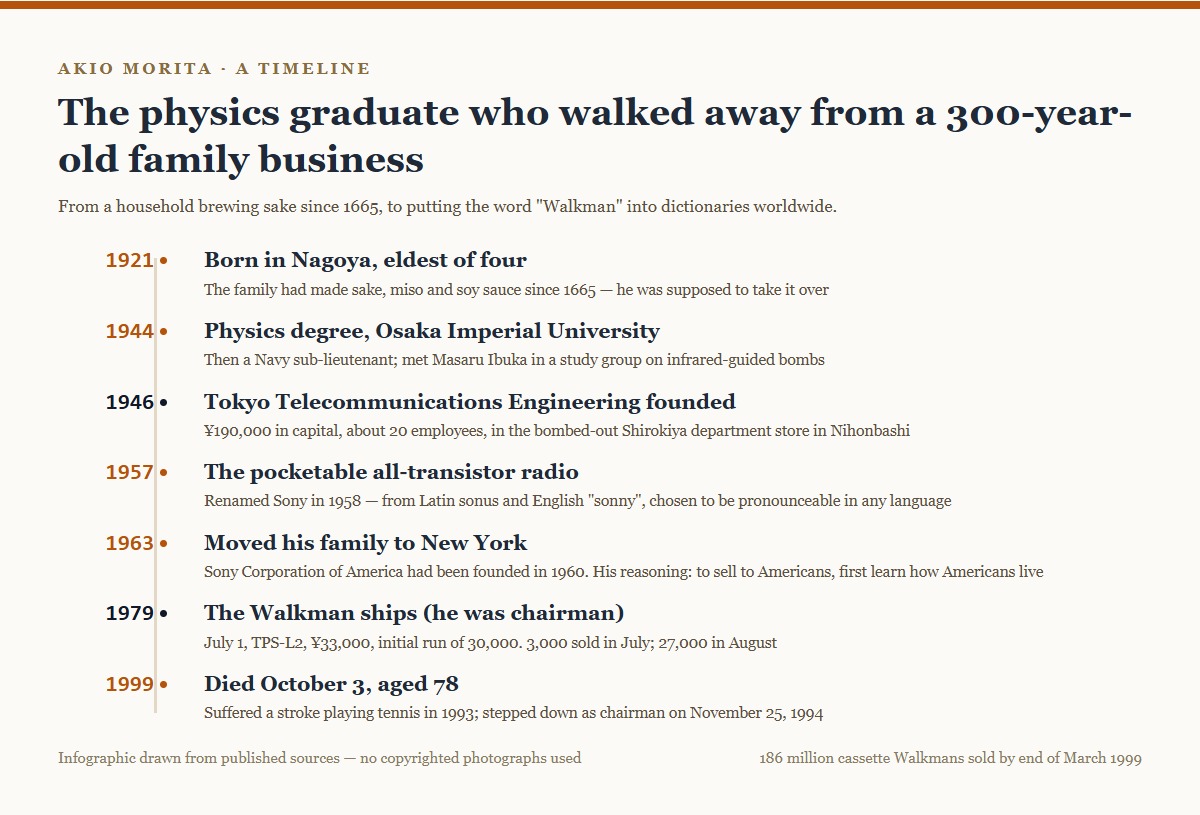
Akio Morita was born in Nagoya on January 26, 1921, the eldest of four. His family had made sake, miso and soy sauce since 1665 — by the logic of succession, he was the one meant to take it over.
He took a physics degree from Osaka Imperial University in 1944 and served as a sub-lieutenant in the Imperial Japanese Navy. He met Masaru Ibuka in a study group working on infrared-guided bombs.
The year after the war ended, in 1946, the two founded Tokyo Telecommunications Engineering. Capital of ¥190,000, about twenty employees, offices in what was left of the bombed-out Shirokiya department store in Nihonbashi.
That is the first thing to understand about him: he was not a young man out of a garage. He was a physics graduate who walked away from three centuries of family business.
”Sony” was chosen so Americans could pronounce it
In 1957 the company produced a pocketable, fully transistorized radio. In 1958 Tokyo Telecommunications Engineering renamed itself Sony — from the Latin sonus, sound, and the English sonny.
The rename was not popular internally: a Japanese name that had built some recognition, traded for four letters nobody knew. Morita’s argument was that it was easy to say in any language.
He founded Sony Corporation of America in 1960 and moved his family to New York in 1963. For the founder of a Japanese electronics firm to go and live in America was an odd thing to do at the time, but his reasoning was direct: if you want to sell things to Americans, first learn how Americans live.
He became president in 1971, and chairman in 1976 when Ibuka retired. When the Walkman arrived, he was chairman.
The Walkman started because Ibuka wanted opera on long flights
The product did not come from marketing.
Ibuka flew the Pacific often and wanted to listen to opera in the air. The engineer Nobutoshi Kihara modified a Pressman for him — a monaural recorder built for journalists — stripping the recording function and adding stereo playback.
Morita borrowed it for a weekend and played it for his golf partners and his family. Everyone was startled by the sound.
Then came the internal objections. Market research was clear: nobody would buy a tape machine that could not record, and the headphones would put people off.
Both were reasonable inferences at the time. The established use of a tape machine was recording, and wearing headphones in public was not yet a thing people did.
The problem is that this product’s value only exists from the moment you put the headphones on, and research cannot ask about that moment. You cannot get someone to evaluate an experience that does not yet exist.
Three thousand units in the first month
Reality initially sided with the research. July sold 3,000, which made the 30,000-unit run look like a joke.
Sony’s response is still worth copying. They judged that the thing could not be explained, only tried. Japanese celebrities were hired for print ads, and staff rode trains and walked crowded shopping districts at weekends, holding out headphones so strangers could listen for themselves.
August sold 27,000 units and cleared the initial run.
The product reached the United States in 1980, badged Soundabout.
The one thing he got wrong
The TPS-L2 had two headphone jacks, and an orange button labelled “hotline” — hold it and the music ducked so two people could talk through their headphones.
Morita insisted on both. His thinking was that one person sealing off the world with headphones was rude. So the machine was designed on the assumption that you would listen with someone else.
Buyers ignored it completely. Nobody pulled a friend in to share a Walkman; everyone put the headphones on alone and walked into the crowd. Within a few years Sony quietly dropped the second jack and the hotline button.
He was right about the product and wrong about the person the product would create. He thought he was selling music you could share. What he actually invented was being alone in public — one of the largest behavioural shifts of the late twentieth century, and its inventor did not initially approve of it.
That is also the most instructive part: he shipped the thing he disagreed with. He held out for the second jack, but he never used “people should listen together” as a reason to kill a machine that could not record.
Why he makes the list: 94.20 across six dimensions
The board weights six dimensions: vision 20%, insight 15%, taste 10%, business 15%, scale 20%, originality 20%. Morita scores:
| Dimension | Score | Basis |
|---|---|---|
| Vision | 98 | Built “personal music” over research and internal opposition, while the behaviour still did not exist |
| Insight | 92 | The two headphone jacks are the deduction — right about the product, wrong about people |
| Taste | 93 | From the TR-63 to the Walkman to Trinitron, Sony’s small-and-precise register was set by him |
| Business | 90 | He put Japanese manufacturing into American living rooms; the later content bets (CBS Records, Columbia) took a long time to settle |
| Scale | 93 | 186 million cassette Walkmans — the volume of a whole category |
| Originality | 97 | ”Walkman” entered dictionaries in many languages; he made both the category and the word |
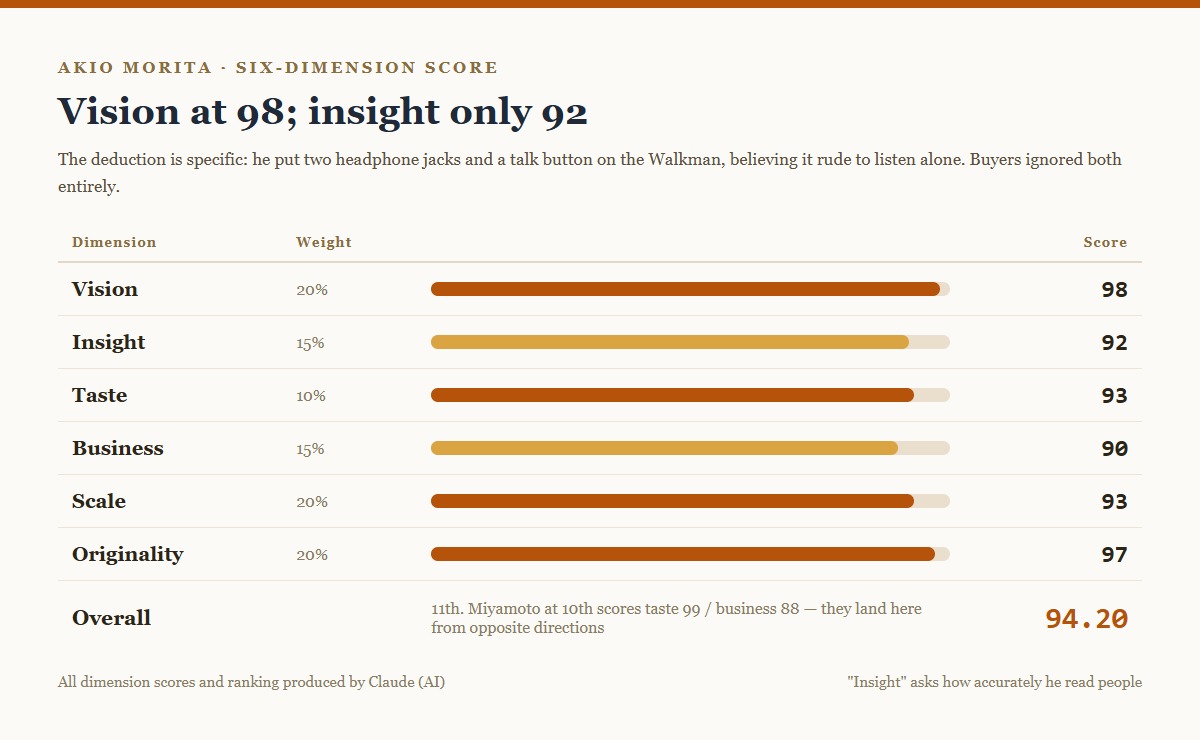
Weighted, that is 94.20 — eleventh on the board.
Why 11th, and not the top ten
The gap sits in two places.
Insight 92 is on the low side for the top fifteen. That dimension asks how accurately he read people, and the two headphone jacks are a hard counter-example: the product worked, but his prediction about its users was inverted.
Business 90 is also low for this range. Sony under him did put Japanese manufacturing into living rooms worldwide — that part is real. But Betamax losing to VHS from 1975, and the enormous content acquisitions of the late 1980s, both make it hard to score business highly. The first was a standards war lost; the second took Sony years to digest.
For contrast, Miyamoto at 10th scores taste 99 and originality 99 at the ceiling, with business 88 — even lower. The two of them arrive at 10th and 11th from almost opposite directions.
Morita suffered a stroke while playing tennis in 1993, stepped down as chairman on November 25, 1994, and died of pneumonia on October 3, 1999, aged 78.
By the time he died, nobody needed convincing that wearing headphones alone on the street was a normal thing to do.
The scoring method is written out in full on the board page: six dimensions of 0–99 each, weighted into an overall score, ranked in descending order. All dimension scores and rankings are produced by Claude (AI) — I set the dimensions, the weights and the inclusion criteria; Claude scores independently, and I revisit a score after writing the long piece.
Historical facts here come from Sony’s published company history, published accounts of Morita’s life, and contemporary reporting on the Walkman’s launch. The illustrations are infographics drawn from those facts; no copyrighted photographs are used.
Discussion