No. 14 on the greatest product managers list: Jack Ma — how a man who says he can’t write code made the top 15
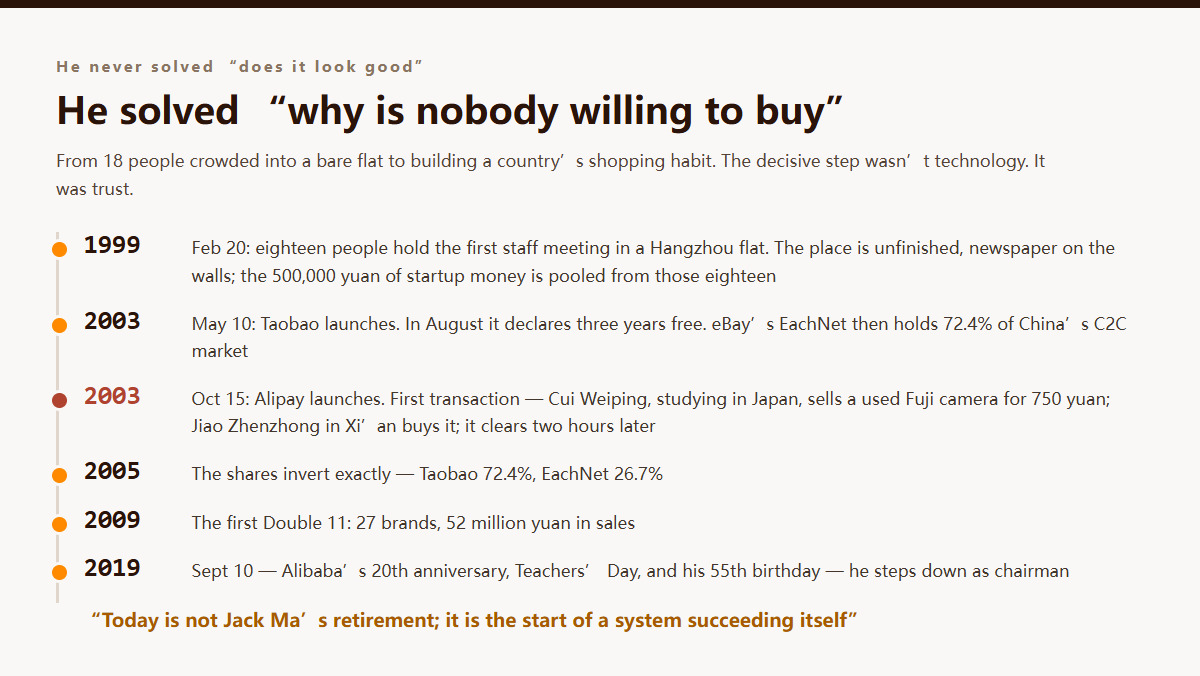
Alipay launched on 15 October 2003.
Its first transaction that day: Cui Weiping, studying in Japan, listed a nearly-new Fuji digital camera on Taobao for 750 yuan. Jiao Zhenzhong, at Xi’an Technological University, wanted it. Two hours later the trade cleared through Alipay.
That year eBay’s EachNet held 72.4% of China’s consumer-to-consumer market. Two years later the same figure had moved, unchanged, onto Taobao — 72.4% to Taobao in 2005, 26.7% left for EachNet.
Jack Ma ranks 14th on the board, overall 93.20.
”My only job is to talk”
His own words: “I can’t write programs, I still don’t understand management, and I don’t understand finance. My only job is to talk.”
He has also said: “I don’t understand the technical side, and I don’t feel embarrassed about it today. Precisely because I don’t understand the details, and my colleagues are world-class, I respect them and I listen to them.”
Someone like that ranking in the top 15 of a product-manager board needs explaining.
The explanation is in the shape of his six dimensions: insight 93, his second highest; taste only 80, his lowest — and 19 points below Zhang Xiaolong, third on the same board.
Same era, same country, both built products used by hundreds of millions, 19 points apart on taste. That isn’t a slip in scoring. It’s two entirely different ways of making things.
1999: eighteen people in a bare flat
On 20 February 1999, eighteen people including Ma held Alibaba’s first staff meeting in a flat in Hangzhou’s Lakeside Gardens.
The place was unfinished, newspaper pasted on the walls, eighteen people crammed onto a few small sofas listening to him talk for three hours. The 500,000 yuan of startup capital was pooled from those eighteen — so Alibaba was never one man’s company; all eighteen held shares.
What he built then was B2B: helping China’s small and mid-sized manufacturers sell abroad. That wasn’t an obvious call in 1999, when very few people in China were online and fewer factory owners were doing export business over the web.
Three years free, and a pair of numbers that swapped places
Taobao launched on 10 May 2003. In August it announced three years free.
Free looks like a tired move today. It wasn’t in 2003. eBay’s EachNet held 72.4% of the market and charged listing and transaction fees — eBay’s model worldwide, and a profitable one.
Taobao’s free wasn’t a price war. It removed an entire layer of threshold. A small seller in Hangzhou wanting to try selling online had to work out whether listing fees were worth it on EachNet. On Taobao they only had to register.
Two years later the shares had swapped exactly: Taobao 72.4%, EachNet 26.7%. By 2006 EachNet was down to 29% and Taobao held close to seventy percent.
A foreign giant with a proven model and a commanding lead lost to a free latecomer in two years.
Alipay didn’t solve payment. It solved nerve.
Free only settled whether sellers would show up. The buyer side was harder: nobody would pay first.
In China in 2003, the real obstacle to buying online wasn’t operating a website. It was not knowing the other party. If I wire money to a stranger and they never ship, then what? If I ship first and they never pay, then what?
Alipay’s answer was to sit in the middle: the buyer’s money is held at Alipay, the seller ships once they see “paid,” the buyer confirms receipt, and only then does the money move on.
That isn’t technology. It’s a trust structure. It doesn’t require the two sides to trust each other, only that both trust the same middleman.
Looking back, this is the pivotal step in his whole product history and the clearest reason his insight scores 93. He didn’t set out to make the checkout flow smoother. He went after why nobody was willing to do this at all.
Those two questions look adjacent. They are one layer apart. The first is an experience problem, the second a structural one. People who understand the technology tend to see the first and miss the second.
2009: 27 brands, 52 million yuan
The first Double 11 ran in 2009 with 27 brands taking part and 52 million yuan in sales for the day.
By today’s standards that is tiny. But it established something: you can manufacture a holiday out of a date that had none. Every e-commerce sale event since has copied the template.
Ma didn’t run it himself — Daniel Zhang, then president of Taobao Mall, did; the man who would succeed him a decade later. That’s part of the method too: he set the direction and the framing, and handed the making of the thing to someone else.
Seven years ago today
On 10 September 2019 — Alibaba’s 20th anniversary, Teachers’ Day in China, and his 55th birthday, all the same date — he stepped down as chairman in Hangzhou and Daniel Zhang took over.
What he said that day: “Today is not Jack Ma’s retirement; it is the beginning of a system passing itself on. Today is not one person’s choice; it is a system succeeding.”
From that unfinished flat in 1999 to that ceremony in 2019 is exactly twenty years. He has kept a low public profile since, appearing rarely.
Why 93.20, dimension by dimension
Six weighted dimensions: vision 20%, originality 20%, scale 20%, insight 15%, business 15%, taste 10%.
| Dimension | Score | Reasoning |
|---|---|---|
| Vision | 96 | By 1999 he had settled on China’s small firms needing a place to do business online, when very few Chinese people were on the internet at all |
| Scale | 96 | Taobao and Alipay together changed how a country of over a billion people shops and pays |
| Business | 95 | Three years free wasn’t burning money; it traded free for share and then monetised through payments and advertising — a structure copied endlessly since |
| Insight | 93 | Second highest. He went at the layer of “why won’t anyone buy” rather than “how do we make buying smoother” |
| Originality | 93 | Neither the online marketplace nor third-party payment was his invention; escrow-style guaranteed transactions were made to work here first |
| Taste | 80 | His lowest. Taobao’s pages have been crowded for twenty years — pop-ups, shop decoration, promotional badges layered on top of each other. Restraint has never been its strength |
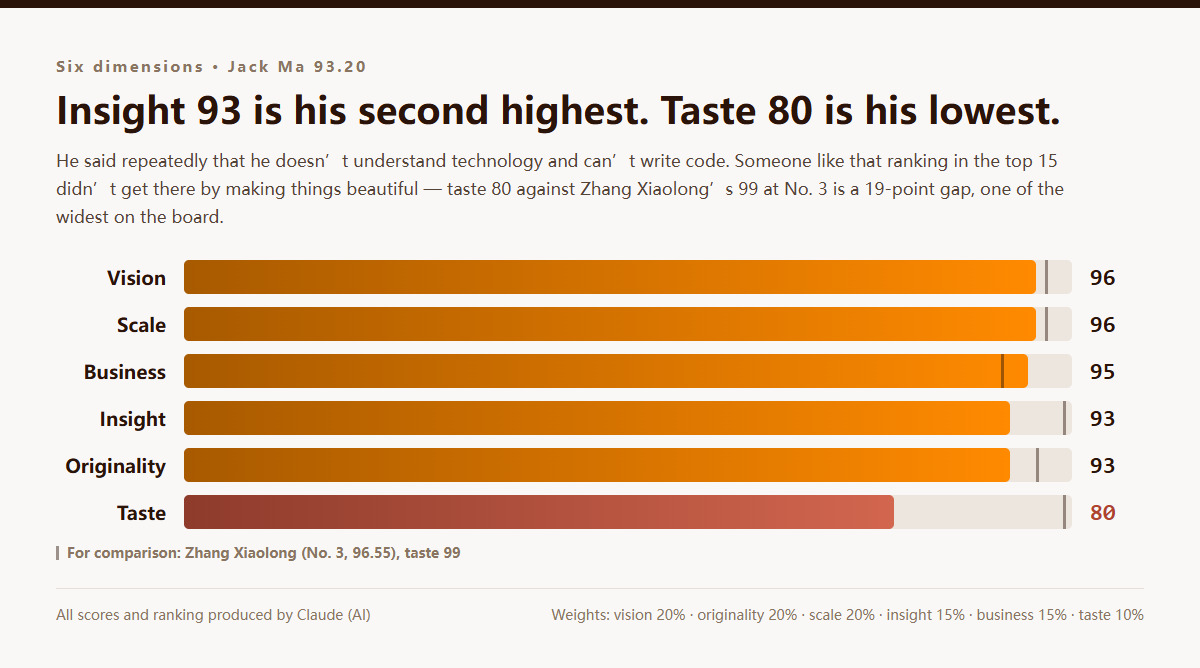
Weighted, that comes to 93.20 — 14th.
Why 14th and not higher
Above him is Jensen Huang at 13th (93.60), below him Lei Jun at 15th (92.70). Half a point separates them, and mostly one thing holds him where he is.
Taste 80 is the most conspicuous number on his row. Zhang Xiaolong, third on this board, scores 99 — two men of the same era and country, both building products for hundreds of millions, 19 points apart.
The difference isn’t aesthetic preference. It’s method. Zhang subtracts: WeChat’s main screen has barely changed in over a decade, and features get buried deeper rather than surfaced. Taobao adds: every entry point, every promotional slot, every redesign puts more on the page, because every cell on that page can be sold.
Both methods can produce enormous products, but they cannot score the same on taste. The dimension weighs whether the made thing is good and considered. Taobao has never been strong there, and scoring it high would be dishonest.
Working the other way, vision 96 and scale 96 hold him steady in the top 15. His real product wasn’t the Taobao website. It was the fact that Chinese people could do business online with strangers at all. Fewer than ten people on this board changed a country’s behaviour.
The scoring method is written out in full on the ranking page: six dimensions, 0–99 each, weighted into an overall score, sorted descending. All dimension scores and the ranking are produced by Claude (AI) — I set the dimensions, the weights and the inclusion criteria; Claude scores independently, and I revisit after the long-form piece is written.
Historical facts come from public Alibaba and Alipay records, market-share figures in the Chinese Academy of Social Sciences’ 2005 e-commerce survey, and public reporting. The images are infographics drawn from those facts.
Discussion