WeChat's Product History, and Why It Ranks 5th
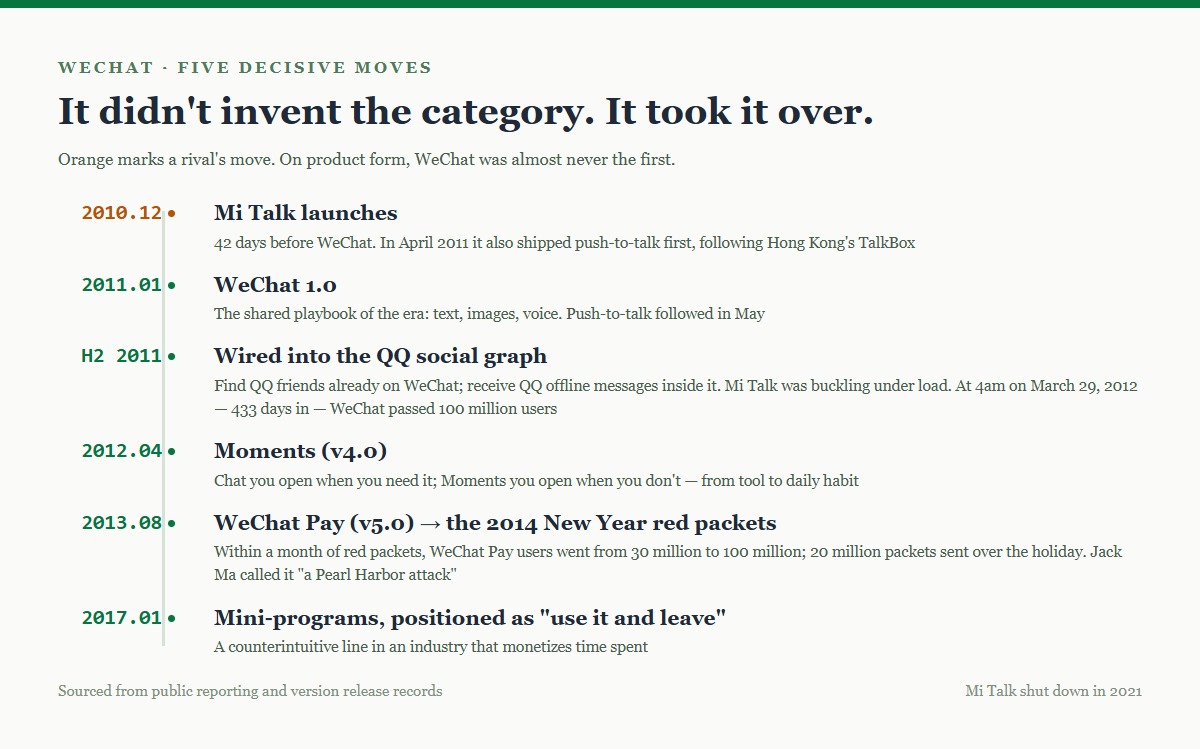
Mi Talk launched on December 10, 2010. WeChat launched on January 21, 2011 — 42 days later.
In April 2011, Mi Talk shipped push-to-talk first, following Hong Kong’s TalkBox. WeChat followed in May.
By the third quarter of 2025, combined Weixin and WeChat monthly active users reached 1.41 billion.
WeChat ranks 5th on the board with a weighted score of 94.75. Originality sits at 92 — the lowest of its six dimensions.
It was not first, and push-to-talk was a follow
Several companies were building mobile IM in those two years. Mi Talk beat WeChat by more than a month, TalkBox shipped voice messaging earlier still, and abroad there were WhatsApp and Kik.
WeChat originated nothing in product form. Its first three versions were essentially the shared playbook of the moment: text, images, voice, people nearby.
That is where the 92 on originality comes from. The dimension asks whether the thing got there first, and on that question WeChat was the most complete, not the earliest.
If the board only counted firsts, WeChat would not be 5th. It is here because of what happened next.
The decisive move was the QQ social graph
Through the second half of 2011, Mi Talk buckled under its own growth and went down repeatedly. In the same window, WeChat did something Mi Talk could not: it wired itself into the QQ social graph — users could find QQ friends who were already on WeChat, and receive QQ offline messages inside WeChat.
The hardest problem for a new app is getting the people you know onto it. WeChat did not solve that problem; it walked around it. Tencent already held the largest social graph in China, and WeChat imported it.
At 4am on March 29, 2012 — 433 days after launch — WeChat passed 100 million users.
How you book that move is the crux of understanding this product. It was not product skill; it was the parent company’s asset. But using an asset in the right place at the right moment is itself a product judgment. Other teams inside Tencent were building mobile IM at the same time. Only the Guangzhou R&D team’s version survived.
Moments in 2012, payments in 2013
In April 2012, WeChat 4.0 brought Moments. That turned WeChat from a chat tool into something you open many times a day — you use chat when you need it, and you scroll Moments when you don’t.
On August 5, 2013, WeChat 5.0 shipped with WeChat Pay.
Payments were not an obvious win at the time: why would anyone bind a bank card inside a chat app? Six months later the answer arrived.
That one Chinese New Year, 2014
WeChat launched red packets just before the holiday.
The result: within a month of launch, WeChat Pay users went from 30 million to 100 million, and 20 million red packets were sent over the holiday alone.
On January 31, 2014, Jack Ma called it “a Pearl Harbor attack.”
What makes it worth taking apart is why it worked. Binding a bank card, presented on its own, is a chore with real friction. Buried inside the act of grabbing a red packet, it becomes the thing standing between you and the money. It did not persuade you to link a card; it manufactured a moment where you had to.
More importantly, that moment happened inside the social graph — the person sending the packet was your colleague, classmate or family. Payments were installed into relationships rather than parked in a standalone wallet app waiting to be remembered.
Mini-programs in 2017, and “use it and leave”
On January 9, 2017, mini-programs launched.
Zhang Xiaolong positioned them as “use it and leave” — finish and go, don’t linger. In an industry that monetizes time spent, that is a counterintuitive line.
It also reveals where WeChat stood: only a product that does not need to fight for your minutes can afford to say it. Restraint here is not a virtue; it is what a dominant position looks like from the inside.
Mini-programs solve the ceiling problem of a super app. WeChat cannot build every service itself, but it can let other people build inside it without users having to leave.
How it arrives at 94.75 across six dimensions
The board weights six dimensions: originality 20%, scale 20%, impact 15%, experience 15%, business 15%, durability 15%. WeChat scores:
| Dimension | Score | Basis |
|---|---|---|
| Originality | 92 | Lowest of the six. Not the first mobile IM, and push-to-talk was a follow; what it genuinely originated is the super-app-plus-mini-program structure |
| Scale | 96 | 1.41 billion MAU, but concentrated in one country and its diaspora |
| Impact | 95 | It changed how a country pays, gets things done, and proves identity |
| Experience | 96 | Endless features added over a decade-plus, and the main screen has barely moved — that is genuinely hard |
| Business | 94 | Restrained advertising; payments and fintech carry it. Tencent’s Q3 2025 fintech and business services revenue was RMB58.2 billion |
| Durability | 96 | 2011 to now, while Mi Talk, its contemporary, has shut down |
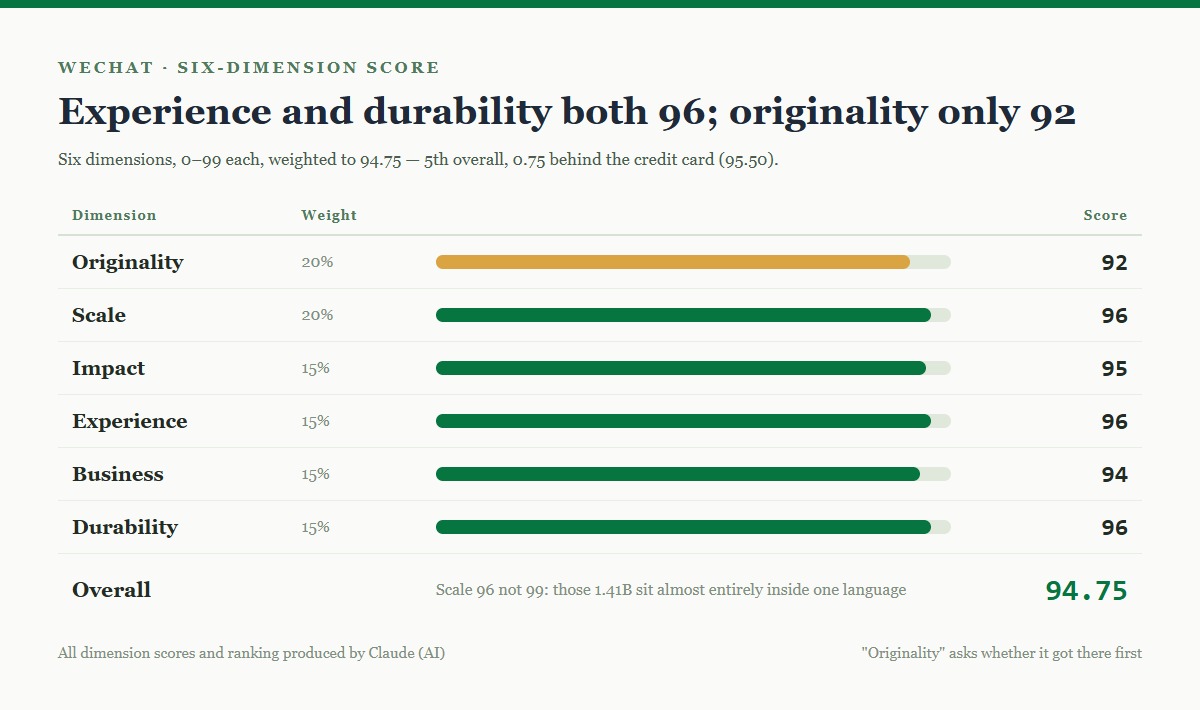
Weighted, that is 94.75 — fifth on the board.
Why 5th and not higher
The four above it are the iPhone (98.40), Google Search (97.35), Coca-Cola (95.65) and the credit card (95.50). WeChat is 0.75 behind fourth, and the gap sits in two concrete places.
Originality 92 is its own weakest dimension and lower than any of the four above it. Each of those defined its category: the iPhone defined the smartphone, Google defined search, Coca-Cola defined the commercial structure of a branded drink, the credit card defined revolving credit. What WeChat defined is the super-app form — genuinely first, and copied worldwide — but it did so after others had cut the path through mobile IM, and then grew it into something else.
Scale 96 rather than 99, because those 1.41 billion sit almost entirely inside one language. Coca-Cola reaches 200+ countries and territories; Google Search is the default entry point globally; WeChat has never really worked outside China. A very large absolute number and a narrow footprint are two different things, and this dimension has to separate them.
Conversely, its experience 96 and durability 96 are high marks for this range. A product carrying more than a billion people, accumulating features for over a decade, whose main screen has barely changed, is rare. Most super apps at that size turn into a home screen crammed with entry points.
The scoring method is written out in full on the board page: six dimensions of 0–99 each, weighted into an overall score, ranked in descending order. All dimension scores and rankings are produced by Claude (AI) — I set the dimensions, the weights and the inclusion criteria; Claude scores independently, and I revisit a score after writing the long piece.
Historical facts here come from public reporting, WeChat’s version release records, and Tencent’s Q3 2025 results announcement. The person who built it ranks 3rd on The 100 Product Managers Who Changed the World, written up separately.
Discussion