AI & The New Social Contract | Does $1,000/Month Make People Lazy? Inside Sam Altman’s $60M, 3-Year OpenResearch UBI Experiment
Yesterday, in Episode 01 of our daily column (When AI Makes Productivity Abundant, Humanity Deserves Joy, Not New Shackles), we argued that as AI agents drive the marginal cost of intelligence and production toward zero, society must establish an unconditional survival floor through Universal Basic Income (UBI).
Whenever UBI is proposed, the pushback is almost always the same sentence:
“Human nature can’t handle free money! If you give people unconditional cash every month with no work requirement, everyone will quit their jobs, sit on the couch, and blow the money on alcohol and video games.”
That objection has been repeated since the English Poor Laws of 1601. For four centuries, defenders and critics of unconditional cash transfers mostly traded ideological anecdotes—because nobody had ever funded a large-scale, multi-year, gold-standard Randomized Controlled Trial (RCT) paying a full $1,000 per month in the United States.
Until Sam Altman—the CEO of OpenAI, who saw earlier than almost anyone how deeply frontier AI would disrupt wage labor—teamed up with philanthropic partners to put $60 million on the table and run the experiment for real.
The result is the landmark OpenResearch Unconditional Cash Study, led by University of Toronto economist Prof. Eva Vivalt alongside researchers from UC Berkeley, the University of Chicago, and the National Bureau of Economic Research (NBER). Let’s open the econometric ledger and look at what actually happened when 1,000 people received $1,000 a month, no strings attached, for three straight years.
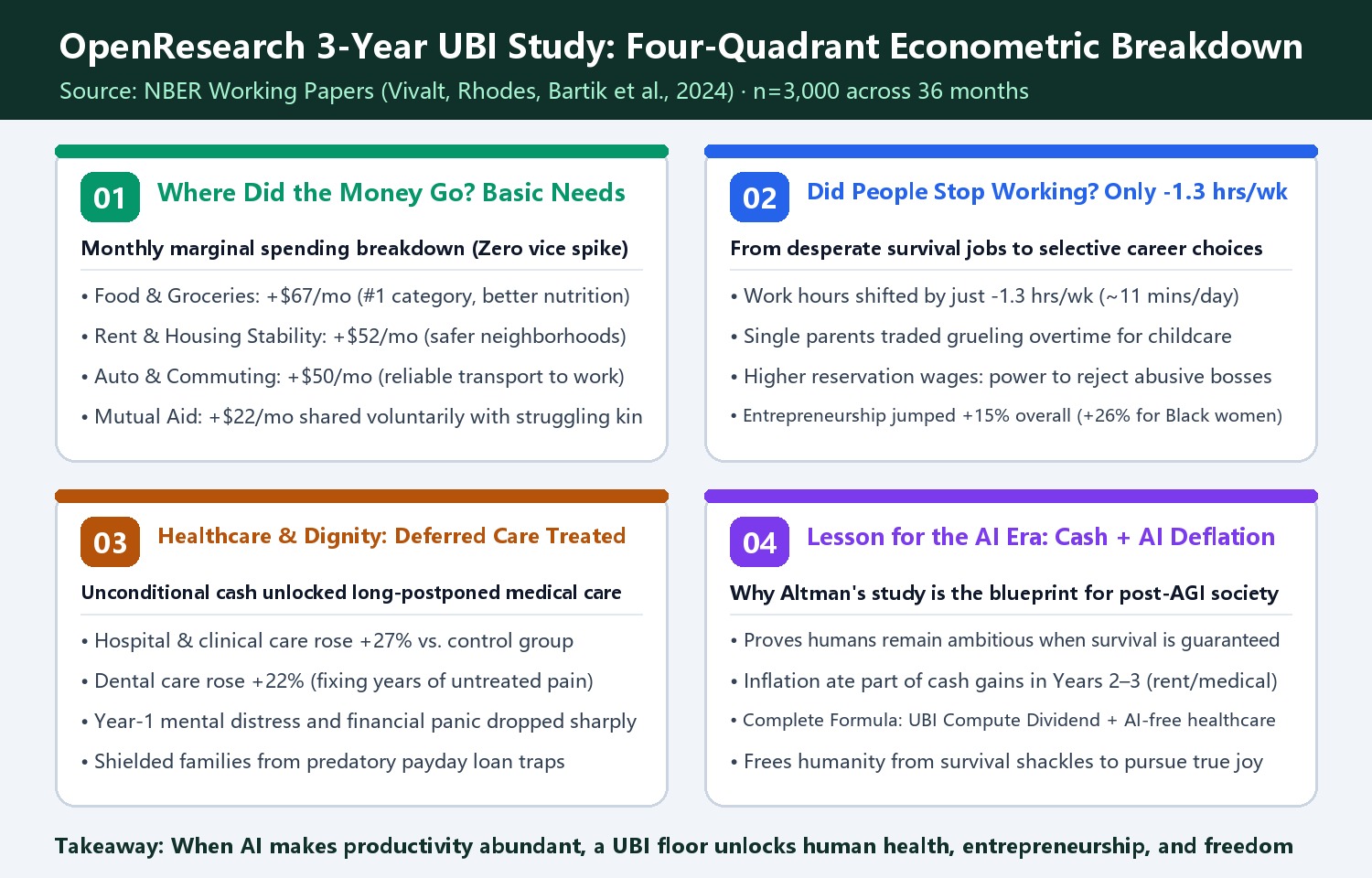
1. The Ultimate Stress Test of Human Nature: $1,000/Month for 36 Months, Zero Strings Attached
Why did Sam Altman start organizing OpenResearch back in 2016, years before ChatGPT became a household name?
Because Altman understood the macroeconomic math of AGI: when software and robotics automate cognitive and physical labor at scale, tremendous wealth is created, but the traditional mechanism for distributing purchasing power—selling 40 hours of human labor a week—breaks down. If policymakers don’t have hard empirical data on how unconditional cash affects human behavior, they will be flying blind when the AI transition hits full speed.
To make the findings bulletproof across the political spectrum, OpenResearch designed one of the most rigorous field experiments in modern economics:
- The Sample (n = 3,000): 3,000 participants aged 21 to 40 across urban, suburban, and rural counties in Texas and Illinois, living in households with an average annual income of roughly $29,900 (just above the federal poverty line).
- The Randomized Split:
- Treatment Group (1,000 people): Received $1,000 every single month for 36 months (November 2020 to October 2023)—a $36,000 tax-free windfall representing roughly 40% of their baseline household income.
- Control Group (2,000 people): Received $50 per month as compensation for completing surveys, blood draws, and credit checks.
- Truly Unconditional: Recipients could do anything they wanted with the cash. If they quit their jobs tomorrow, the $1,000 still arrived on the first of the month.
If the “free money breeds laziness and vice” hypothesis were true, handing low-income workers a 40% income boost with zero work requirements should have triggered an immediate wave of mass resignations and reckless spending.
Instead, three years of bank statements, credit bureau records, blood biomarkers, and survey data told the exact opposite story.
2. Finding #1: Where Did the Money Go? Groceries, Rent, and Car Repairs — Zero Spike in Vice
For generations, paternalistic critics have claimed that unconditional cash given to low-income families gets wasted on alcohol, cigarettes, or gambling.
The OpenResearch economists tracked every dollar of marginal spending in the $1,000/month group compared to the control group. The top four categories where the money actually went were:
- #1: Food and Groceries (+$67/month net increase) The single largest spending increase went to putting fresh food on the kitchen table.
- #2: Rent and Housing Stability (+$52/month) Recipients used the cash to pay rent on time, move out of overcrowded apartments, and relocate to safer neighborhoods.
- #3: Transportation and Auto Maintenance (+$50/month) In most of America, a broken transmission means losing your job. Recipients fixed their cars and maintained reliable commuting.
- #4: Helping Struggling Friends and Relatives (+$22/month) Even on a ~30k income, recipients voluntarily shared more money with family members in crisis than any other discretionary category.
And what about alcohol, tobacco, and recreational drugs? Across both self-reported surveys and objective health biomarkers, there was zero increase in alcohol or substance abuse—in fact, problematic drinking episodes were slightly lower in the $1,000/month group than in the control group.
People don’t drink themselves into despair because they have security; they do it when they are crushed by hopelessness.
3. Finding #2: Did People Stop Working? Only -1.3 Hours/Week — While Entrepreneurship Surged +26%
Now for the headline question: Did people quit working?
Across the entire 36-month period, total employment in the $1,000/month group differed from the control group by only 2 percentage points, and average weekly work hours shifted by just -1.3 hours per week.
Think about that number: 1.3 hours per week is less than 11 minutes per day.
Even more revealing is who reduced their hours and what they did with that time:
- Single parents traded grueling third shifts for childcare: Single mothers and fathers used the $1,000 cushion to cut back on exhausting overtime hours so they could spend evenings with their children.
- Workers became more selective in job searches: Without the terror of immediate eviction, unemployed recipients took slightly longer to vet job offers—refusing abusive, dead-end gigs to find better-fitting roles or complete university coursework.
- Entrepreneurship exploded: By Year 3, recipients in the $1,000/month group were 15% more likely to have started or be actively building a business than the control group. Among Black women, entrepreneurial activity and business planning surged by an astonishing +26%.
Far from turning people into couch potatoes, an unconditional income floor acted as venture capital for the working class. You cannot take a risk on starting a bakery, an indie software studio, or a freelance craft when one missed paycheck means sleeping in your car. Guarantee survival, and human ambition blooms.
4. Finding #3: +27% Hospital Care and +22% Dental Care — Fixing Years of Deferred Pain
In the companion NBER healthcare paper authored with researchers from MIT and Harvard Medical School, another striking pattern emerged:
Recipients of the $1,000/month transfer increased their use of hospital and emergency clinical care by 27% and dental care by 22% compared to the control group.
Why did people with more cash visit doctors and dentists more often? Because prior to receiving UBI, low-income families simply endured untreated toothaches, skipped preventive screenings, and ignored chest pain because they couldn’t afford the co-pay or the unpaid day off work.
In Year 1 of the study, recipients also experienced dramatic reductions in psychological distress and financial panic.
5. The Blueprint for the AI Century: UBI Cash Dividend + AI-Deflated Public Goods
Prof. Vivalt’s team also noted an important macro lesson in Years 2 and 3 (2022–2023): as post-pandemic inflation drove up U.S. rents and healthcare prices, $1,000/month alone could not permanently insulate families from structural housing and medical costs.
That observation completes the equation for the AI economy:
- On the Income Side (UBI / Compute Dividend): Taxing a fraction of AI compute and autonomous robotics to give every citizen an unconditional cash floor gives human beings agency, bargaining power, and the freedom to say “no” to exploitation.
- On the Cost Side (AI Deflation & Universal Basic Services): We must deploy AI medical diagnostics, AI personalized tutoring, and automated construction to drive the cost of healthcare, education, and housing toward zero.
Sam Altman’s $60 million experiment has settled the 400-year argument with hard data: human beings are not lazy by nature. When you lift the boot of survival terror off people’s necks, they buy groceries for their kids, fix their teeth, leave toxic jobs, and start new businesses.
When AI makes productivity abundant, humanity deserves to enjoy the freedom and joy of that abundance—not be punished by it.
Discussion