Anthropic S-1 IPO Prospectus Decoded: From $41M to $16.3B in 1H 2026 — How Claude Code Built the World's Most Profitable AI Lab
On October 26, 2026, Silicon Valley and Wall Street finally got the document they had been waiting three years to read.
Anthropic, the frontier AI company founded by siblings Dario Amodei and Daniela Amodei, publicly filed its Form S-1 Registration Statement with the U.S. Securities and Exchange Commission (SEC) to list on the Nasdaq Global Select Market under the ticker symbol ANT. Led by Goldman Sachs and Morgan Stanley, the IPO is widely expected to target a valuation between $1.5 trillion and $2.0 trillion, following its $65 billion Series H financing in May 2026 at a $965 billion post-money valuation.
Before this filing, one question haunted every tech boardroom: Why were other foundation model labs still struggling to monetize consumer chatbots while Anthropic’s enterprise revenue went vertical?
Once you open the S-1 prospectus and inspect the income statement and unit economics, the mystery vanishes.
Anthropic is not a consumer subscription company trying to squeeze $20 a month out of casual web chatters. It is an industrial-grade software engine powered by Claude Code and usage-based enterprise APIs — and it has quietly become the fastest-growing, first operating-profitable frontier AI company in human history.
Here is our page-by-page product and financial teardown of Anthropic’s historic S-1 filing.
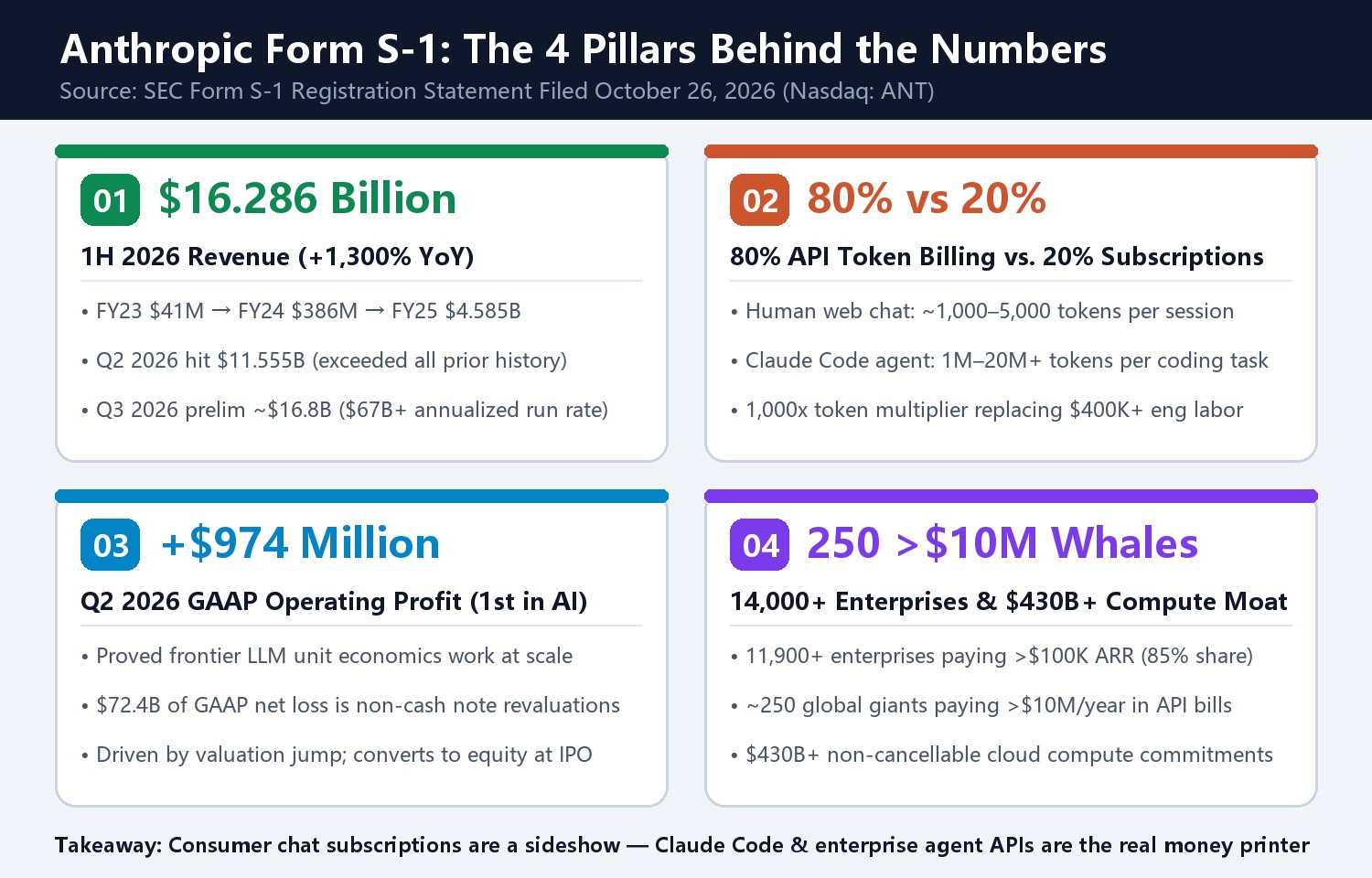
1. The Steepest Revenue Curve in Software History: 400x in 3.5 Years
Even if you have studied the early S-1 filings of Google, Meta, Snowflake, or Nvidia’s data-center boom, the numbers in Anthropic’s consolidated statements of operations look almost surreal:
- Full Year 2023 Revenue: $41 million ($0.041B)
- Full Year 2024 Revenue: $386 million ($0.386B — 9.4x YoY)
- Full Year 2025 Revenue: $4.585 billion (11.9x YoY)
- First Half of 2026 Revenue (6 months ended June 30, 2026): $16.286 billion — up 1,300% (14x YoY) compared to $1.163 billion in 1H 2025!
Look closer at the quarterly acceleration inside 2026:
- Q1 2026 Revenue: $4.731 billion — a single quarter that exceeded all of full-year 2025 ($4.585 billion).
- Q2 2026 Revenue: $11.555 billion — up 144% quarter-over-quarter, generating more revenue in 90 days than Anthropic had generated in its entire corporate history prior to 2026.
- Q3 2026 Preliminary Revenue: The prospectus discloses preliminary third-quarter revenue of approximately $16.8 billion, putting Anthropic on a $67+ billion annualized run rate.
No software business in history has ever compounded at 14x year-over-year at a multi-billion-dollar scale.
2. Debunking the “$80.7B Net Loss” Headline: The First Profitable Frontier AI Lab
Within minutes of the S-1 hitting EDGAR, superficial headlines screamed: “Anthropic Lost $80.7 Billion in the First Half of 2026!”
If you only read the bottom-line GAAP net loss of $80.748 billion, you might think Anthropic is incinerating cash on every API call. Read three lines further into the financial footnotes, and you discover the exact opposite: Anthropic is the first frontier foundation model lab in the world to achieve GAAP operating profitability.
Where did the $80.748 billion GAAP net loss come from?
According to the S-1 footnotes, approximately $72.4 billion of that figure consists of non-cash fair value adjustments on convertible notes, SAFEs, and derivative liabilities issued in earlier financing rounds.
In plain English: between 2023 and 2025, Anthropic raised billions in convertible debt from strategic backers like Amazon and Google. Because Anthropic’s valuation skyrocketed toward $1 trillion+ in 2026, the value of those investors’ conversion options exploded. Under U.S. GAAP rules, when a private company’s valuation soars, the increase in the fair value of its convertible notes must be booked as a non-cash “expense” on the income statement. It is a paper accounting artifact caused by Anthropic’s own massive valuation surge — and upon IPO conversion, those derivative liabilities vanish into common equity.
When you strip out non-cash financing revaluations and look at GAAP Operating Income (Loss) — the true measure of revenue minus compute costs, R&D, and sales & marketing:
- 1H 2026 Operating Loss: Narrowed to just $693 million across the full six-month period.
- Q2 2026 Single-Quarter GAAP Operating Profit: +$974 million!
Let that sink in. For three years, skeptics insisted that frontier LLMs had fatally broken unit economics. In Q2 2026, after paying for inference compute, frontier model training, and top researcher compensation, Anthropic generated nearly $1 billion in pure operating profit in a single quarter.
3. The Core Product Secret: Why 80% API Revenue and Claude Code Changed Everything
For product managers and founders, the most important number in the S-1 is not on the balance sheet — it is the revenue mix:
Out of Anthropic’s $16.286 billion in 1H 2026 revenue, approximately 80% came from usage-based API token billing, while only ~20% came from seat subscriptions.
That 80% vs. 20% split explains why Anthropic overtook consumer-first rivals in enterprise monetization.
Chatting vs. Autonomous Coding: The 1,000x Token Multiplier
Compare two product paradigms:
- The Consumer Chatbot Subscription ($20/month): A human opens a browser tab, types a prompt, asks for an email rewrite or a recipe, and reads the reply. Even a heavy human user typing with ten fingers only consumes a few thousand tokens per session. Worse, consumer churn is brutal.
- The Autonomous Coding Agent (
Claude Code+ API): Instead of chasing consumer spectacle, Dario Amodei’s team obsessed over software engineering benchmarks, tool use (Model Context Protocol / MCP), computer use, and long-horizon agentic reliability from Claude 3.5 Sonnet through the Claude 4 and 4.6 families. When a developer or product builder givesClaude Codea single instruction in the terminal — “Refactor this billing microservice, write integration tests, fix failing builds, and open a PR” —Claude Codeautonomously reads hundreds of files across the repository, plans the architecture, writes code, runs test suites, reads stack traces, and iterates. A single autonomous task consumes 1,000,000 to 20,000,000+ tokens.
Claude Code created a 1,000x token consumption multiplier.
Human typing speed has a biological ceiling; autonomous agents reading and writing production code do not. And unlike casual web chat, enterprises happily pay millions of dollars for those tokens because they directly multiply — or replace — $400,000/year software engineering labor.
The Enterprise Moat in Numbers
Look at the enterprise customer metrics disclosed in the S-1 (as of September 30, 2026):
- 14,000+ total enterprise customers.
- 11,900+ enterprise customers spending more than $100,000 per year in ARR (~85% of the enterprise base).
- Approximately 250 global enterprises spending more than $10 million per year with Anthropic.
Whether you look at AI-native IDEs and coding agents or Fortune 500 internal engineering pipelines, Claude has become the default reasoning engine of global software production.
4. The $430B+ Compute Fortress
To feed a token engine growing 14x year-over-year, Anthropic has locked up physical infrastructure at a scale never before seen by a newly public company.
Under Commitments and Contingencies, the S-1 reveals:
- $430+ billion in non-cancellable multi-year cloud and compute purchase commitments (primarily across AWS Trainium clusters and Google Cloud TPUs).
- Up to $637 billion in total compute commitments when including conditional capacity expansions.
As we detailed in our earlier investigation, Why Did Google Guarantee $43.8 Billion in Third-Party Data Center Leases?, Anthropic’s hyper-growth required Wall Street, Google, Broadcom, and power-grid operators to invent entirely new off-balance-sheet compute SPVs to deliver gigawatts of AI capacity. Now we see why: every gigawatt of compute Anthropic brings online is immediately absorbed by high-margin enterprise API demand.
5. What Anthropic’s S-1 Means for Every Builder
Anthropic’s journey from $41 million in 2023 to $16.3 billion in the first half of 2026 proves a fundamental truth about the AI era:
The marginal cost of writing syntax is collapsing toward zero, while the value of product judgment, user insight, and clear specification is compounding exponentially.
That is the exact philosophy behind DO AI PM (“Speak it, and AI builds it”). You no longer need a 50-person engineering department or years of coding syntax to turn a sharp product insight into working software. With Claude Code in your terminal, one person who deeply understands a user problem can describe it, build a high-fidelity product, and ship it to the world.
Anthropic didn’t become the world’s most valuable AI powerhouse by building a better toy to chat with. It won by giving builders the hammer to construct the future.
Discussion