In 2004, Email Boxes Held Just 2MB and Forced You to Delete Mail Daily: Then Google's Employee #23 Gave Away 1GB on April Fools' Day
On April 1, 2004, Google issued a press release that every journalist in Silicon Valley immediately dismissed as an April Fools’ Day prank: Google was launching a free webmail service called Gmail, and every user would receive 1,000 megabytes (1 GB) of free storage.
To understand why nobody believed it, remember what email looked like in early 2004:
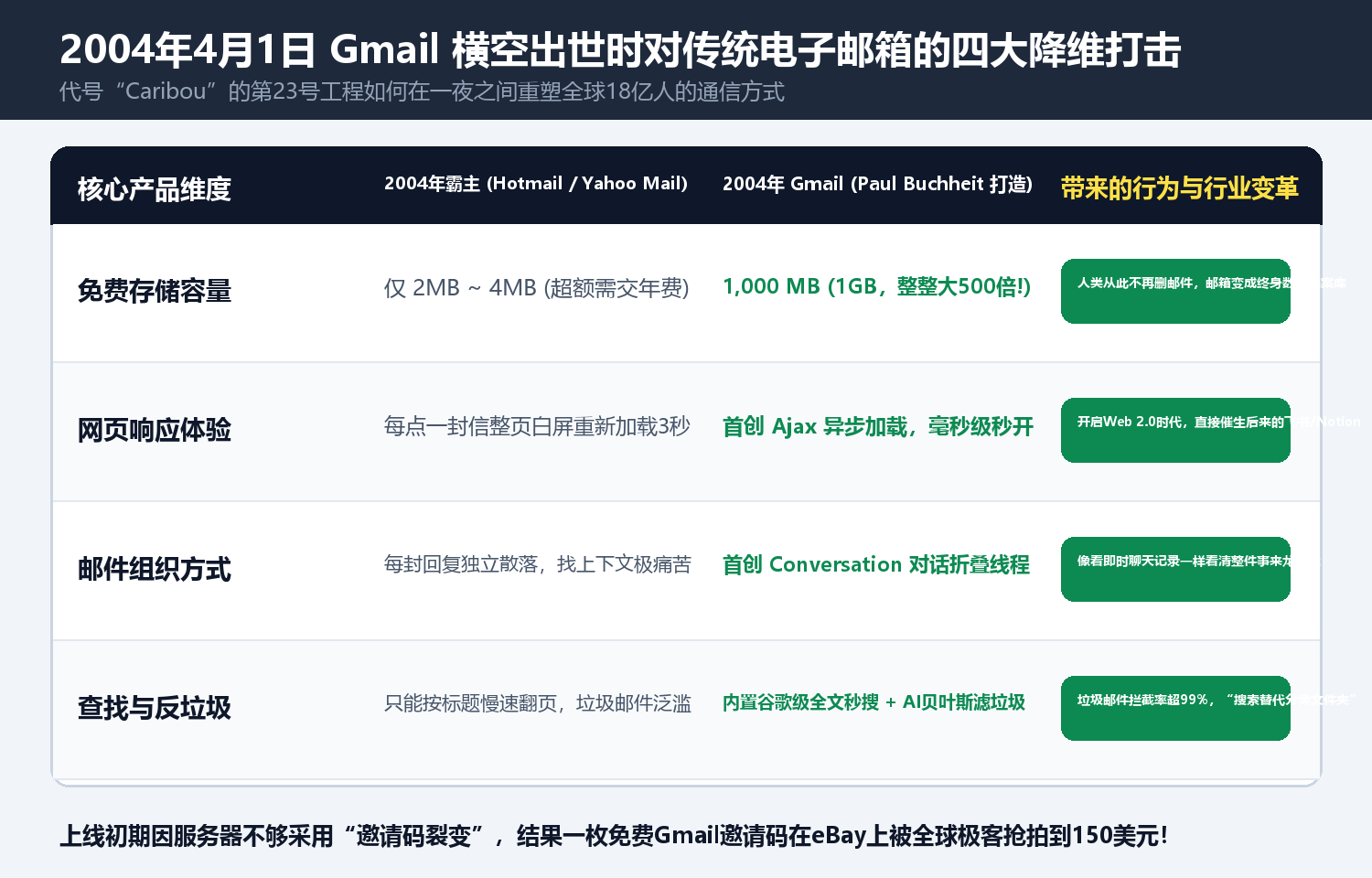
- Market leaders Microsoft Hotmail and Yahoo! Mail gave free users just 2 MB to 4 MB of total storage;
- Receiving two digital photos would fill your inbox, bouncing incoming messages and forcing you to spend 15 minutes every morning manually deleting old emails—or pay $29.99/year for a 10 MB upgrade.
By offering 500 times more storage for free, Google’s 23rd employee Paul Buchheit didn’t just build a better inbox—he permanently rewrote human digital behavior and launched the modern Web 2.0 application era. At #50 (OVR 85) on our 100 Greatest Products list, we examine Gmail’s three breakthroughs.

1. The 500x Capacity Leap: Replacing “Sort & Delete” with “Search & Archive”
Codenamed Project Caribou in August 2001, Gmail faced fierce internal skepticism inside Google. Buchheit realized that when users only had 2 MB of space, search was useless because they couldn’t keep more than a hundred messages.
By expanding storage 500-fold to 1 GB, Gmail eliminated the need to ever delete an email again—replacing tedious folder filing with instant Google full-text search and grouping scattered replies into clean Conversation Threads.
2. Pioneering AJAX: Proving the Browser Could Run Desktop-Grade Software
Before Gmail, every click in a webmail client triggered a full-page white-screen reload taking 3 seconds. Buchheit built Gmail on an asynchronous JavaScript architecture (later coined AJAX) that kept the entire interface alive in memory, responding to keyboard shortcuts (J/K) in milliseconds and paving the way for Google Docs, Figma, and Notion.
Combined with an Accidental Scarcity engine—where limited server capacity forced an invite-only rollout that saw free Gmail invites auctioned for $150 on eBay—Gmail grew into the undisputed global standard serving over 1.8 billion users.
Discussion