TAG

# Google

← All tags · 10 post(s)

2026-11-08

PM Rank #54 · Andy Rubin (86 OVR): Evicted and Broke at 41, He Gave Away His OS for Free and Put It in 3.5 Billion Pockets

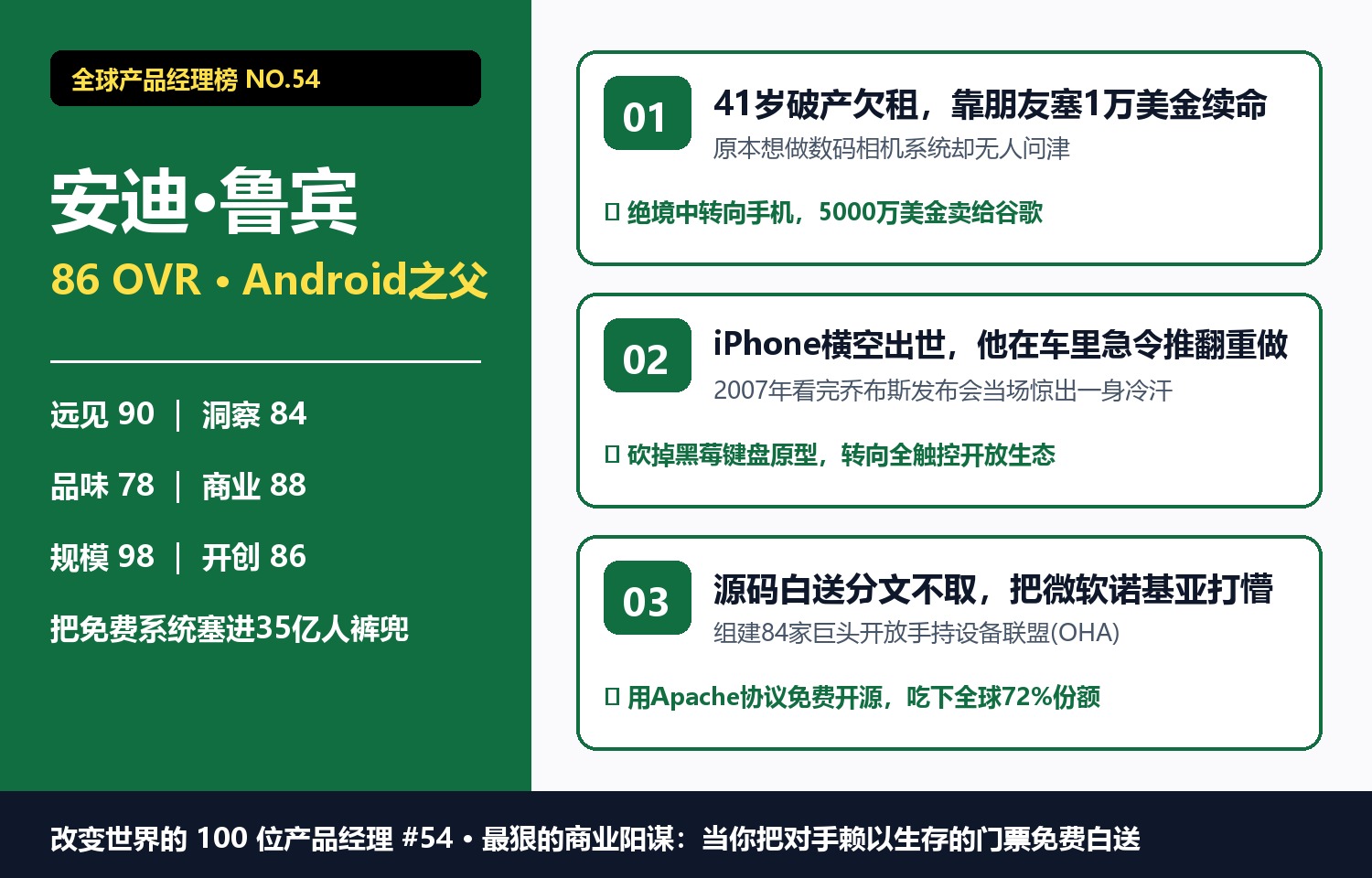
No. 54 on the 100 Greatest Product Managers ranking (86 OVR): Andy Rubin, Father of Android. In 2004, at age 41, Rubin went broke building a digital camera OS and needed a $10,000 cash loan from a friend just to avoid eviction. Faced with Apple's closed iPhone fortress, he weaponized free open-source distribution to unite the global handset industry and win 71% of the world's smartphones.

PM Rank #54 · Andy Rubin (86 OVR): Evicted and Broke at 41, He Gave Away His OS for Free and Put It in 3.5 Billion Pockets
2026-11-06

PM #52 · Marissa Mayer: Guarding the Most Valuable Blank Page on Earth with 41 Shades of Blue and Building Silicon Valley's APM Factory

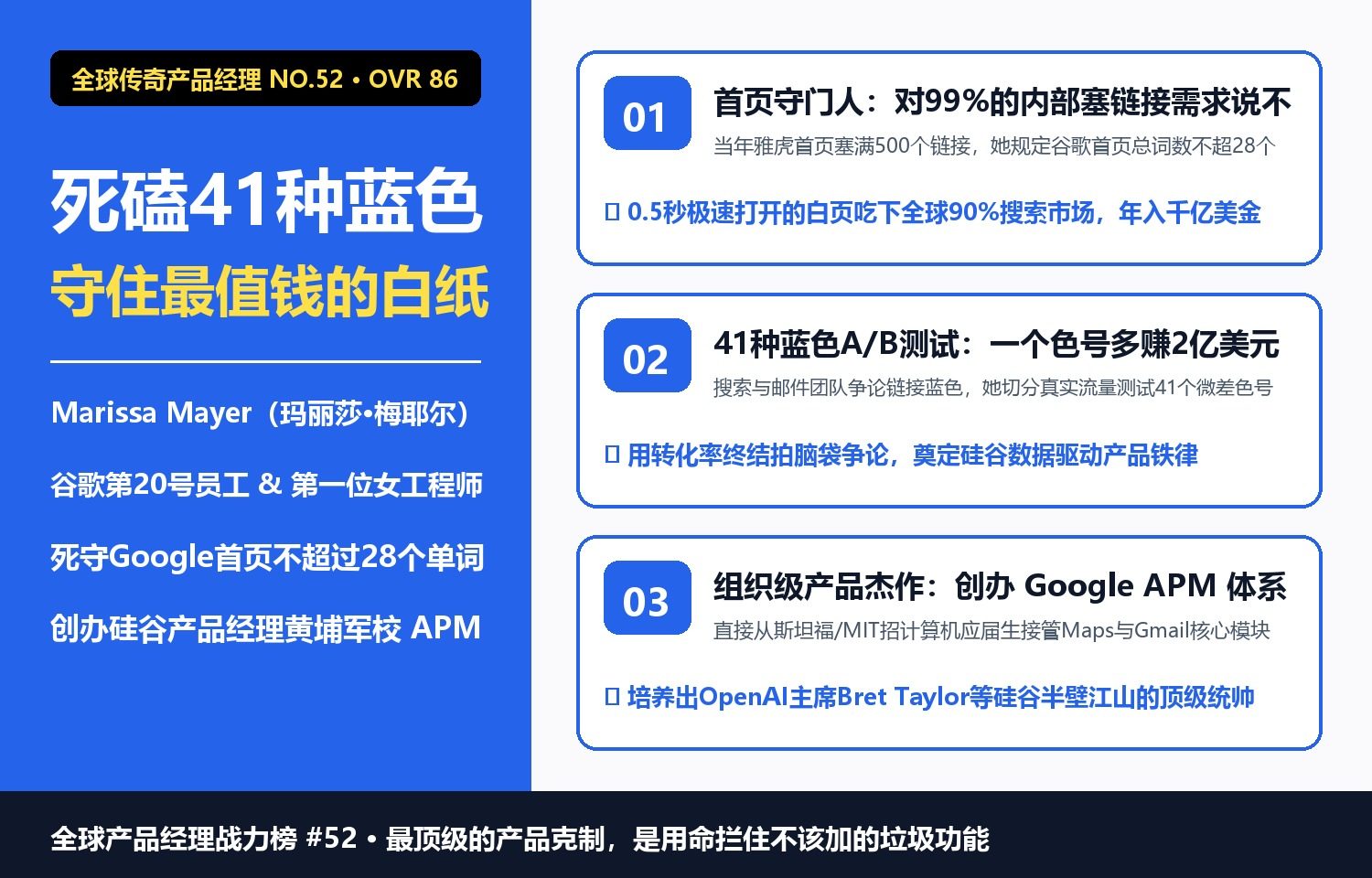
Global PM Top 100 #52 (86 OVR). As Google's 20th employee and first female engineer, Marissa Mayer ran Google Search, Gmail, and Maps for over a decade. She defended the minimalist Google homepage against every internal land-grab, pioneered hyper-rigorous A/B testing ('41 shades of blue'), and created the legendary Google Associate Product Manager (APM) program.

PM #52 · Marissa Mayer: Guarding the Most Valuable Blank Page on Earth with 41 Shades of Blue and Building Silicon Valley's APM Factory
2026-11-03

The 100 PMs Who Changed the World · #49 | Paul Buchheit: Everyone Thought His 1GB Free Inbox on April Fools' Day Was a Hoax

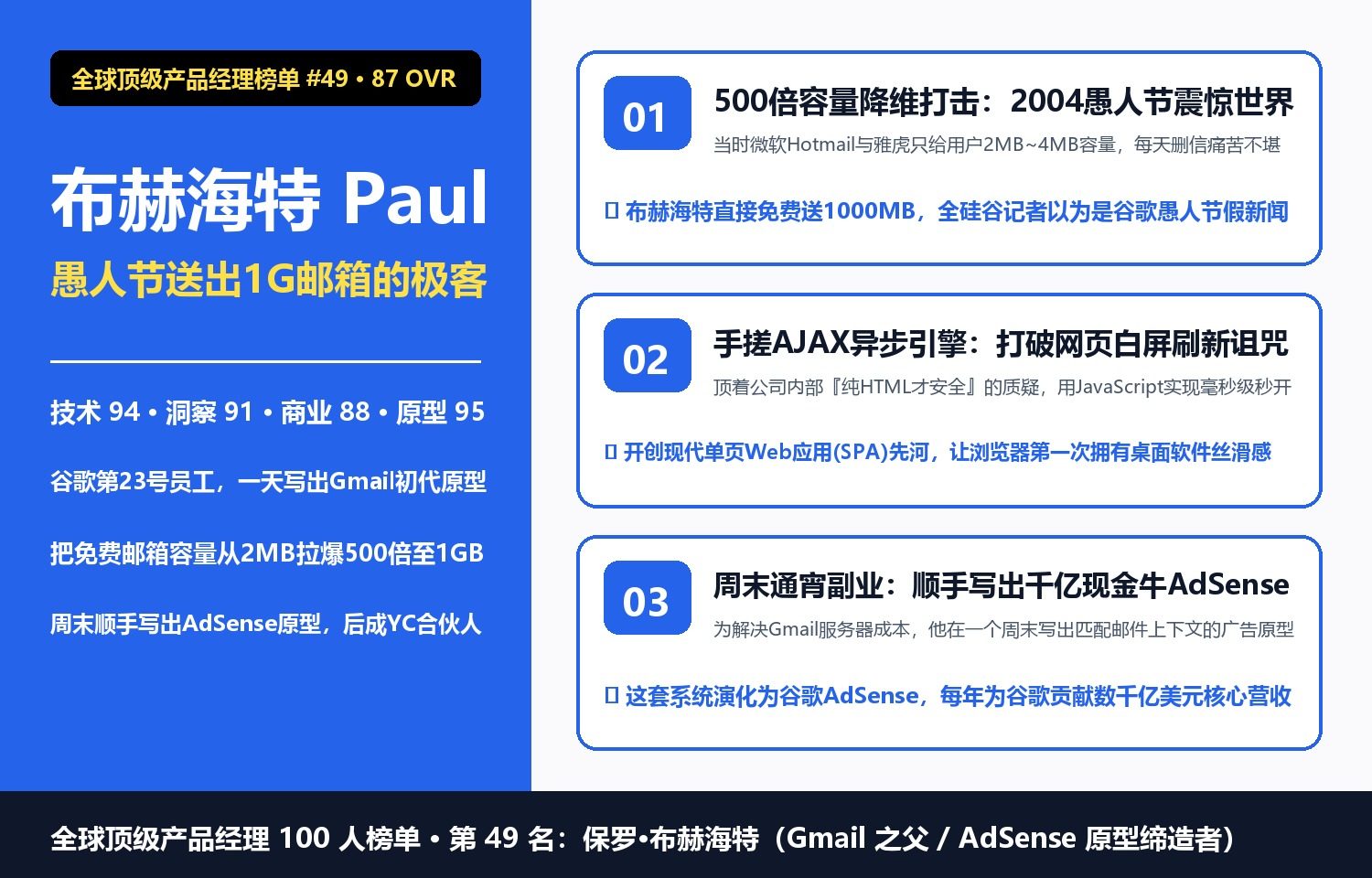
【World's Top 100 Product Managers #49 · 87 OVR】On April 1, 2004, when Microsoft Hotmail and Yahoo! Mail gave free users a measly 2MB to 4MB of storage—forcing people to delete emails daily—Google employee #23 Paul Buchheit dropped a bomb: 1,000 MB (1GB) of free storage, 500x the competition. The entire tech press assumed it was an April Fools' prank. Here is how Buchheit built the first Gmail prototype in a single day, pioneered Ajax web apps, coded the first AdSense prototype over a weekend, and coined 'Don't be evil.'

The 100 PMs Who Changed the World · #49 | Paul Buchheit: Everyone Thought His 1GB Free Inbox on April Fools' Day Was a Hoax
2026-11-01

Sundar Pichai (Chrome): From Toolbar PM to Google CEO—How 'Invisible Speed' Captured 70% of the Global Browser Market

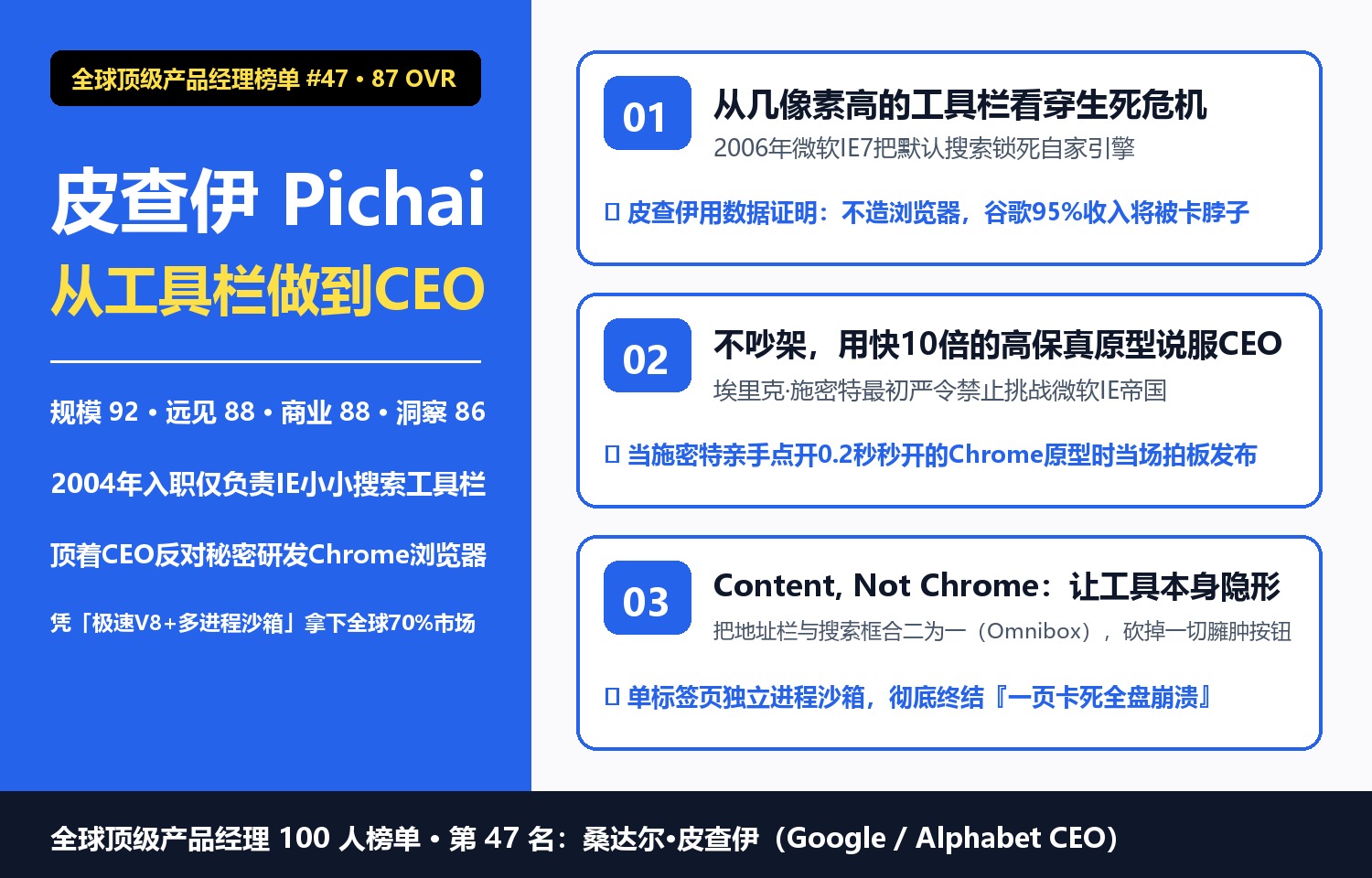
[Top 100 Product Managers · #47] When Sundar Pichai joined Google in 2004, he was a rank-and-file product manager overseeing the tiny Google Toolbar for Internet Explorer. When then-CEO Eric Schmidt fiercely opposed building a standalone browser—calling it a suicidal war against Microsoft—Pichai quietly led a small team to build Chrome with the V8 engine and multi-process sandboxing, defining the ultimate ceiling of the product manager career path.

Sundar Pichai (Chrome): From Toolbar PM to Google CEO—How 'Invisible Speed' Captured 70% of the Global Browser Market
2026-10-12

100 Products That Changed the World · #19: Google Maps

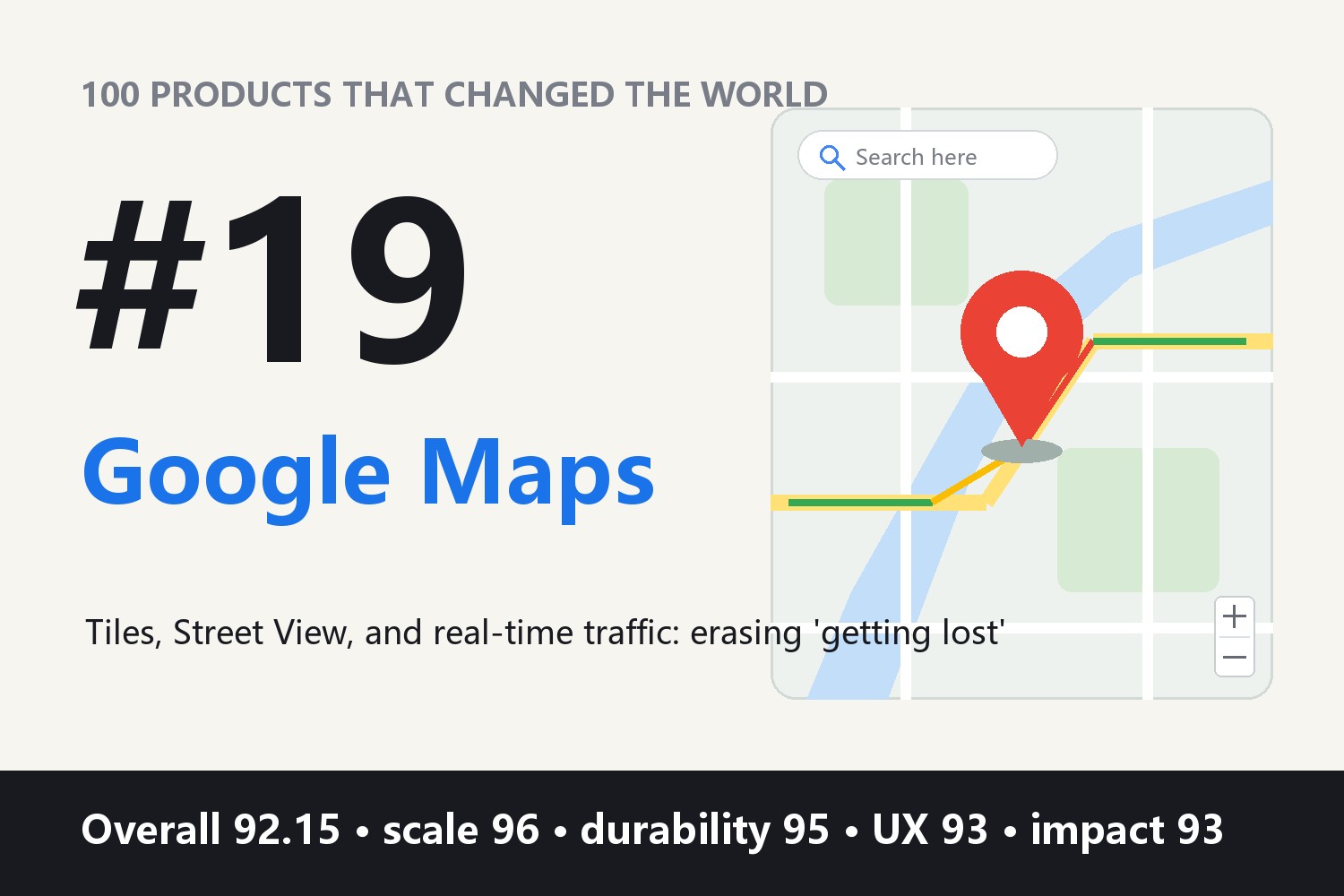
On February 8, 2005, Google Maps launched. With dynamic map tiles and asynchronous data fetching, it ended the era of MapQuest's blank-page reloads; with Street View fleets and hundreds of billions of ground-truth data points, it turned software into heavy physical infrastructure. #19 of 100 products that changed the world, overall 92.15, scale 96, durability 95, UX 93, impact 93, originality 88, business 88.
100 Products That Changed the World · #19: Google Maps
2026-10-07

100 Products That Changed the World · #15: Android

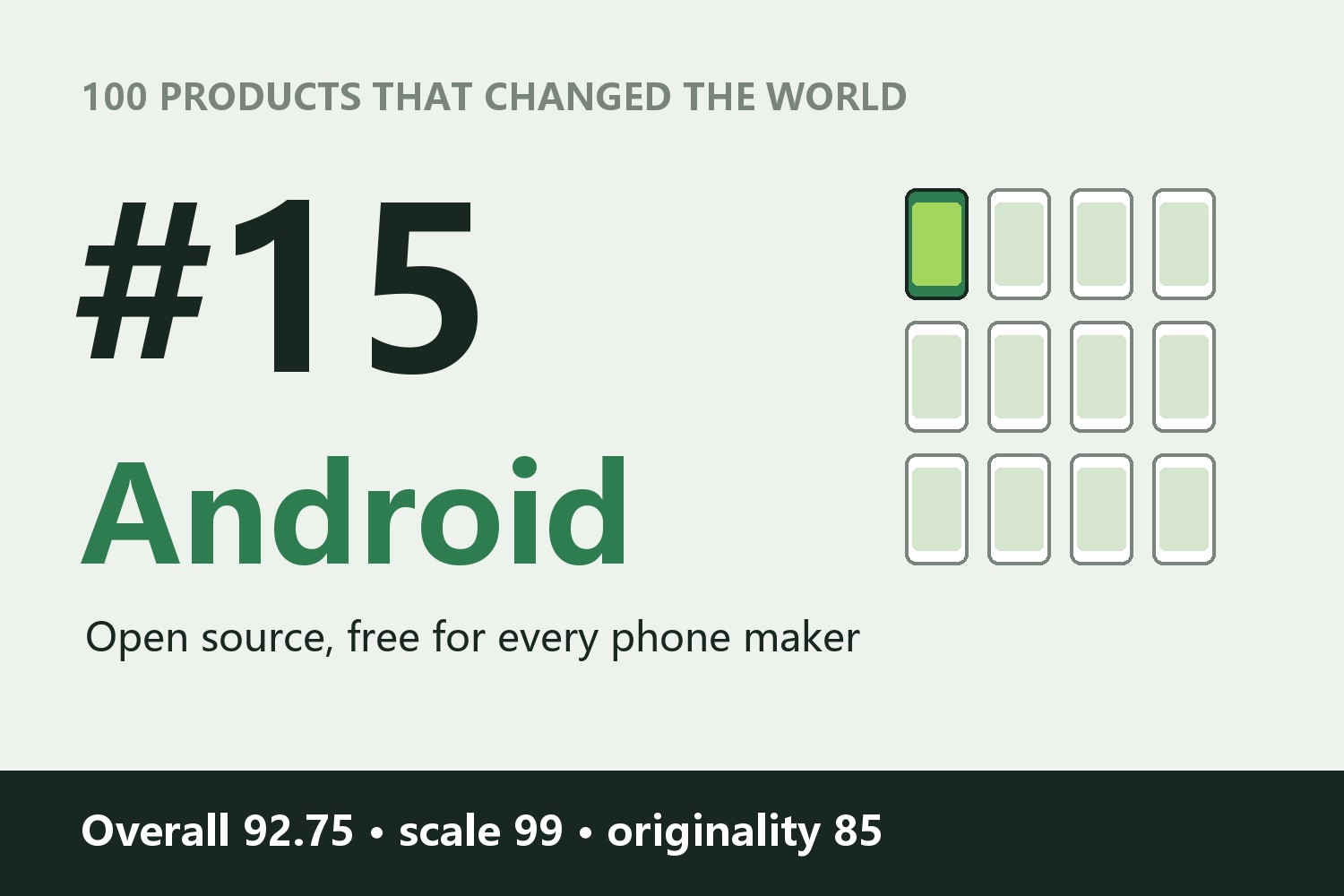
The first Android phone, the HTC Dream, was announced on September 23, 2008. Eighteen years later Android is on version 17. It got into billions of phones because of one product decision: open source, free for phone makers to use. Android ranks #15 overall at 92.75, with scale 99 its highest score and originality 85 its lowest.

100 Products That Changed the World · #15: Android
2026-09-02

Google Didn't Invent Search. It Bought the Ad Model in a Settlement

Second on my board is Google Search, at 97. But when it launched in September 1998, WebCrawler, Lycos, Infoseek, Excite and AltaVista were already running — and the paid-auction model that made it rich belonged to someone else. Overture sued for two years; the 2004 settlement cost Google 2.7 million shares. Neither of its two core pieces was original. It now holds 91.32% of global search.

Google Didn't Invent Search. It Bought the Ad Model in a Settlement
2026-08-10

They Organized the World's Information. Their Own Homepages Stopped in 1998 — and Still Say They're 'Currently Working on Google, a Search Engine for the Web'

On August 10, 2026, I pasted infolab.stanford.edu/~page/ and ~sergey/ into a terminal. Both returned 200. Page's is titled 'Lawrence or Larry Page's Page'; it lists him as a Ph.D. Student, office Gates 360, phone (650) 330-0100, and one line of body text: Currently working on Google, a search engine for the Web. Brin's says Currently I am at Google and In fall '98 I taught CS 349, with a paper co-authored with Page marked Work in progress. Twenty-eight years, not one edit. Meanwhile one of them is now at Google almost every day helping train Gemini, and the other crossed $300 billion in net worth on April 30 this year and went off to do AI manufacturing. This piece is about the thing product managers most reliably overestimate: how they describe a project on the day it starts.

They Organized the World's Information. Their Own Homepages Stopped in 1998 — and Still Say They're 'Currently Working on Google, a Search Engine for the Web'
2026-08-06

AlphaGo's Demis Hassabis Steps Back From Running DeepMind Day-to-Day — and Google's Chief Scientist Walks Out the Same Day With Three Others

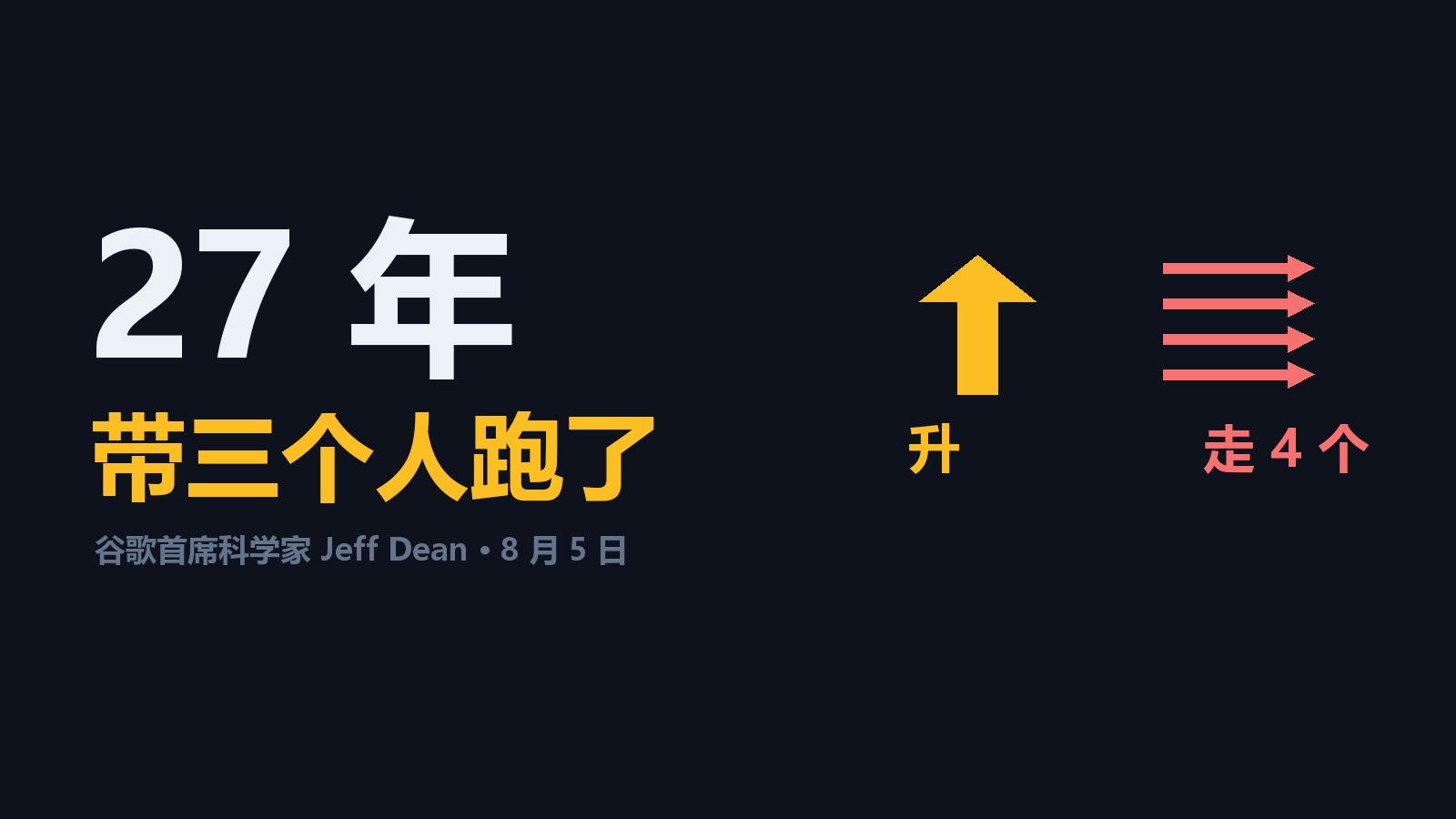
On August 5 Google announced that Demis Hassabis is becoming chair of Google DeepMind and handing off day-to-day operations. Alphabet fell more than 5%. Everyone talked about that. The same day carried another item almost nobody looked at closely: Jeff Dean, Google's chief scientist and 27-year veteran, left to start a company — taking Sanjay Ghemawat, Quoc Le and Oriol Vinyals with him. Sanjay's name means little to most readers, yet he and Dean are the only two level 11 Senior Fellows Google has had in twenty-odd years, and they spent those years writing code hunched over the same computer. What Dean built in 27 years was all foundation: search index scaled 100×, Google's first ads system, MapReduce, BigTable, Spanner, TensorFlow, the TPU program. That operating system assumes you have time to build foundations — and Google just moved the clock forward. Stranger still: Google didn't push him out. It invested in his new company and wants to sell him cloud.

AlphaGo's Demis Hassabis Steps Back From Running DeepMind Day-to-Day — and Google's Chief Scientist Walks Out the Same Day With Three Others
2026-08-05

Why Is Google Guaranteeing $43.8B of Other People's Data Center Rent? TPU Operators Borrow at 7.1%, Nvidia's at 9.3%

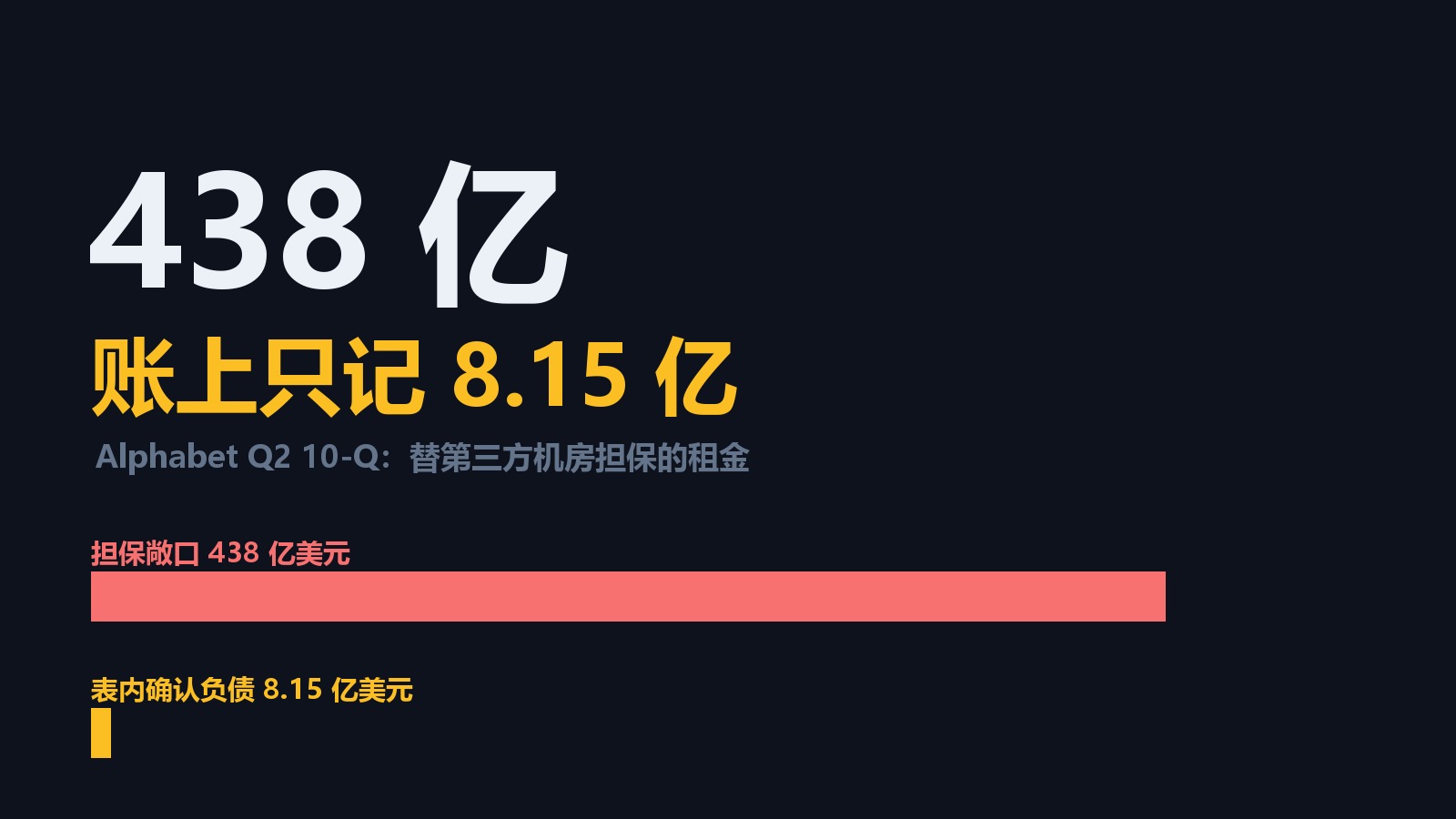
There's a number in Alphabet's Q2 2026 10-Q: as of June 30, Google had committed to cover up to $43.8 billion in third-party data center lease payments if tenants default. Nine months earlier that figure was $6.5 billion — a sevenfold increase. None of those data centers are Google's. What the guarantee buys is very concrete: with Alphabet standing behind them, operators running Google TPUs borrow at 7.1% while comparable projects in Nvidia's ecosystem pay 9.3% — a structural 2.2-point gap. At the other end of the chain sits Anthropic: run-rate revenue just past $30 billion, up from about $9 billion at the end of 2025, but with no credit rating and no way to borrow at this scale on its own. In between stand Morgan Stanley's Compute SPV, Broadcom as residual-value guarantor, and crypto miners supplying grid power. This piece takes apart how the machine works, why Google would rather keep $43.8B of exposure off its balance sheet, and the path the risk travels back.

Why Is Google Guaranteeing $43.8B of Other People's Data Center Rent? TPU Operators Borrow at 7.1%, Nvidia's at 9.3%