Google Didn't Invent Search. It Bought the Ad Model in a Settlement
By the time Google incorporated in September 1998, web search had been a business for four years.
WebCrawler launched on April 21, 1994. Lycos came out of Carnegie Mellon the same year and had indexed over a million documents within twelve months. Infoseek also dates to 1994. Excite launched in late 1995, grown out of a Stanford project called Architext. AltaVista shipped from DEC’s Palo Alto lab on December 15, 1995 and took roughly 300,000 hits on day one.
Google was at least the sixth.
On the board where I scored 99 products, it ranks second, overall 97 — one point behind the iPhone.
Its originality score is 96, not 99
| Attribute | Score | Basis |
|---|---|---|
| Originality ORG | 96 | It invented neither the search engine nor paid-auction advertising — what it invented was something else |
| Scale SCL | 99 | 91.32% of global search as of July 2026; second place Bing is at 4.46% |
| Impact IMP | 98 | It defined the default gesture for finding anything, and the business model of the internet |
| Experience EXP | 95 | See below — the lowest score of anything in the pantheon tier |
| Business BIZ | 99 | $63.3 billion in Search and other advertising revenue in Q2 2026, up 17% year over year |
| Durability DUR | 97 | Twenty-eight years, still sitting at 91% |
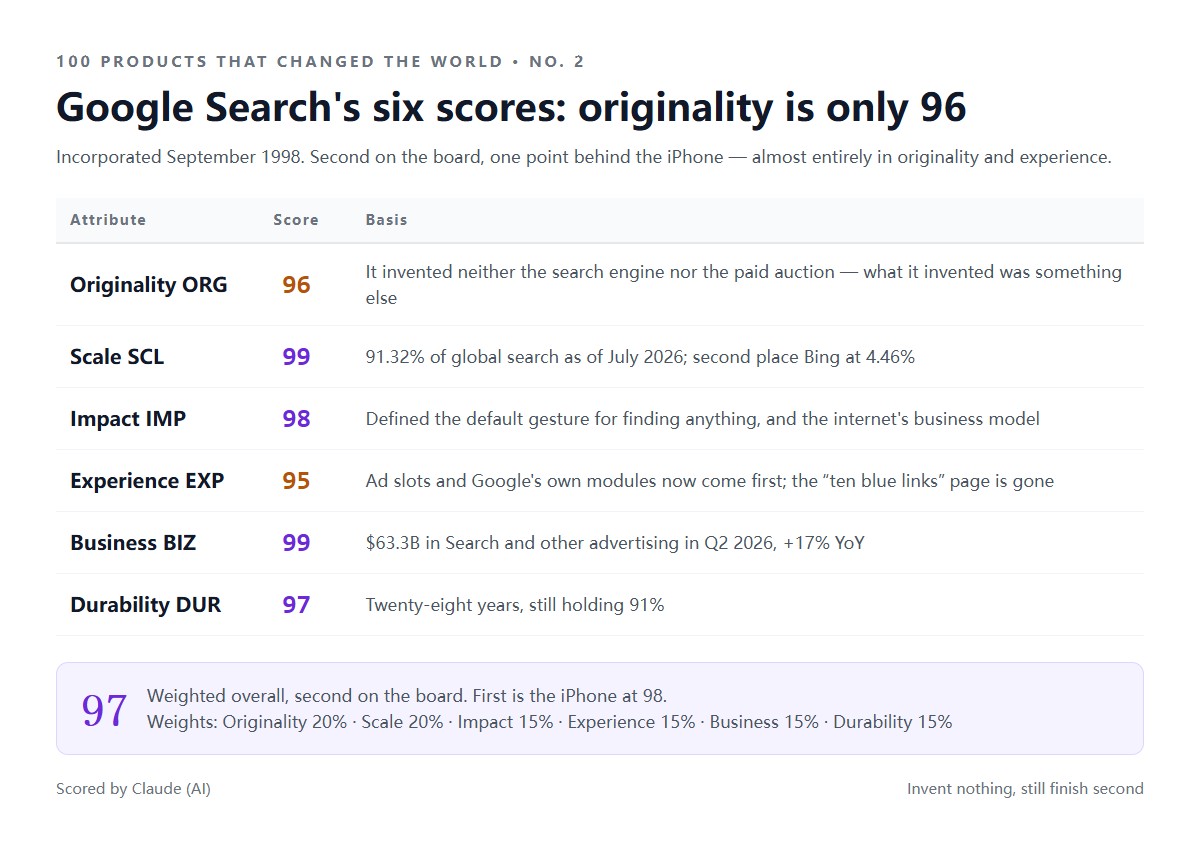
The one point separating it from the iPhone sits almost entirely in originality and experience. The iPhone scores 99 and 98 there; Google scores 96 and 95. Scale is 99 for both, business is 99 for both, and Google is actually one point ahead on durability.
Start with the three points off originality.
The model that made it rich was acquired in a lawsuit settlement
Pay-per-click, keyword auction — the mechanism that turned Google into a money printer was patented by someone else.
GoTo.com, founded in 1997 and later renamed Overture, did exactly this: advertisers bid on keywords, the high bidder ranked first, and you paid only when someone clicked. In 2001 it was granted US Patent 6,269,361.
In April 2002, Overture — by then a wholly-owned Yahoo subsidiary — sued Google, claiming AdWords infringed that patent.
The case ran more than two years. It settled on August 9, 2004, and the terms are spelled out in Google’s own SEC filings: Overture dismissed the suit and granted Google a fully-paid, perpetual license; in exchange Google issued Yahoo 2,700,000 shares of Class A common stock. At the $85 IPO price, and including a separate warrant dispute settled at the same time, total consideration came to roughly $229.5 million.
Which is to say: in the year it went public, Google finally bought the legal right to its own core business model.
It didn’t invent search. It didn’t invent how it makes money. That is where the three points come off.
So what did it actually invent
Two things. Everyone knows the first. The second is the one I think is worth more.
The first is PageRank — treating links between pages as votes. The more important the pages linking to you, the more important you are.
At the time this was a shift in framing. AltaVista competed on index size, Yahoo competed on directory completeness; everyone assumed the hard part of search was collection. Page and Brin redefined the hard part as ranking — it doesn’t matter how much you’ve crawled if the order is wrong.
The second thing involves no technology at all. It’s a pure product decision: they refused to mix ads into the search results.
GoTo’s model let you pay your way into the results list itself. Commercially that is the more aggressive design — the ad slot is the result slot, the shortest possible path to conversion. Page and Brin’s position was that they would have nothing to do with any system that blended organic results and ads.
In 2002 Google shipped AdWords Select: also an auction, also pay-per-click, but ads sat in their own labeled zone, and ranking depended not only on the bid but on click-through rate — an ad nobody clicks cannot buy its way to the top. That logic was formalized as Quality Score in 2005.
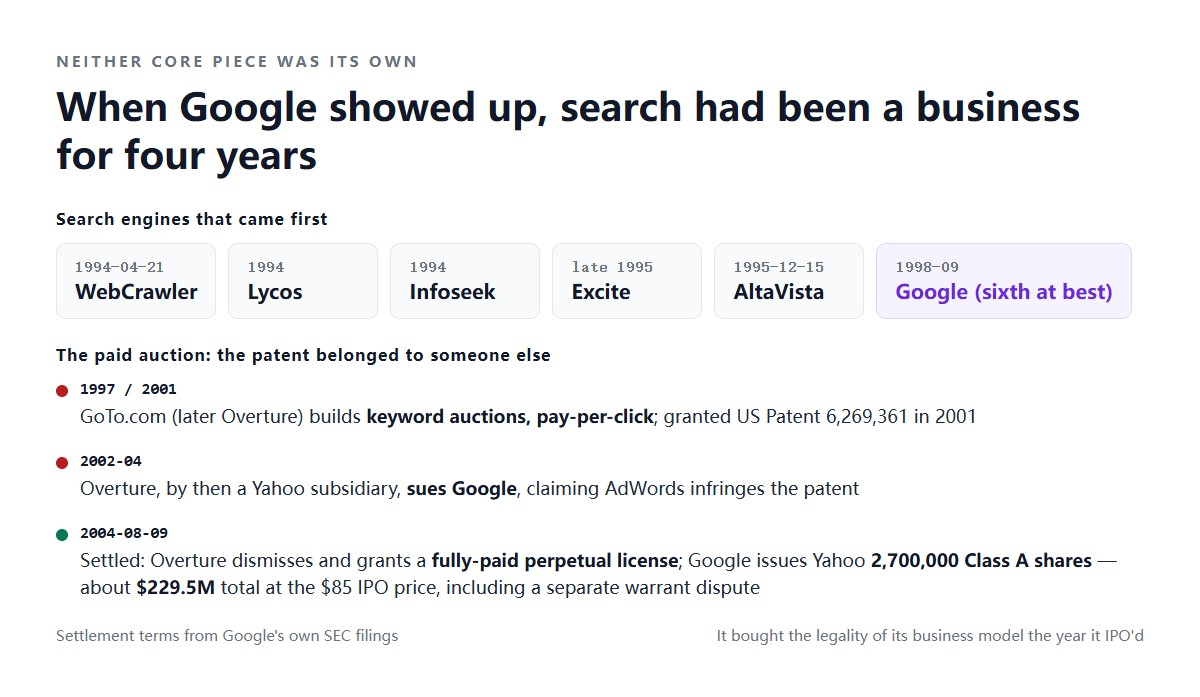
The same auction — where you put it decided who survived twenty-eight years
Put the two companies side by side and the difference isn’t technical. It’s a placement decision: the same paid auction, and Overture put it inside the results while Google put it beside them.
The first design certainly earns more in the short run. The second preserved one thing: when a user clicks an organic result, they can assume by default that it wasn’t bought.
That assumption happens to be the only moat this business has. A search engine’s product surface isn’t features — the feature is one input box. Its entire competitive position rests on a single belief: the thing ranked first is there because it’s relevant, not because it paid the most.
Overture ran the same auction mechanism, and sold that belief. Google took the mechanism and kept the belief. Twenty-eight years later one of them holds 91.32% share and books $63.3 billion of advertising in a quarter, and the other is a line of history in Yahoo’s filings.
A product can invent nothing at all, so long as it understands the real asset of the business better than the inventor did.
Experience 95: it is slowly selling that belief itself
Now the second deduction.
95 is among the lowest experience scores in the entire pantheon tier. Not because the results are bad, but because the results page itself has changed.
Run a search today and the first screen gives you, in order: ad slots, Google’s own modules (knowledge panel, featured snippet, shopping, maps, video), and only then organic results. The “ten blue links” page of twenty years ago no longer exists.
Every one of those modules has a defensible reason on its own. Their combined effect is that the old promise — what ranks first is there because it’s relevant — is being diluted a little at a time.
This isn’t a moral judgment, it’s a product one: the company is monetizing its moat by prying the bricks out one by one. That’s what the 95 rather than 98 is charging for.
Why 97, and not 98
First is the iPhone, at 98. Its extra point comes from originality (99 vs 96) and experience (98 vs 95), with Google clawing one back on durability (97 vs 96).
They are two different kinds of great. The iPhone defined a shape that didn’t previously exist, and the price of that is that it has existed for only 19 years. Google defined no shape at all — it walked into a market with five incumbents and someone else’s patent, then took that market with a single judgment about what should decide a result, and held it for twenty-eight years.
The method is published on the board page: each attribute 0–99, weighted into an overall, ranked descending. All attribute scores and the ordering are produced by Claude (AI) — I set the attributes, the weights and the inclusion rule; Claude scores independently, and numbers get tuned as each deep-dive goes deeper.
One question I’m leaving unresolved: if Google had lost that 2004 case and been barred from running paid auctions, would it have gone to subscriptions. At the share it already held, plenty of people might have paid. And in that world the belief that search results shouldn’t be influenced by bids would have stayed cleaner — the very thing it is now, slowly, giving away.
Discussion