Steam: How a Forced Updater That Players Hated for Five Years Became the Cash Register and Shelf of PC Gaming
Today, when an indie developer finishes a game and wants to sell it worldwide, the first step is rarely a publisher or a retail deal. It is a store page on Steam.
But when Steam launched in September 2003, almost no player wanted it.
It wasn’t a store, and it didn’t look like a platform in the making. It was an updater you were forced to install: if you wanted to keep playing Counter-Strike, you had to install it first, and then it crashed, failed to log in, and downloaded slowly. Forum threads cursing it outnumbered the ones praising it.
It was a product users complained about for roughly five years, and it ended up as the cash register and shelf of the whole PC gaming industry.
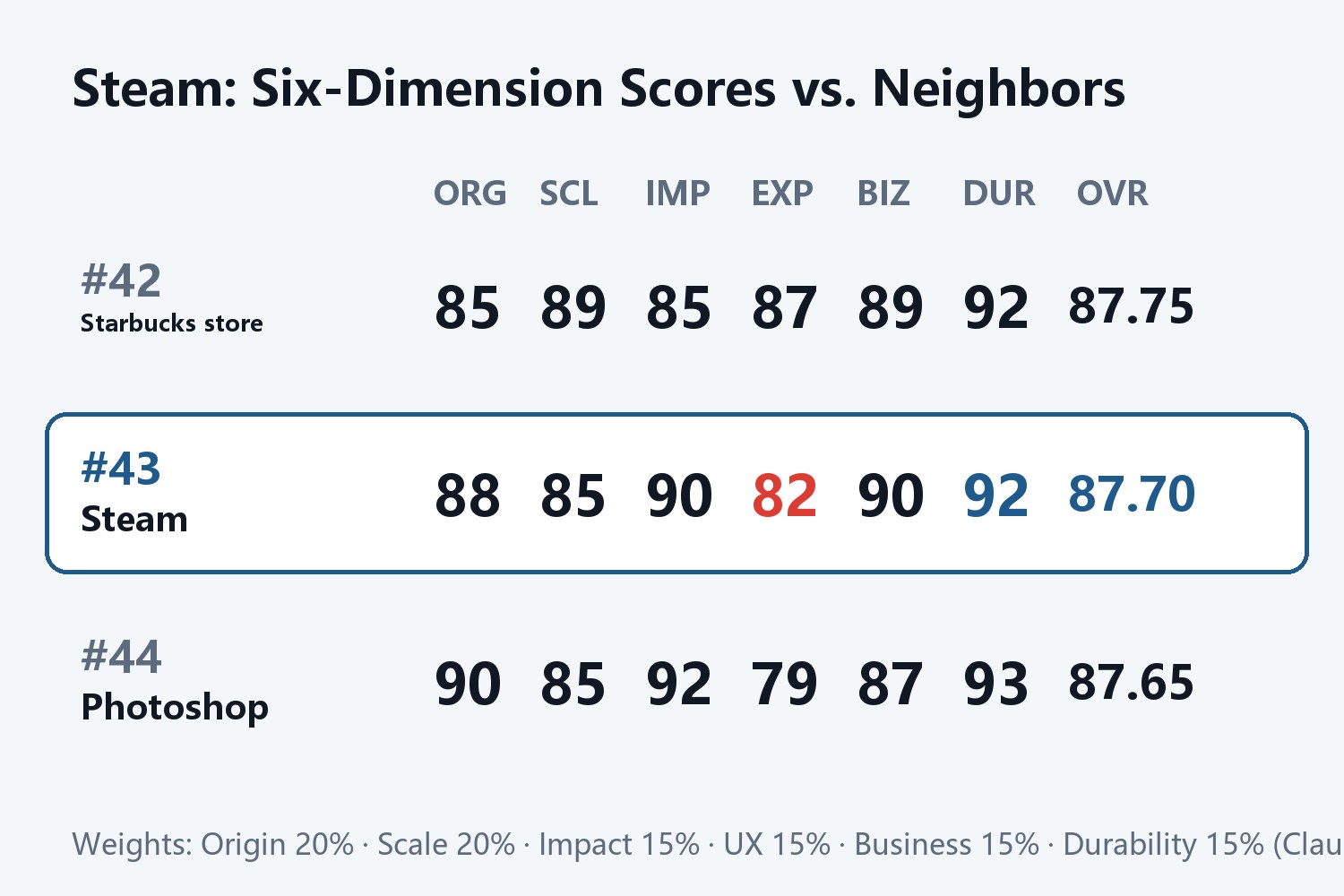
In our 100 Products That Changed the World ranking, Steam stands at #43 with an overall score of 87.70 (scored by Claude AI under our unified six-dimension framework): 92 in Durability, 90 in Impact, 90 in Business, 88 in Originality, 85 in Scale, and 82 in Experience.
Editor’s note: this piece was planned as “#30”. After checking the real sorted order (descending by unrounded weighted score), Steam’s actual rank is #43, and this article uses the real rank.
1. From Patcher to Platform: A Product Born to Update
To understand Steam, go back to PC gaming in the early 2000s. Online games had a very concrete pain point: patches. In multiplayer games like Counter-Strike, if client and server versions didn’t match you couldn’t join a room, so players hunted for patches on various websites, downloaded them, and installed them by hand. Friends would be ready to play and stuck on a version mismatch.
Valve was founded in 1996 by two former Microsoft employees, one of whom was Gabe Newell, later the company’s public face. Half-Life, released in 1998, made their name, and Counter-Strike, originally a community-made Half-Life mod, became one of the most popular online shooters in the world under their roof.
Valve’s logic was simple: if patching is the lifeline of online games, build a client that updates itself. In September 2003, Steam shipped alongside Counter-Strike and players had to install it.
It was a classic “solve your own problem first” product: its first real user was Valve itself, which wanted version sync, anti-cheat, and identity under its own control.
For players, though, it was an enforced experience: you bought a game and were told to install another program, create an account, and stay online—at a time when broadband was far from universal. It felt almost insulting.
2. Half-Life 2: An All-In Forced Bundle
Steam’s real turning point was November 2004, when Half-Life 2 launched.
It was one of the most anticipated sequels in the world, and Valve made a bold call: whether you bought a boxed disc at retail or bought online, you had to activate through Steam to play.
The backlash was fierce: a disc in the box that you can’t just play? If the activation servers had trouble, people who paid couldn’t get in. Players’ anger focused there, not on the game itself.
Strategically, though, it gave Steam millions of installs overnight. To play the most important game of the year you needed Steam, and once installed, your account, library, and friends list began to accumulate.
In the following years Valve moved its own games onto Steam, then invited third-party developers. The first third-party games arrived around 2005, and the client began shifting from “Valve’s updater” to “a store where others can sell too.”
A very typical product evolution:
| Stage | What players saw | What was actually accumulating |
|---|---|---|
| 2003 | An updater forced on me | Accounts, version sync, anti-cheat |
| 2004 | A gate for Half-Life 2 | An install base in the millions |
| 2005 onward | Third-party games appear | Content suppliers and payment rails |
| Following years | Sales, community, cloud saves, Workshop | A full distribution, operations, and revenue-sharing ecosystem |
No single step looked like “building a platform,” yet each one laid the groundwork for the next.
3. The Real Moat: Not a Store but a Flywheel
If Steam were just a download site, it would have been cloned quickly. It’s hard to dislodge because it binds several things into a self-reinforcing flywheel.
1. Digital distribution removed the middle layers. Before Steam, a PC game had to pass through publishers, logistics, and retail shelves, leaving developers a limited share. Steam compressed this to developer—platform—player, with a publicly known revenue split (the industry long knew it as 70/30), letting small teams reach global players directly.
2. Discounts became a culture. Steam’s seasonal sales made “wishlist now, buy on sale” a common habit. For players it means ever-growing libraries and the “bought but never played” joke; for the platform it means accounts that hold more and more assets, with ever higher switching costs.
3. The library is the heaviest lock. The dozens or hundreds of games you bought on Steam launch only inside Steam. Switching platforms isn’t switching stores; it’s abandoning your entire library. This is Steam’s sturdiest and quietest moat.
4. Community and tools turn users into co-builders. Friends, reviews, the Workshop, cloud saves, streaming, and controller support—none is astonishing alone, but stacked together they make Steam not just a place to buy but a place players spend time.
5. Developer barriers kept coming down. From community voting in Greenlight (2012) to Steam Direct (2017), where developers pay a listing fee, Steam moved the “who gets listed” decision out of a few editors’ hands. That fed a golden age of indie games, and also brought a flood of content and discovery problems.
Behind this flywheel is a clear philosophy that Newell has voiced publicly many times: the most effective answer to piracy isn’t a tighter lock but better service. When legitimate downloads are fast, updates are convenient, and the community is lively, players have little reason to look elsewhere. For more on his product thinking, see our profile: Gabe Newell (#38 among product managers).
4. Three Real Tests
Whether a platform deserves the word “infrastructure” depends on how it behaves under pressure. Steam faced at least three:
- The early years of player anger. Unstable servers, failed logins, forced connectivity—real experience debt. Valve chose not to retreat but to keep patching, until the “complaints” slowly turned into “habit” and then “dependence.”
- A frontal assault. In late 2018 the Epic Games Store went after developers and players with a lower revenue cut and timed exclusives. Steam didn’t collapse; players’ libraries, friends, and communities remained the strongest glue.
- From software to hardware. In February 2022 Valve released the Steam Deck handheld, bringing the Steam library to a portable device and pushing the Proton compatibility layer for running Windows games on Linux. This stretched the platform’s boundary beyond the PC.
Steam also entered the Chinese market: besides the international version there is a China edition with a local partner, showing its reach has long extended beyond its original Western core audience.
5. Why Steam Ranks #43 (OVR 87.70)
In our 100 Products That Changed the World framework, Steam’s scores are:
- Durability 92: more than twenty years on, it hasn’t been replaced and remains the central distribution channel of PC gaming—its highest score;
- Impact 90 & Business 90: it redefined how PC games are distributed and gave a modestly sized company a very stable platform revenue stream;
- Originality 88: digital distribution wasn’t Valve’s invention, but growing an updater into a platform and using library and community as stickiness is Steam’s own evolutionary path;
- Scale 85: its reach is mainly PC gamers, a specific population, smaller than mass-market products like the smartphone or search;
- Experience 82 (the drag): forced connectivity, sprawling store discovery, a once-criticized client design, and the “bought a pile, never launched them” backlog anxiety keep its experience score well behind its business score.
Altogether its raw score of 87.70 lands it at #43, between #42 Starbucks Store (87.75) and #44 Photoshop (87.65)—all within 0.1 points.
A small tool born to spare players from hunting patches by hand was hated for five years and became an industry’s underlying infrastructure. Steam’s best product story is one of being disliked first and becoming indispensable later.
See Steam’s live ranking on our board: 100 Products That Changed the World (#43 · Steam), and an earlier platform-ecosystem case: Taobao (#28).
Discussion