Sundar Pichai (Chrome): From Toolbar PM to Google CEO—How 'Invisible Speed' Captured 70% of the Global Browser Market
In Silicon Valley history, the CEOs of trillion-dollar tech giants almost always come from one of two molds: the original technical founders (Jobs, Bezos, Zuckerberg) or hard-nosed sales and operations executives (Ballmer, Cook).
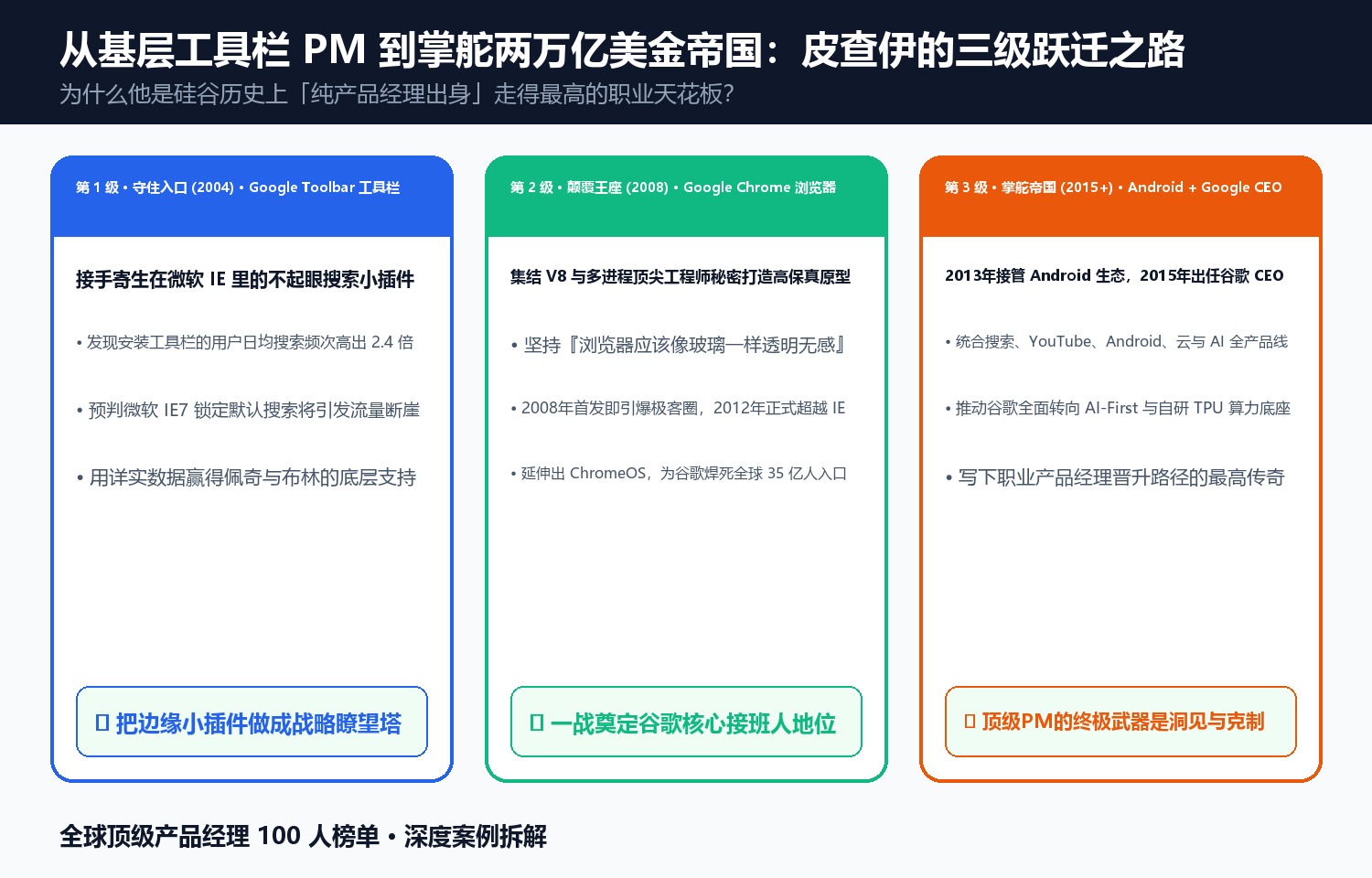
Only one leader embodies the ultimate ceiling of the Product Manager (PM) career path: he was not a co-founder, nor did he arrive as an executive. When he joined Google on April Fool’s Day in 2004, his first job was managing a tiny browser add-on—the Google Toolbar for Microsoft Internet Explorer.
Yet within 11 years, by spearheading a project that Google’s own CEO initially forbade—Google Chrome—he toppled Microsoft’s 90%-market-share Internet Explorer monopoly, took charge of Android, ChromeOS, and Google Workspace, and ascended to CEO of Google and Alphabet.
He is Sundar Pichai. On the Top 100 Product Managers Ranking, Pichai stands at No. 47 (Overall OVR 87: Scale 92 / Vision 88 / Business 88 / Insight 86 / Taste 86 / Originality 80). Here is how a toolbar PM used hard data and a 10x prototype to reverse a boardroom veto and reshape how 3.5 billion people access the web.
1. The 2006 Existential Crisis Hidden Inside a Tiny Toolbar
In 2004, over 85% of the world’s PC users accessed the internet through the blue “e” icon on their desktop: Microsoft Internet Explorer 6. To save users from typing google.com, Pichai’s team maintained a small search bar plugin that sat inside IE.
Where an average PM would simply optimize button clicks, Pichai spotted an existential threat to Google’s entire business model:
- In 2006, Microsoft prepared to ship Internet Explorer 7 with a built-in search box hardwired by default to Microsoft’s own search engine;
- Pichai pulled the global telemetry and proved two decisive facts to co-founders Larry Page and Sergey Brin: users with the Google Toolbar searched 2.4x more often than those without it, and leaving Google’s primary distribution channel inside Microsoft’s browser meant Microsoft could choke off Google’s ad revenue with a single Windows update.
Yet CEO Eric Schmidt—scarred by watching Microsoft crush Netscape in the 1990s—flatly vetoed building a browser: “The last thing Google needs is to fight a bruising, unwinnable browser war against Microsoft.”
2. Speaking with a Working Prototype: Omnibox, Multi-Process Sandboxing, and V8
Instead of arguing in slide decks, Pichai worked with engineers Ben Goodger, Darin Fisher, and Danish virtual-machine wizard Lars Bak to build a working prototype around three radical product principles:
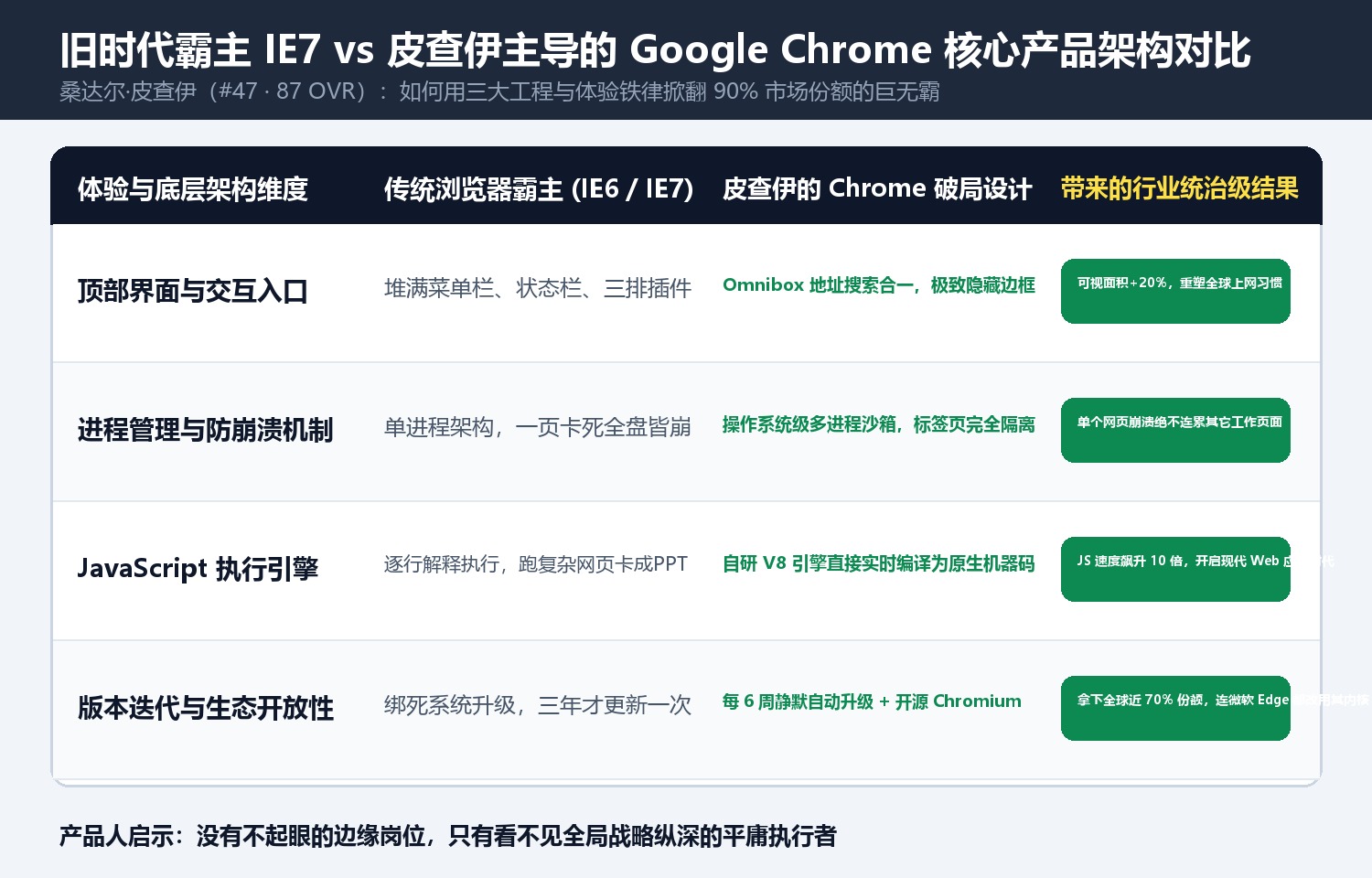
| Legacy Browser Flaw (IE6 / IE7) | Pichai’s Three Chrome Product Laws | Real User Impact |
|---|---|---|
| Bloated UI: Rows of menus, toolbars, and status bars eating 25% of the screen | ”Content, Not Chrome”: Merge URL bar and search into a single Omnibox; strip away visual clutter | 20% more screen real estate; instant search from the address bar |
| Single-Process Crashes: One frozen tab killed the entire browser and wiped unsaved work | OS-Level Multi-Process Sandbox: Every tab runs in its own isolated OS process | One rogue webpage crashes into a “Sad Tab” without touching your other 20 open tabs |
| Sluggish JavaScript: Interpreted line-by-line, choking on complex web apps like Gmail | V8 JavaScript Engine: Compiles JS directly into native machine code (JIT) | 10x faster JavaScript execution, turning the browser from a document viewer into an application OS |
When Schmidt finally tested the prototype on his own machine and watched complex web apps load in 200 milliseconds, he reversed his veto on the spot. Launched on September 2, 2008, Chrome overtook IE by 2012 and now commands nearly 70% of global browser usage.
3. Three Product Lessons from Sundar Pichai
- Find Strategic Leverage in Unsexy Roles: Pichai turned a humble toolbar maintenance job into the strategic thesis that saved Google’s core search moat.
- The Best Tool Disappears: Ironically named after the decorative frame (“chrome”) of a window, Chrome won by making the browser frame practically invisible so users could focus 100% on web applications.
- A 10x Runnable Prototype Beats Every Boardroom Debate: Don’t argue over hypotheticals—build the high-fidelity prototype and let speed speak for itself.
Discussion