When Robotaxis and Autonomous Trucks Flood the Streets: Where Do 30 Million Drivers Go, and Why Every Autonomous Wheel Must Pay a Universal Dividend
Late last Friday night, I hailed a fully driverless robotaxi outside an industrial park.
The car glided to the curb with an empty driver’s seat, the steering wheel turning smoothly on its own. For a 14-kilometer ride, the fare came out to just $1.90—less than half the price of a regular ride-share.
From the perspective of a passenger’s wallet or a tech giant’s income statement, it looks like an unvarnished triumph of engineering.
Yet as I stepped out and saw a long line of human-driven ride-share cars waiting anxiously at the intersection, a chilling macroeconomic question hit me: For the past twenty years, whenever factories automated or white-collar offices downsized, driving a ride-share car, hauling freight, or delivering packages served as society’s ultimate employment shock absorber. What happens when the steering wheel itself no longer needs human hands?

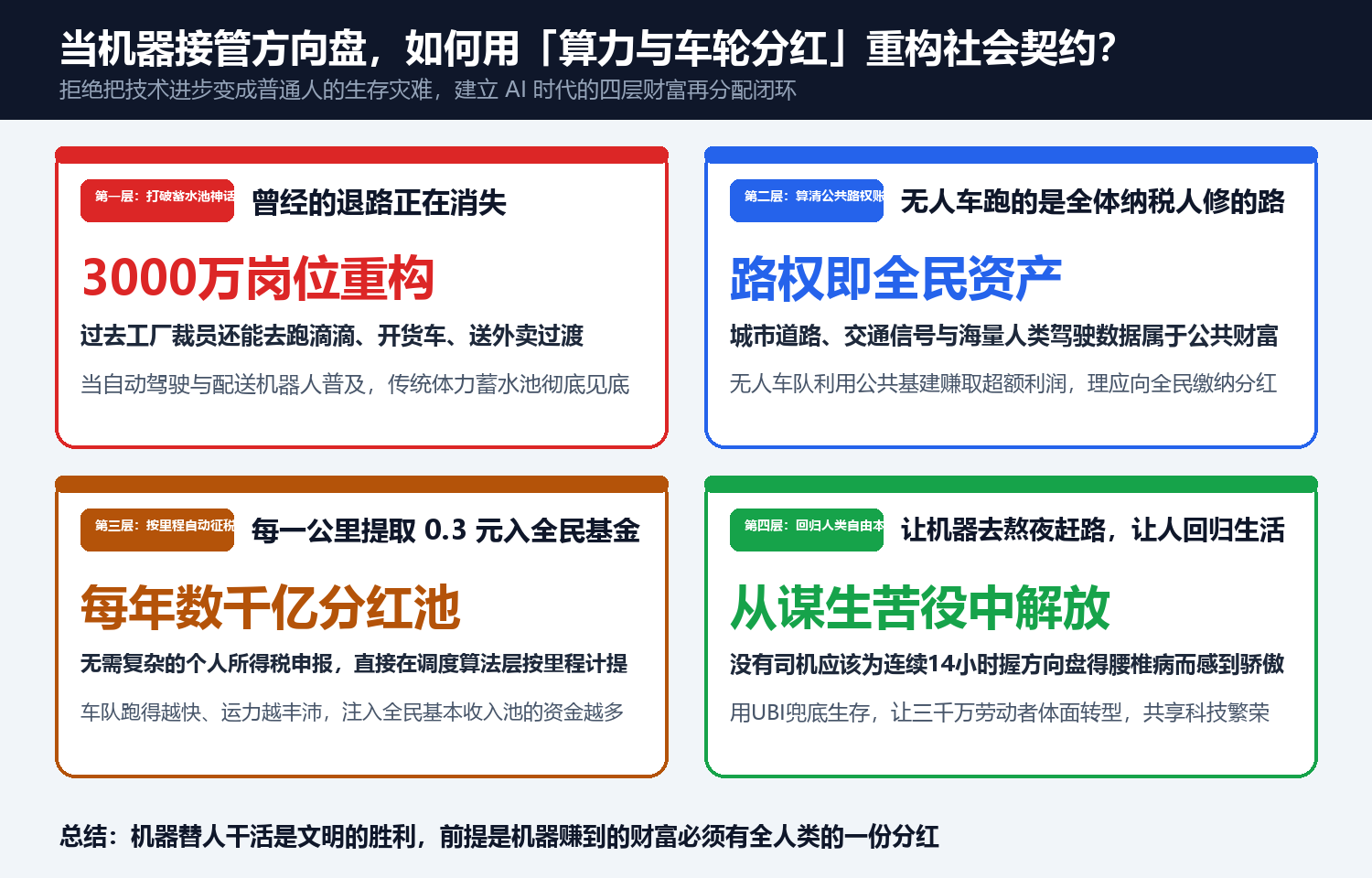
1. The First Ledger: Why Autonomous Driving Empties Society’s Last Employment Reservoir
Whenever automation threatens jobs, textbook economists love to repeat the 19th-century parable: “When automobiles replaced horse-drawn carriages, carriage drivers simply became taxi and truck drivers!”
Applying that analogy to Level 4 autonomous driving commits a fatal logical error:
- Replacing horses with engines changed the power source, not the human seat: A combustion engine still required a human brain and two eyes behind the windshield. Because cars traveled faster and farther than horses, demand for professional human drivers actually multiplied.
- Autonomous driving specifically eliminates the human driver: Whether it is urban robotaxis, highway autonomous freight platoons, or last-mile delivery bots, their entire unit-economics pitch rests on one variable—cutting the 55% to 65% of transport cost that goes to human wages and benefits down to zero.
- 30 million breadwinners supporting 100 million family members: Across trucking, ride-hailing, taxis, and instant delivery, over 30 million working-age adults rely on driving as their primary livelihood. Once lidar and end-to-end neural networks drain this reservoir, there is no lower-barrier physical sector left to absorb displaced workers.
2. The Second Ledger: Robotaxis Do Not Eat Noodles or Pay Rent
Fleet operators see only the cost side: replacing a human driver drops per-kilometer operating costs by 65%. Why wouldn’t that make society richer?
Because in a circular economy, one company’s labor cost is every other business’s customer revenue:
- Where human drivers’ earnings go: When a truck or taxi driver earns $50 a day, that money is spent within 48 hours at roadside diners, grocery markets, clothing stores, and apartment rentals. It circulates rapidly through local small businesses.
- Where robotaxi profits go: Ten thousand robotaxis can run 22 hours a day, pausing only to charge. They never buy lunch, never rent an apartment, and never buy shoes for their children. The trillions saved in driver wages flow straight into the balance sheets of a handful of fleet monopolies, draining grassroots purchasing power and triggering deflationary stagnation.
3. The Third Ledger: Autonomous Fleets Run on Public Roads and Human Data
Even from a strict property-rights perspective, autonomous fleets owe a direct dividend to the public:
- Taxpayer-funded infrastructure: Robotaxis do not float in a vacuum. They operate on trillions of dollars of public highways, paved streets, traffic signals, and 5G networks paid for by generations of taxpayers.
- Billions of miles of human training data: End-to-end driving models learned how to navigate complex intersections by ingesting billions of miles of real-world driving trajectories generated by tens of millions of human drivers.
4. The Solution: An Autonomous Wheel Tax Funding Universal Basic Income (UBI)
Smashing robotaxis is backward Luddism—no human being should have to sit in a cramped cab for 14 hours a day ruining their spine just to survive.
The civilized solution is to attach a Universal Basic Income (UBI) meter to every autonomous wheel:
- Per-Kilometer Autonomous Dividend Tax: Every commercial robotaxi and driverless freight truck automatically contributes a fixed per-kilometer levy directly into a national UBI Sovereign Fund.
- Guaranteed Survival Floor for All: When AI and robotics make transportation and manufacturing virtually free at the margin, humanity must claim its rightful share of that abundance. When productivity explodes, human beings deserve to enjoy freedom, happiness, and creative life—not become casualties of unemployment or prisoners of a new survival trap!
Discussion