Why Did Henry Ford Double Workers' Wages in 1914? When AI Replaces Human Workers, Even Trillion-Dollar Tech Giants Will Collapse Without UBI
In the 1950s, while touring a newly automated Ford engine plant in Cleveland, Henry Ford II gestured at a row of mechanical stamping machines and teased United Auto Workers president Walter Reuther:
“Walter, how are you going to get those robots to pay your union dues?”
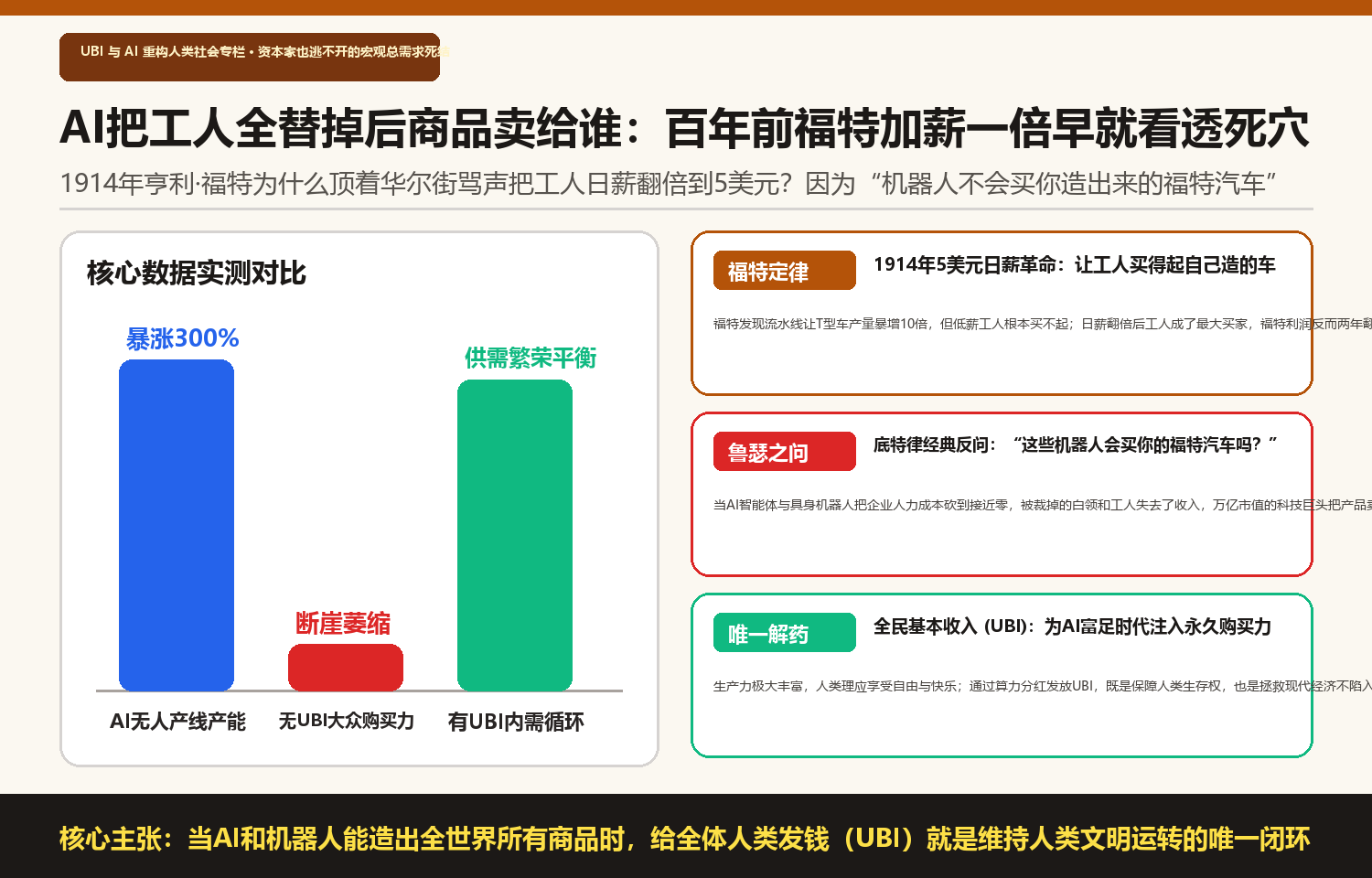
Without missing a beat, Reuther replied with a question that has haunted macroeconomists for seventy years:
“Henry, how are you going to get them to buy your Fords?”
In 2026, as AI agents and embodied robotics replace human white-collar and blue-collar labor at near-zero marginal cost, Reuther’s question is no longer a clever quip—it is the central existential crisis of modern capitalism: When AI replaces the human workforce and drives production capacity toward infinity, who will have the money to buy what automated factories and trillion-dollar tech giants produce?
1. The 1914 “$5-a-Day” Lesson: Mass Production Requires Mass Purchasing Power
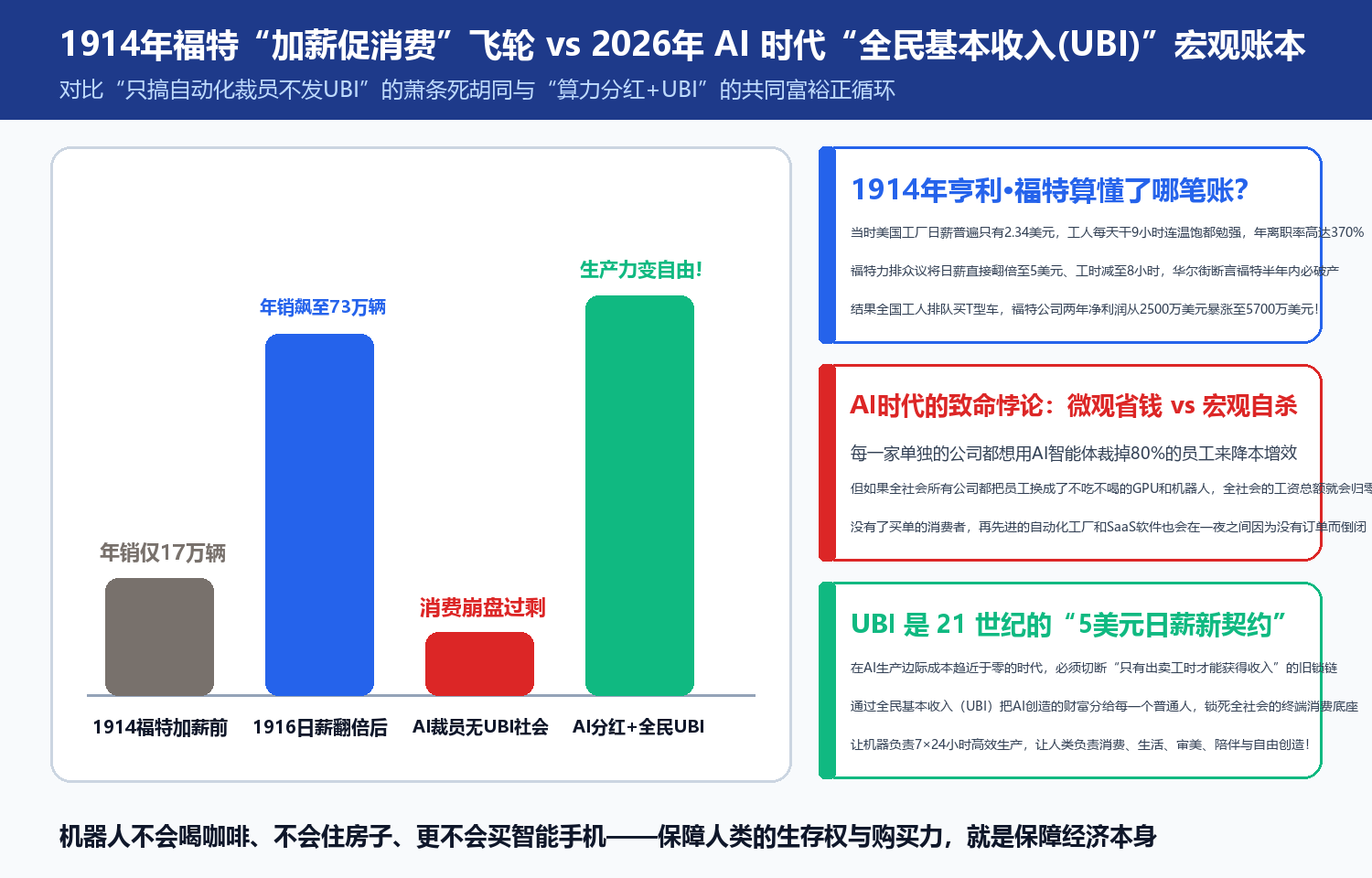
In 1913, Henry Ford’s moving assembly line cut the time required to build a Model T from 12.5 hours to 93 minutes. Output exploded tenfold—yet Ford faced two crises: annual worker turnover hit 370%, and ordinary factory hands earning $2.34 a day could never afford the cars they were building.
On January 5, 1914, Ford stunned Wall Street by doubling his workers’ minimum wage to $5 a day while cutting shifts from 9 hours to 8. Critics predicted bankruptcy within six months. Instead:
- Ford’s own workers became his biggest customers;
- Model T sales surged from 170,000 in 1913 to 730,000 by 1916, and Ford’s net profits more than doubled from $25 million to $57 million in two years!
2. The AI Fallacy of Composition: Micro Cost-Cutting vs. Macro Demand Suicide
Today, every individual corporation wants to replace 80% of its human payroll with AI agents while quietly hoping other companies’ employees will still have wages to buy its products. When every company automates simultaneously, aggregate payroll evaporates and consumer markets implode.
Unlike 1914—when factories still needed human hands on the line—21st-century AI and dark factories can scale output without hiring human labor. Therefore, wage labor can no longer serve as the primary pipe for distributing purchasing power.
Universal Basic Income (UBI) funded by an AI Compute & Automation Dividend is the 21st-century successor to Ford’s $5 day:
- It guarantees every human being’s unconditional right to survival, freedom, and joy in an age of extraordinary material abundance;
- And it provides the permanent consumer demand floor that keeps the entire modern economy from collapsing under its own automated abundance.
Discussion