What Do People Actually Do When Given $500/Month Unconditionally? 3-Year Trial Data: Entrepreneurship Doubled and Nobody Became Lazy
Whenever we advocate for Universal Basic Income (UBI) in an era where AI and robotics are pushing productivity to unprecedented abundance, one objection always surfaces first:
“Human nature is inherently lazy! If you give everyone a guaranteed monthly floor so they don’t have to worry about rent and groceries, who will innovate, build companies, or advance science? Everyone will just lie on the couch playing video games!”
This intuitive fear confuses two completely different things: the natural human desire to escape soul-crushing drudgery and the innate human drive to create, explore, and build.
In Issue #10 of our UBI & AI Social Reconstruction series, let’s look at hard empirical evidence from multi-year unconditional cash transfer trials—and examine how cognitive neuroscience explains what happens to the human brain when survival terror is finally lifted.
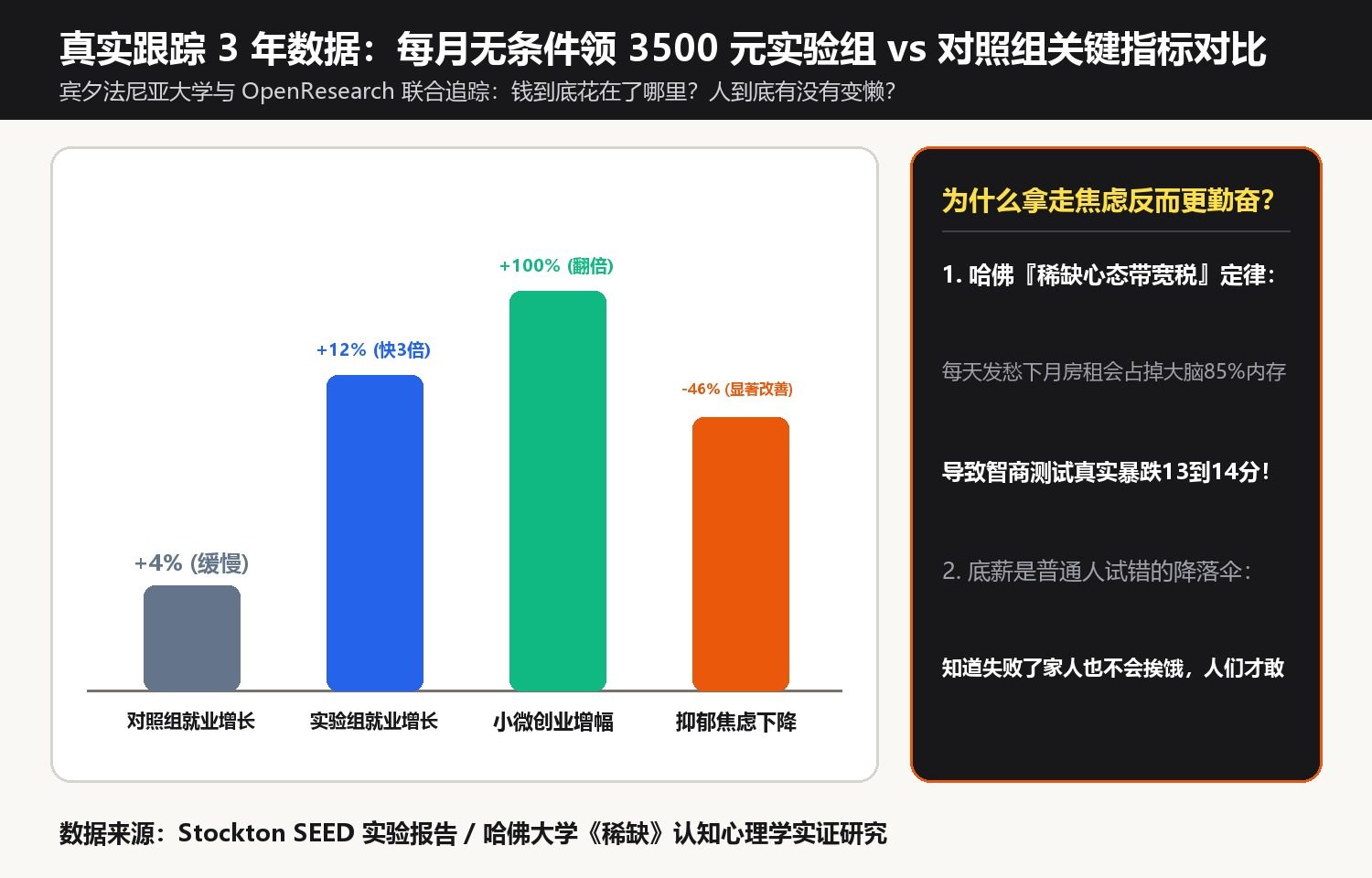
1. The Empirical Ledger: What Did Recipients Actually Do With Unconditional Cash?
In the landmark Stockton Economic Empowerment Demonstration (SEED) evaluated by researchers from the University of Pennsylvania and the University of Tennessee, randomly selected residents received $500 per month unconditionally on the 15th of every month for two years—no work requirements, no strings attached. Combined with Sam Altman’s 3-year OpenResearch trial ($1,000/month) and Canada’s historic Mincome archives, the data shattered every stereotype:
| Tracked Metric | Control Group (Living in Constant Survival Anxiety) | Unconditional Cash Group ($500–$1,000/mo Floor) | Economic & Cognitive Explanation |
|---|---|---|---|
| 1. Alcohol, Tobacco & Impulse Spending | ~1.2% of budget | Dropped below 0.8% | Less despair meant less need for self-medication |
| 2. Transition to Full-Time Skilled Work | +4% (from 28% to 32%) | +12% (jumped from 28% to 40% — 3x faster!) | A financial floor allowed workers to take 8 weeks to finish licensing & training |
| 3. New Small Business & Studio Creation | Baseline rate | Doubled (+100% increase in entrepreneurship) | People finally had the safety cushion to buy tools and test business ideas |
| 4. Mental Health & Cognitive Bandwidth | Chronic clinical anxiety | Anxiety/depression fell 46%; +13 IQ point equivalent | Eliminated the mental “bandwidth tax” of rent-countdown panic |
Far from turning people into couch potatoes, an unconditional survival floor doubled the rate of entrepreneurship and tripled the rate at which people upgraded into better jobs. Why? Because you cannot take a creative risk when a single failed month means your children go hungry.
2. The Neuroscience of Scarcity: Why Survival Panic Taxes 13 IQ Points
Harvard economist Sendhil Mullainathan and Princeton psychologist Eldar Shafir proved in their groundbreaking research on Scarcity that financial survival anxiety imposes a massive “Cognitive Bandwidth Tax” on the human prefrontal cortex:
- Worrying about next month’s rent and utility bills consumes over 80% of working memory—equivalent to running a heavy background virus on a 16GB computer;
- In controlled lab tests, the exact same individuals scored 13 to 14 IQ points lower when experiencing acute financial scarcity—a cognitive drop worse than pulling an all-nighter without sleep;
- Throughout history—from Isaac Newton developing calculus and optics during 18 months at Woolsthorpe, to Charles Darwin spending 20 years refining On the Origin of Species—humanity’s greatest scientific and artistic breakthroughs were born not out of fear of starvation, but out of psychological safety combined with boundless curiosity.

3. AI + UBI: Unleashing 8 Billion Minds Simultaneously
For thousands of years, 99.9% of human geniuses died in fields, mines, assembly lines, and cubicles without ever getting the chance to invent, paint, or explore—because society needed their manual hours just to survive.
When AI and robotics reduce the marginal cost of goods, healthcare, education, and software toward zero, funding a universal floor via compute and automation dividends will not put humanity to sleep. When production is abundant, human beings deserve to enjoy the freedom and joy of that abundance rather than becoming casualties of unemployment. Removing the sword of survival terror from 8 billion heads will ignite the largest Renaissance of science, art, entrepreneurship, and human connection in the history of our species.
Discussion