Why Did Henry Ford Double His Workers' Wages? If AI Replaces Every Worker, Who Will Trillion-Dollar Tech Giants Sell To?
In the spring of 1952, Ford Motor Company executives proudly escorted legendary United Auto Workers (UAW) president Walter Reuther through a newly opened, highly automated engine plant in Cleveland, Ohio.
Pointing to rows of mechanical arms tirelessly stamping and boring engine blocks, a Ford executive tapped Reuther on the shoulder and joked:
“Walter, how are you going to collect union dues from all these machines?”
Reuther paused and delivered a reply that echoed through economic history:
“You know, that is not what’s bothering me. What’s bothering me is: how are you going to sell Ford cars to all of them?”
More than seventy years later in 2026, as AI models, coding agents, and humanoid robots rapidly take over customer support, software engineering, financial auditing, graphic design, and warehouse logistics, Reuther’s question has become the existential paradox of the global economy: when AI drives the marginal cost of production toward zero while simultaneously hollowing out human paychecks, who is left to buy the output?
1. The 1914 Wall Street Shock: Why Ford Doubled His Workers’ Pay
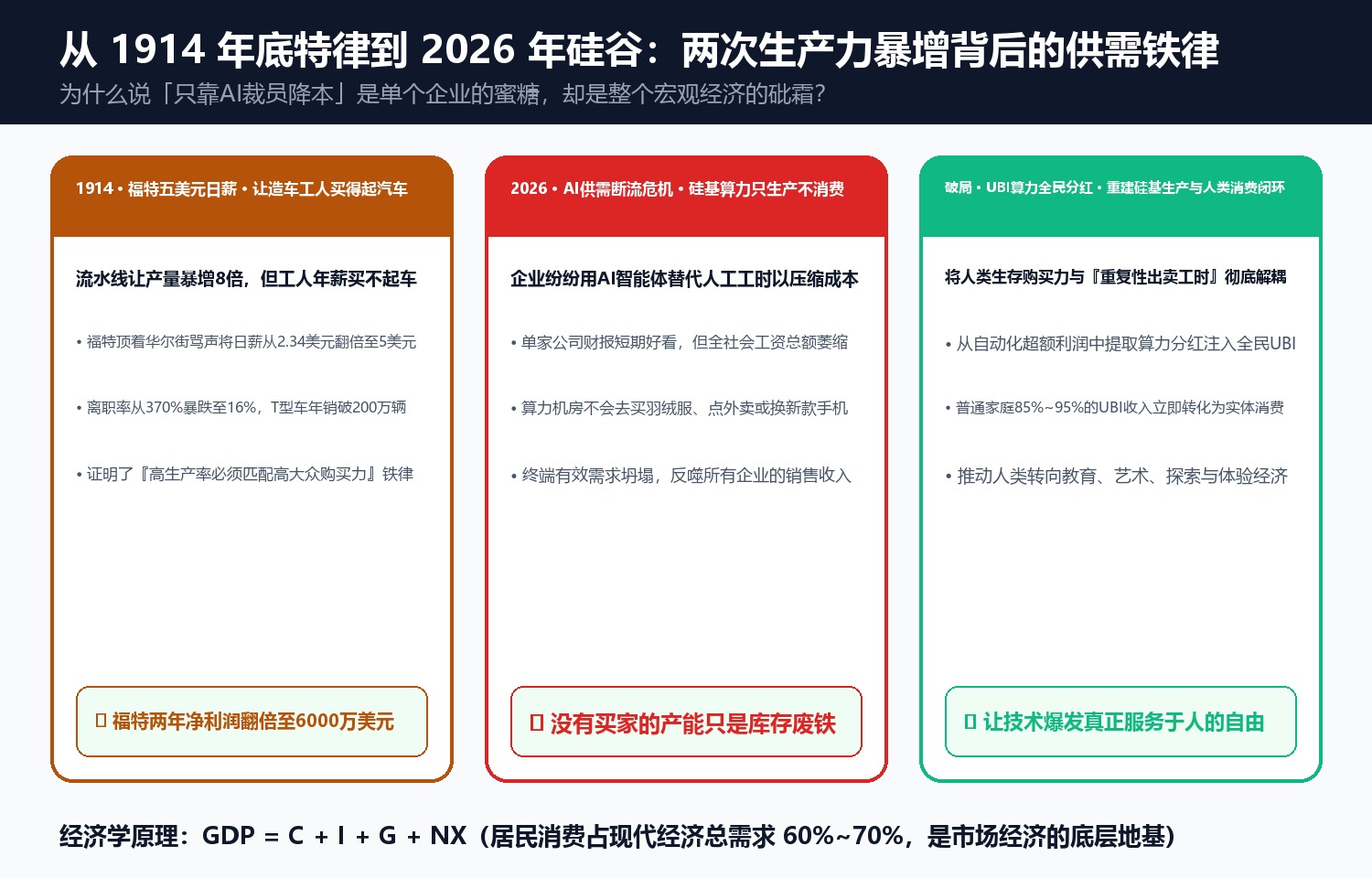
Rewind to 1913. At his Highland Park plant in Michigan, Henry Ford introduced the world’s first moving assembly line, slashing the time required to build a Model T chassis from 12 hours and 28 minutes down to 93 minutes.
Productivity multiplied eightfold in a single year, yet Ford immediately hit two walls:
- Crushing turnover from soul-numbing monotony: Annual employee turnover hit 370% in 1913—to keep a 14,000-person workforce running, Ford had to hire 52,000 people in a single year.
- The Demand Ceiling: The average US manufacturing wage was $2.34 a day (~$700 a year), while even the stripped-down Model T cost $550. The very workers building cars at record speed could not afford the product of their own labor.
On January 5, 1914, Henry Ford stunned Wall Street by doubling minimum daily pay to $5.00 while cutting the workday from nine hours to eight.
- Turnover plunged from 370% to 16%;
- Hundreds of thousands of autoworkers entered the middle class and bought Model Ts, pushing annual sales past 2 million units;
- Ford’s net profits more than doubled within two years, jumping from $25 million to $60 million.
As Ford later wrote in his autobiography: “The payment of five dollars a day for an eight-hour day was one of the finest cost-cutting moves we ever made… because your own employees ought to be your best customers.”
2. The 2026 Macro Ledger: AI Produces Everything, But Consumes Nothing
Why is Ford’s circular flow breaking down in the AI revolution? Because for the first time in economic history, we have introduced a super-productive economic agent—silicon compute—that produces 24/7 but consumes zero consumer goods.
| Economic Loop Stage | Industrial Era (The Ford Flywheel) | Unchecked AI Era (Without UBI) | Macroeconomic Consequence |
|---|---|---|---|
| Supply (Production) | 10,000 workers produce $1B in goods | 200 executives + AI cluster produce $1.5B | Output of software, goods & services surges 50%+ |
| Income Distribution | 60%–65% paid out as human wages ($600M enters household wallets) | 5% to elite engineers; 95% retained as capital & compute rent | Labor share of GDP collapses to historic lows |
| Consumer Demand | 10,000 families buy homes, cars, phones, groceries, vacations | GPU clusters eat electricity—they never buy iPhones, rent apartments, or eat out | Household consumption (68% of GDP) implodes |
| Final Outcome | Virtuous cycle of rising output & rising living standards | Deflationary spiral: overflowing supply meets penniless consumers | Even tech giants see ad and SaaS revenues crash |
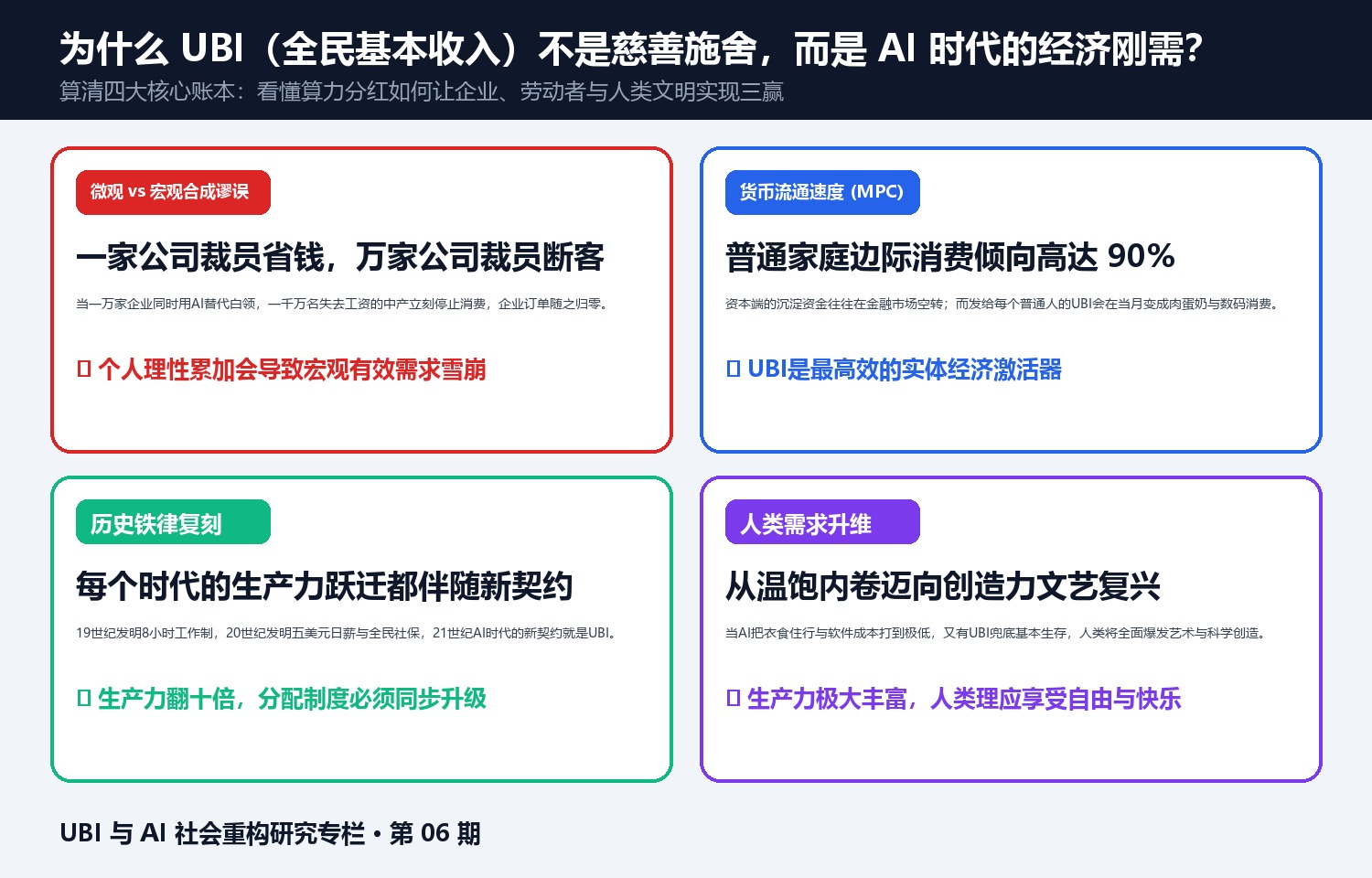
When a single company replaces 1,000 workers with API tokens, its quarterly profit margin looks spectacular. When every company does it simultaneously, aggregate consumer demand evaporates overnight.
3. UBI Is the 21st-Century “$5 Day”: Saving the Market by Guaranteeing Human Purchasing Power
Once you follow the math to the end of the ledger, it becomes obvious why Universal Basic Income (UBI)—funded by a modest AI compute and automation dividend—is not utopian charity. It is the essential macroeconomic stabilizer of the 21st century:
- Reconnecting Silicon Supply with Human Demand: Decoupling survival income from repetitive wage labor ensures every household retains reliable purchasing power even as AI automates routine work.
- Maximum Velocity of Money: Low- and middle-income households have a Marginal Propensity to Consume (MPC) of 85% to 95%—every UBI dollar immediately circulates back into local groceries, housing, education, and consumer products.
- Unleashing the Human Experience Economy: With material abundance produced by AI and basic security guaranteed by UBI, human energy is freed for what machines can never replace: creativity, scientific curiosity, in-person care, art, and the pure joy of living.
Discussion