How Should Bill Gates' 'Robot Tax' Actually Work? Doing the Hard Math on Funding UBI with a 2% AI Token & Automation Dividend
Whenever we advocate for Universal Basic Income (UBI) to guarantee every human being’s unconditional right to survive in the age of AI, the most common objection in the comments is always the same: “The vision sounds great, but where does the money actually come from? You can’t just print infinite cash.”
That question goes straight to the heart of whether UBI is a daydream or a viable modern institution. Any social contract that talks about distributing money without balancing the fiscal ledger is built on sand.
In fact, Microsoft co-founder Bill Gates answered this exact question back in a famous 2017 interview, pointing out the biggest structural blind spot in modern tax codes and proposing a bold solution: the “Robot Tax.”
Fast-forward to 2026: humanoid robots are walking onto automotive assembly lines, and AI agents processing millions of tokens per second are replacing junior programmers, customer support teams, financial auditors, and translators at scale. When we pull out a calculator today and run the numbers on Gates’ thesis, a striking truth emerges: the money is not only there, it doesn’t require crushing businesses—a modest productivity dividend on commercial AI compute and industrial automation is more than enough to guarantee universal basic security.
In Episode 05 of our UBI & AI Social Reconstruction series, let’s put slogans aside and work through the three hard ledgers behind the Robot Tax and the AI Token Dividend.
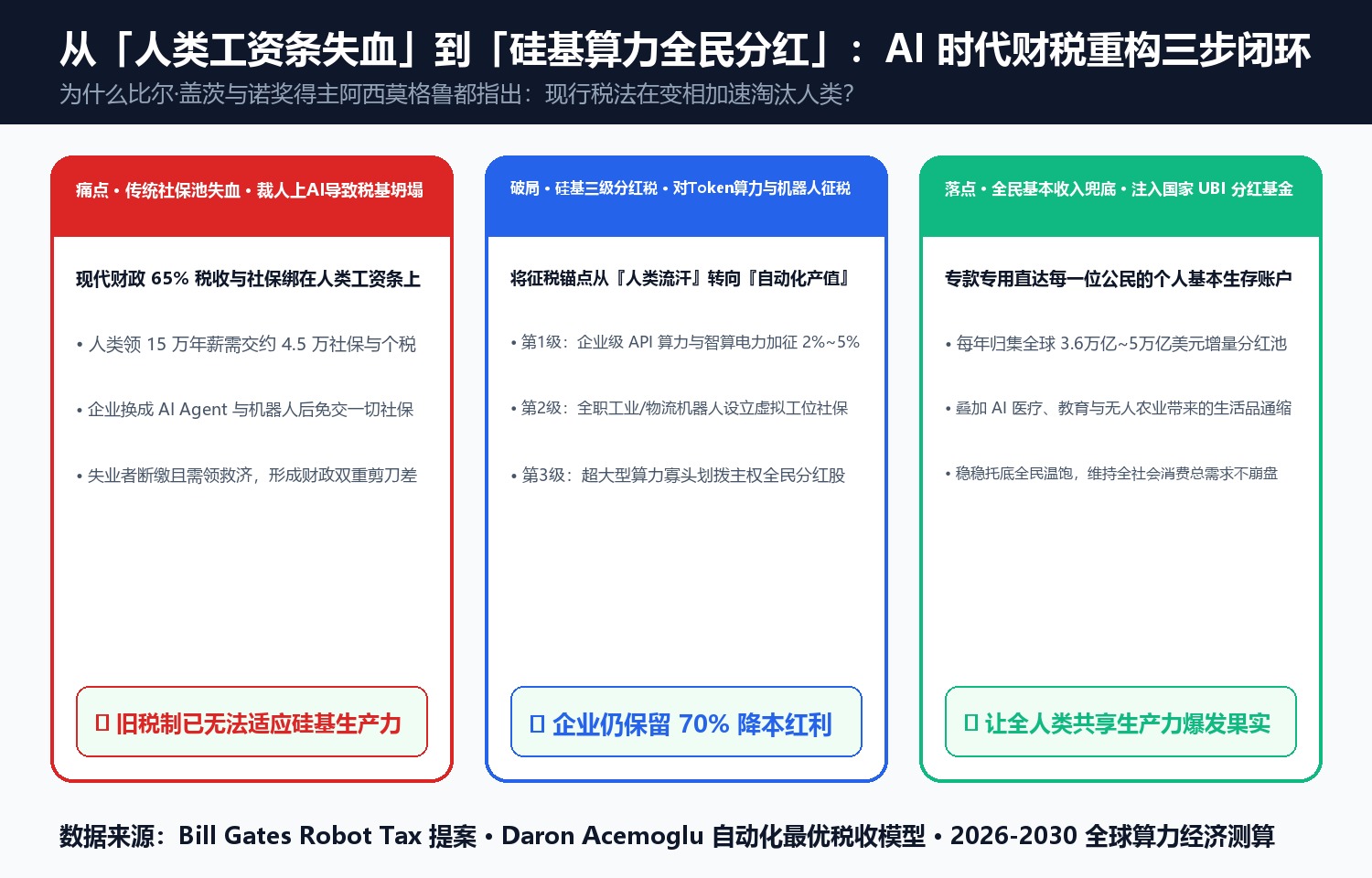
1. Ledger One: Why the Faster AI Grows, the Faster Traditional Social Security Bleeds
To understand why a Robot Tax is inevitable, we first need to look at the foundation of the modern fiscal state.
For the past century, across virtually every developed and industrializing nation, 60% to 70% of government tax revenue and social safety net funding (pensions, healthcare, unemployment insurance) has been tethered directly to the human paycheck:
- Direct income tax withheld from employees’ wages;
- Payroll and social security contributions paid jointly by employers and employees (often totaling 25% to 35% of gross wages).
This mechanism worked well in the industrial era because scaling output required hiring more people. But when frontier AI models and autonomous robots enter the equation, a fiscal cliff opens up:
Imagine a mid-sized software and customer operations firm employing 1,000 people at an average total compensation cost of $60,000 per year ($60 million total payroll). Under the human labor model:
- Roughly $18 million per year flows directly into public income tax and social security funds;
- The remaining $42 million in take-home pay circulates through grocery stores, restaurants, housing, and retail, generating another $5 million in consumption and value-added taxes.
Now suppose the firm deploys autonomous AI agent clusters and automated coding pipelines, laying off 800 employees while keeping 200 senior engineers, and paying $4 million a year in API token bills to a cloud provider:
- For corporate capital: Labor costs plunge from $60 million to $16 million, creating $44 million in excess profit;
- For the public treasury: $14.4 million in annual payroll and income taxes vanishes overnight—while 800 displaced workers suddenly shift from net contributors to claimants drawing unemployment benefits.
As Bill Gates put it: “Right now, the human worker who does, say, $50,000 worth of work in a factory, that income is taxed… If a robot comes in to do the same thing, you’d think we’d tax the robot at a similar level.”
2. Ledger Two: The Three-Tier Architecture of an AI & Robot Tax
If taxing human sweat no longer works when silicon does the heavy lifting, the tax base must follow productivity—shifting from human hours to automated compute and robotic output.

- Tier 1: A Commercial AI Token & Compute Excise (2%–5%) Tokens are the crude oil of the digital economy, and gigawatt data centers are its refineries. Personal educational and consumer AI usage remains tax-exempt, while enterprise-scale API calls and commercial inference clusters pay a transparent 2% to 5% compute dividend collected automatically at the cloud billing gateway.
- Tier 2: “Silicon Workstation” Social Security for Industrial & Logistics Robots Instead of granting accelerated tax depreciation that subsidizes human displacement, full-time commercial robots and autonomous freight vehicles contribute 30% of the equivalent human payroll tax into the national social insurance pool—still leaving companies with over 60% net cost savings.
- Tier 3: Sovereign AI Public Equity Dividends Because frontier LLMs were trained on the collective commons of human civilization—centuries of books, code, science, and art—a share of hyper-scale AI infrastructure equity belongs in a Sovereign AI Citizen Dividend Fund, modeled after the Alaska Permanent Fund.
3. Conclusion: Taxing Silicon So Humans Can Thrive
We did not invent steam engines, semiconductors, and large language models to turn 90% of humanity into an anxious, disposable underclass. We built them so silicon and steel could shoulder the drudgery of survival.
Taxing tireless 24/7 silicon compute by a few percentage points to fund an unconditional basic income (UBI) for every citizen is not a penalty on innovation—it is the only way to ensure that when productivity becomes abundant, humanity gets to enjoy the freedom, dignity, and joy it created.
Discussion