Human Workers Pay 35% in Payroll Taxes While Robots Pay Zero: Doing the Hard Math on Bill Gates' Robot Tax and the AI Compute Dividend
Whenever we advocate for Universal Basic Income (UBI)—arguing that because AI is fundamentally restructuring human society and driving material productivity toward abundance, every citizen’s basic right to survival must be unconditionally guaranteed so humans can enjoy freedom and happiness rather than unemployment panic—the most common pushback is always the same:
“That sounds noble, but where does the money come from? How can any government afford a universal dividend?”
To answer this question, we do not need utopian slogans. We only need to pick up a calculator and follow the fiscal logic raised by Microsoft co-founder Bill Gates in his famous “Robot Tax” proposal.
Once you run the numbers, a startling truth emerges: in an economy where AI agents and robotics take over human labor, failing to levy an “AI Compute & Robot Dividend Tax” to fund UBI will bankrupt modern social security systems first.
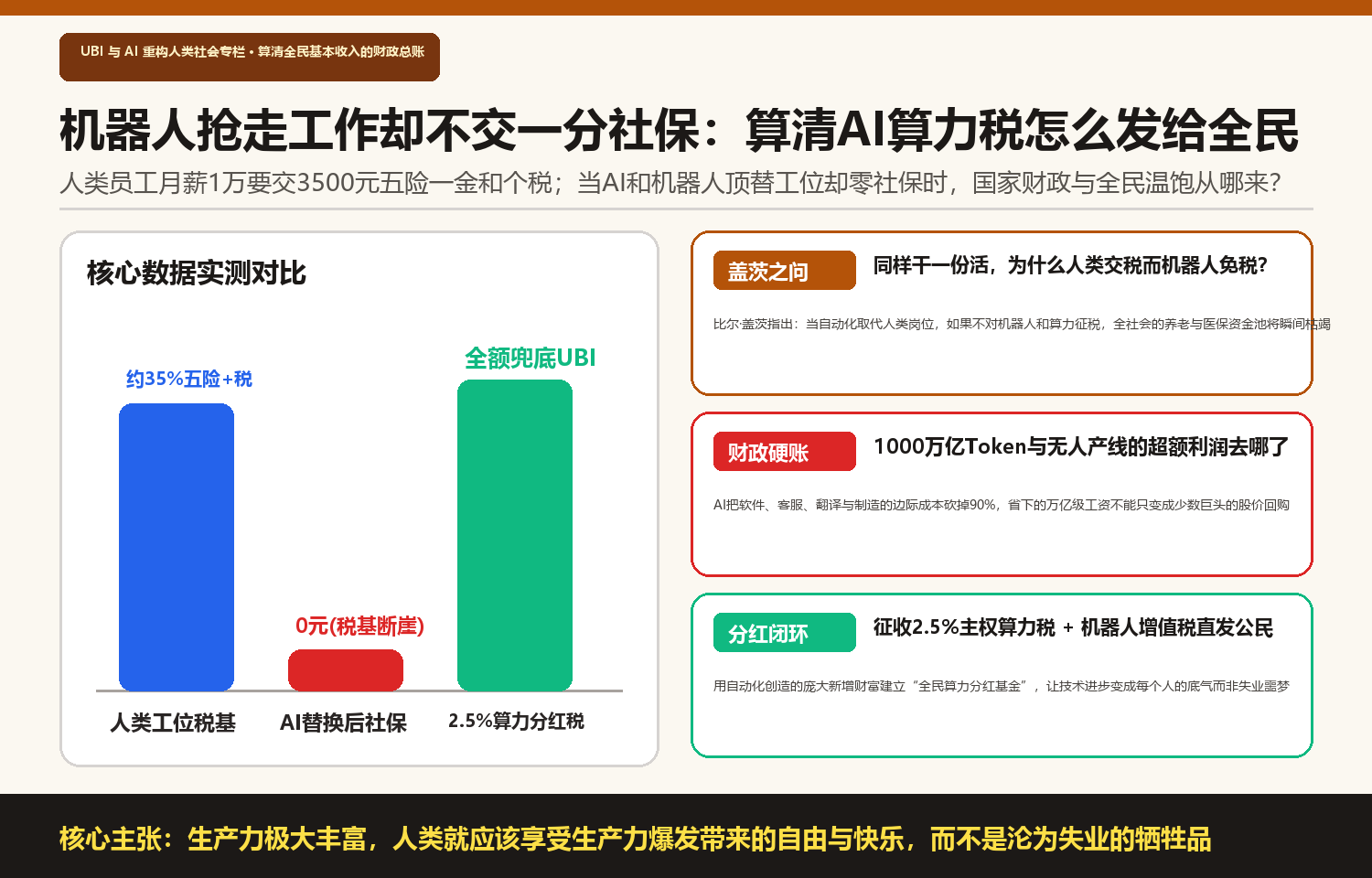
1. Gates’ Paradox: Why Tax Human Sweat at 35% While Giving GPUs a Tax Holiday?
Consider a straightforward accounting comparison: Suppose a company employs a human clerk, software tester, customer support specialist, or factory technician earning $50,000 a year (or ¥10,000/month):
- Under the 20th-century industrial social contract, that single human workstation generates roughly 35% to 40% in combined employer/employee social security contributions, Medicare/healthcare levies, and personal income taxes;
- When that worker spends their take-home pay on groceries, rent, and local services, they generate a second wave of value-added and sales taxes.
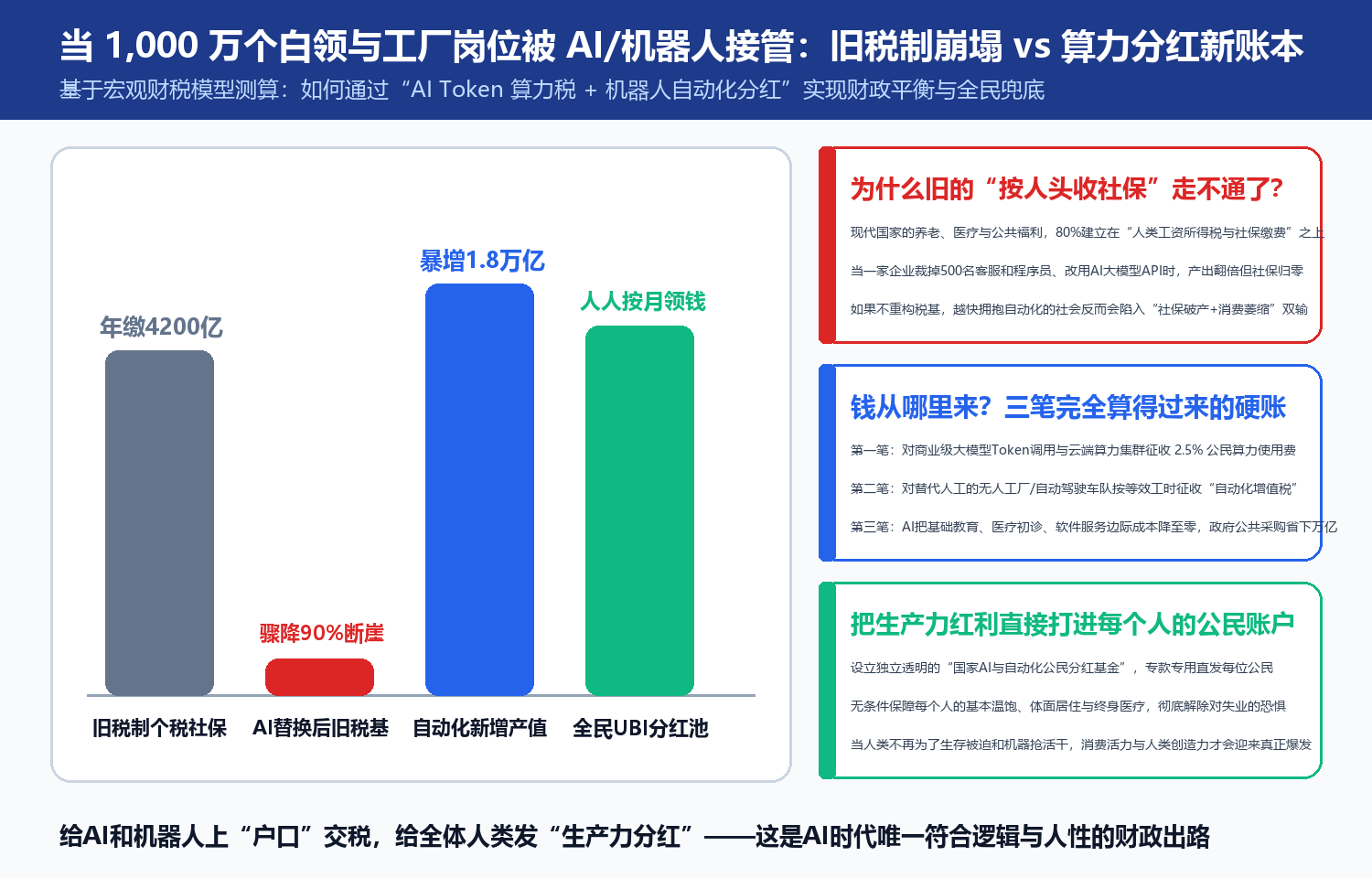
- Over 80% of modern public pensions, healthcare funds, and municipal budgets rest directly on taxing human time.
Now watch what happens in 2026 when an AI Agent or industrial robot takes that seat: The company replaces the $50,000 human role with an automated LLM workflow or robotic arm costing $2,500 a year in electricity and API tokens. Look at the national fiscal ledger the morning after that layoff:
- Economic output has not fallen—it has doubled, and corporate gross margins surge from 10% to 70%+;
- Yet payroll tax and social security contributions from that seat drop to $0.00! A rack of H100 GPUs does not pay into pension funds; an AI agent does not contribute to public healthcare;
- A double fiscal shock: the treasury loses a taxpayer while simultaneously gaining a displaced citizen who needs social support.
As Bill Gates pointed out: “Right now, the human worker who does, say, $50,000 worth of work in a factory, that income is taxed… If a robot comes in to do the same thing, you’d think we’d tax the robot at a similar level.”
2. Three Hard Ledgers: How the AI Compute Dividend Easily Funds UBI
Where does the funding for Universal Basic Income come from? It comes directly from the trillions of dollars in surplus productivity unlocked by automation:
| Fiscal & Economic Dimension | Legacy Human-Payroll Economy | Unregulated AI Monopoly Scenario | The AI Compute Dividend + UBI Contract |
|---|---|---|---|
| Labor Cost per $1M Output | ~$500,000 paid in wages | Drops to ~$40,000 (power + compute) | Unlocks $460,000 in automation surplus |
| Public Tax & Pension Contribution | ~$175,000 in payroll & income taxes | $0 payroll tax (tax base evaporates) | Levies an Equivalent-Hour Robot & Token Tax |
| Cost of Public Healthcare/Education | High human-service marginal cost | Near-zero marginal cost via AI tutors/diagnostics | Public service delivery purchasing power triples |
| Macro Consumer Demand | Workers have wages to buy goods | Displaced workers cannot buy corporate output | UBI floor sustains aggregate consumer demand |
- Source #1: A 2.5%–5% Sovereign Compute & Automation Value-Added Levy By shifting the tax base from human hours to commercial compute tokens, kilowatt-hours of AI data centers, and automated robotic workstations, governments capture a fraction of the massive labor-cost savings without slowing innovation.
- Source #2: AI Deflation in Public Goods (UBS + UBI) When solar energy, AI medical screening, and 1-on-1 AI tutoring drive the marginal cost of essential public services toward zero, every dollar of UBI delivers vastly greater real-world security.
- Source #3: Saving Aggregate Demand from Collapse Even from a purely capitalist perspective, if AI replaces human wages, who will buy the iPhones, electric cars, and groceries produced by automated factories? UBI is the macroeconomic circuit breaker that keeps consumer markets alive.
3. Productivity Abundance Belongs to All Humanity
Humanity did not spend three centuries building steam engines, electricity grids, and artificial intelligence so that ordinary people could starve in front of warehouses overflowing with automated abundance.
When AI and robotics make material production extraordinarily abundant, humans deserve to enjoy the freedom, leisure, and joy of that abundance—not become its casualties. Taxing commercial compute and robotics to fund a universal citizen dividend (UBI) is not charity; it is the foundational fiscal architecture of the 21st century.
Discussion