Pirated MP3s Nearly Killed the Global Record Industry: How Spotify's Obsession with '200ms Latency' Turned 500M People into Legal Listeners
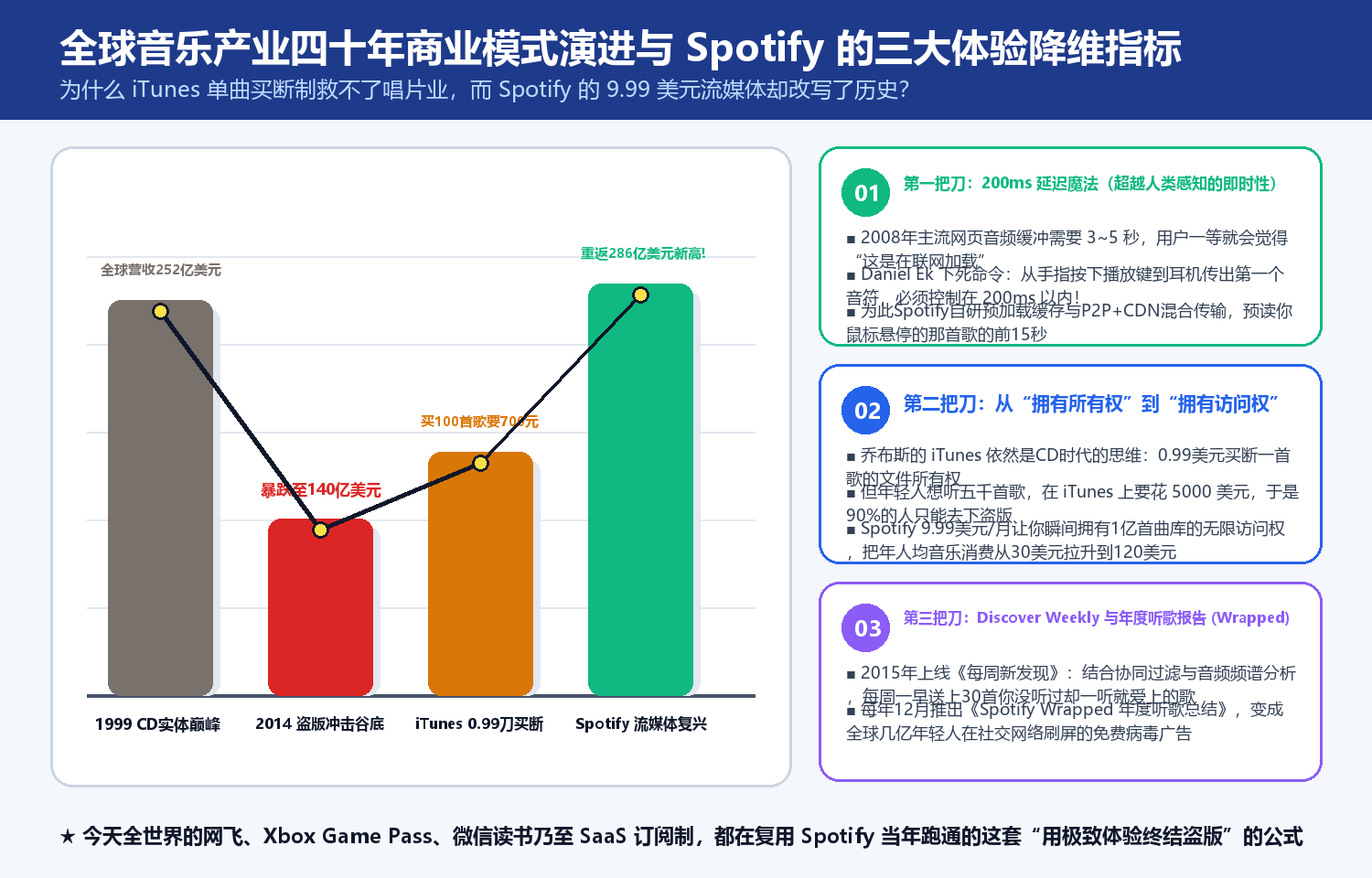
Rewind the clock to 2006, and the executives running the world’s major record labels (Universal, Sony, Warner, EMI) were staring into an existential abyss. Between 1999 and 2008, as peer-to-peer file sharing exploded from Napster to BitTorrent and Sweden’s infamous Pirate Bay, global recorded music revenues plunged from $25.2 billion to $14.0 billion—nearly cut in half.
How did the music industry respond? With lawsuits. The RIAA filed legal actions against more than 30,000 college students and families for downloading MP3s, while police raided server rooms. It failed spectacularly. An entire generation had grown up believing music on the internet was meant to be free.
Then, from Stockholm, Sweden—the very capital of global internet piracy—23-year-old entrepreneur Daniel Ek stated a truth that would become gospel for modern product design:
“You can never legislate away piracy. The only way to solve the piracy problem is to create a service that is better than piracy.”
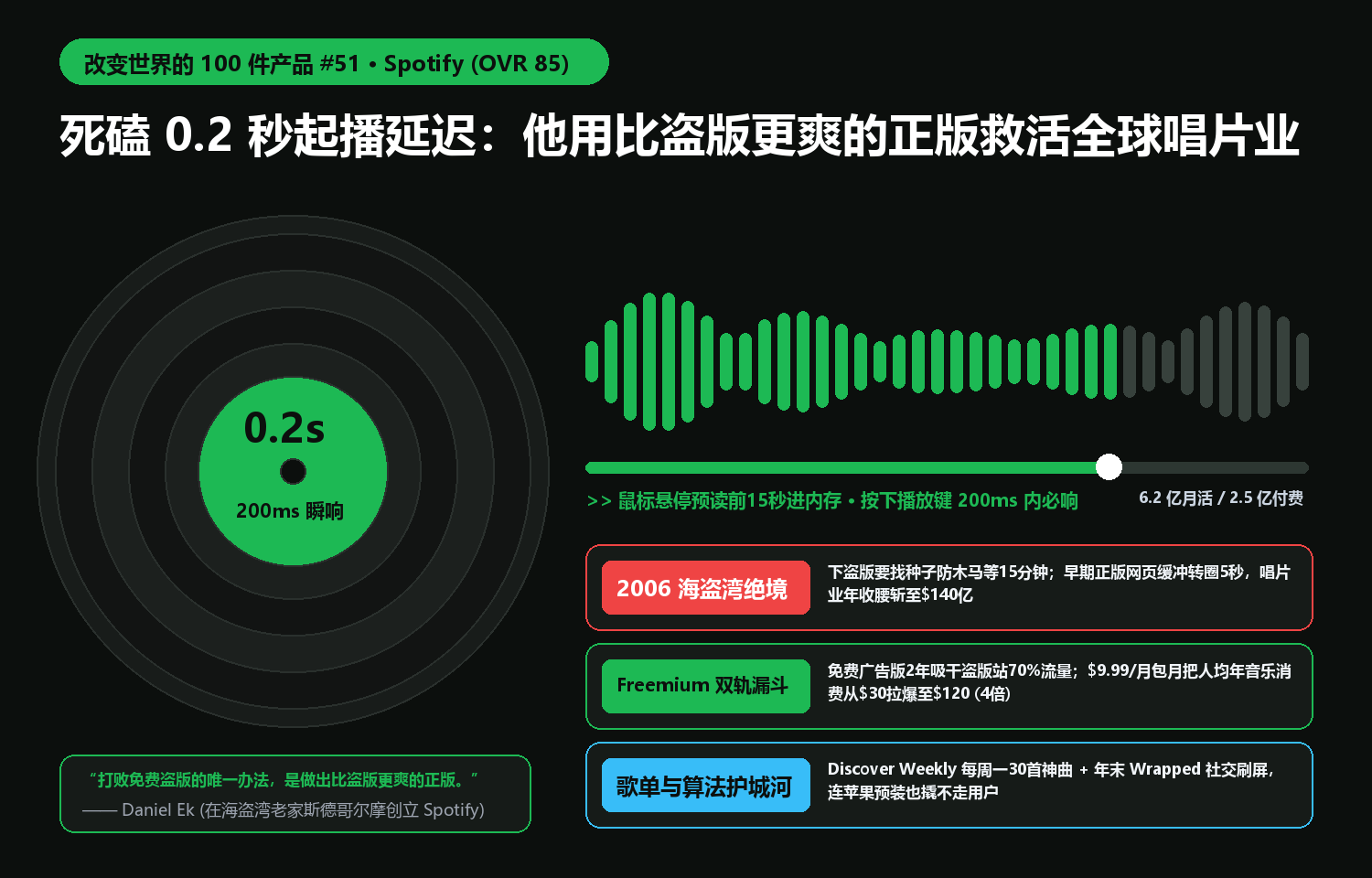
Ranked #51 (OVR 85) on our 100 Products That Changed the World board, Spotify single-handedly pulled the global music industry back from the cliff through three product breakthroughs: the 200-millisecond latency threshold, the Freemium access-over-ownership funnel, and algorithmic playlist lock-in.
1. The 200-Millisecond Magic Trick: Engineering the Illusion of Local Storage
When Daniel Ek and co-founder Martin Lorentzon started Spotify in 2006, Ek examined why he and his friends torrented MP3s from The Pirate Bay.
Piracy was free, but it was actually slow and full of friction: finding a healthy torrent, dodging malware disguised as .mp3.exe, waiting 15 minutes for the download, and syncing files to an MP3 player.
Yet legal web players in 2006 were worse: clicking play triggered a spinning Buffering... wheel for 4 to 6 seconds before a single note played.
Ek obsessed over a critical threshold in human-computer interaction psychology: 200 milliseconds (0.2 seconds). When a system responds to a human click within 200ms, the human brain perceives the response as instantaneous—like flipping a physical wall switch. Cross 500ms, and the illusion breaks.
Ek gave his engineering team an uncompromising mandate: “When a user clicks play on any song in a catalog of millions, or drags the scrub bar to the middle of a track, audio must play within 200 milliseconds. It must feel as if the entire history of recorded music is already sitting on the user’s local hard drive.”
To hit 200ms over 2007 broadband connections, Spotify built an extraordinary audio engine:
- Predictive Hover Pre-fetching: The moment your mouse cursor hovered over a track title—before you even clicked—the Spotify desktop client quietly streamed the first 15 seconds of that track into local RAM.
- Turning P2P Against Piracy: Using a hybrid peer-to-peer protocol alongside central servers, Spotify pulled encrypted audio chunks directly from nearby listeners’ local caches, making popular songs play faster the more people listened.
2. Access Over Ownership: Why $9.99 Freemium Succeeded Where iTunes $0.99 Stalled
Steve Jobs’s iTunes Store had proved people would pay $0.99 for a digital song, yet iTunes was still rooted in CD-era unit ownership. A music lover who wanted to listen to 3,000 songs a year could not afford to pay $3,000 on iTunes—and prior to streaming, the average consumer spent less than $30 a year buying CDs or downloads.
Spotify replaced ownership with a two-stage Freemium rocket:
- The Ad-Supported Free Tier: It drained the piracy swamp by offering every song legally for free with occasional radio-style ads, starving torrent sites of 70%+ of their traffic within two years.
- The $9.99/month Premium Tier: Once users built their personal playlists inside Spotify, over 40% of active users upgraded to Premium for ad-free, offline listening—multiplying average annual revenue per listener from $30/year to $120/year (a 4× expansion of the music industry’s addressable pie).
3. Playlists as Identity & “Discover Weekly”: The Moat Apple Could Never Breach
When Apple launched Apple Music in 2015 with the exact same 50-million-song catalog pre-installed on every iPhone, Wall Street predicted Spotify’s demise. Instead, Spotify widened its lead. Why? Because on Spotify, the song catalog is a commodity, but your playlists and taste profile are your soul:
- Discover Weekly (2015): By combining collaborative filtering across a billion user-curated playlists with raw audio waveform analysis, Spotify delivered 30 uncannily accurate song discoveries every Monday morning.
- Spotify Wrapped: Every December, Spotify turned private listening data into vibrant, shareable story cards—transforming 600 million listeners into an unpaid global marketing army.
Discussion