The 100 Greatest Products · #48 Tesla Model S (OVR 86): 7,104 Laptop Cells, a Skateboard Chassis, and the Car That Updates Overnight
Before June 2012, every major automaker on earth agreed on what an electric car was: a slow, short-range compliance appliance that required drivers to sacrifice speed, space, and style for the sake of the environment.
Then Tesla Model S rolled off the Fremont line, delivered 265 miles (426 km) of EPA range, out-accelerated a Porsche 911, and scored 99 out of 100 in Consumer Reports—the highest score in the magazine’s history. Ranked #48 (OVR 86) on our list of the 100 Greatest Products, the Model S wrote the architectural blueprint that every modern EV still follows today.

1. First-Principles Engineering: 7,104 Commodity Cells in a Skateboard Floor
Instead of waiting for bespoke automotive batteries that cost over $1,000/kWh, Tesla wired 7,104 commodity Panasonic 18650 laptop cells cooled by a patented liquid thermal ribbon, cutting pack costs by 60%. Mounting that flat pack along the floor between the axles created the Skateboard Chassis—giving a family sedan a supercar’s center of gravity (18 inches) and a front trunk (“frunk”).
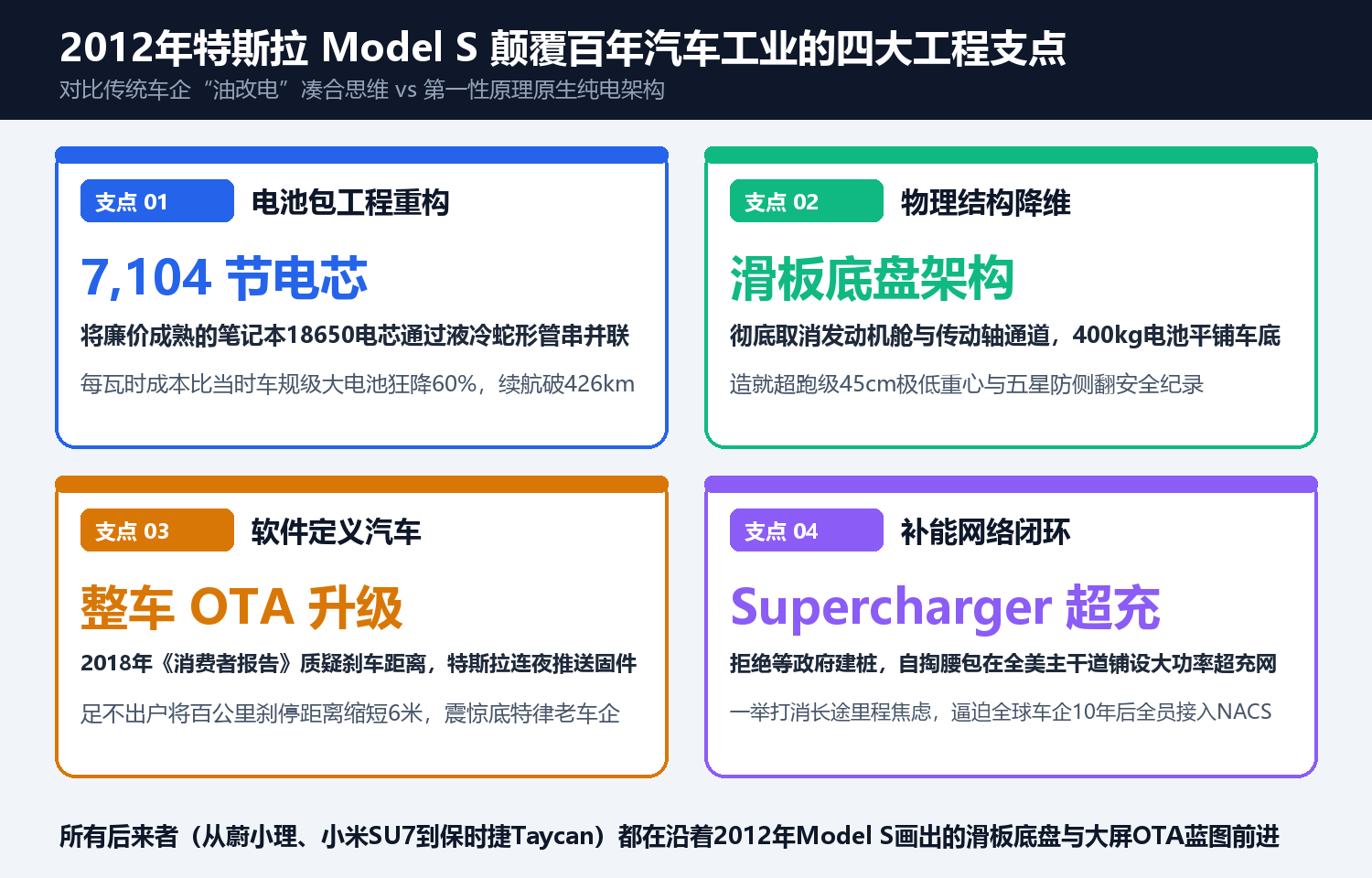
2. Software-Defined Vehicle: The 17-Inch Screen and Over-the-Air (OTA) Updates
By replacing physical buttons with a 17-inch capacitive touchscreen and connecting every ECU to cellular OTA updates, Model S turned the automobile from a static mechanical appliance that depreciates the day you drive it off the lot into a computer on wheels that improves its braking distance, range, and autonomy while parked in your garage overnight.
Discussion