The 100 Products That Changed the World · #51 Tetris (84): Built with Text Brackets by a Soviet Researcher Who Made $0 for a Decade while 520 Million Copies Sold
In June 1984, inside a dimly lit computer room at the Soviet Academy of Sciences in Moscow, 29-year-old researcher Alexey Pajitnov sat in front of an Elektronika 60 terminal.
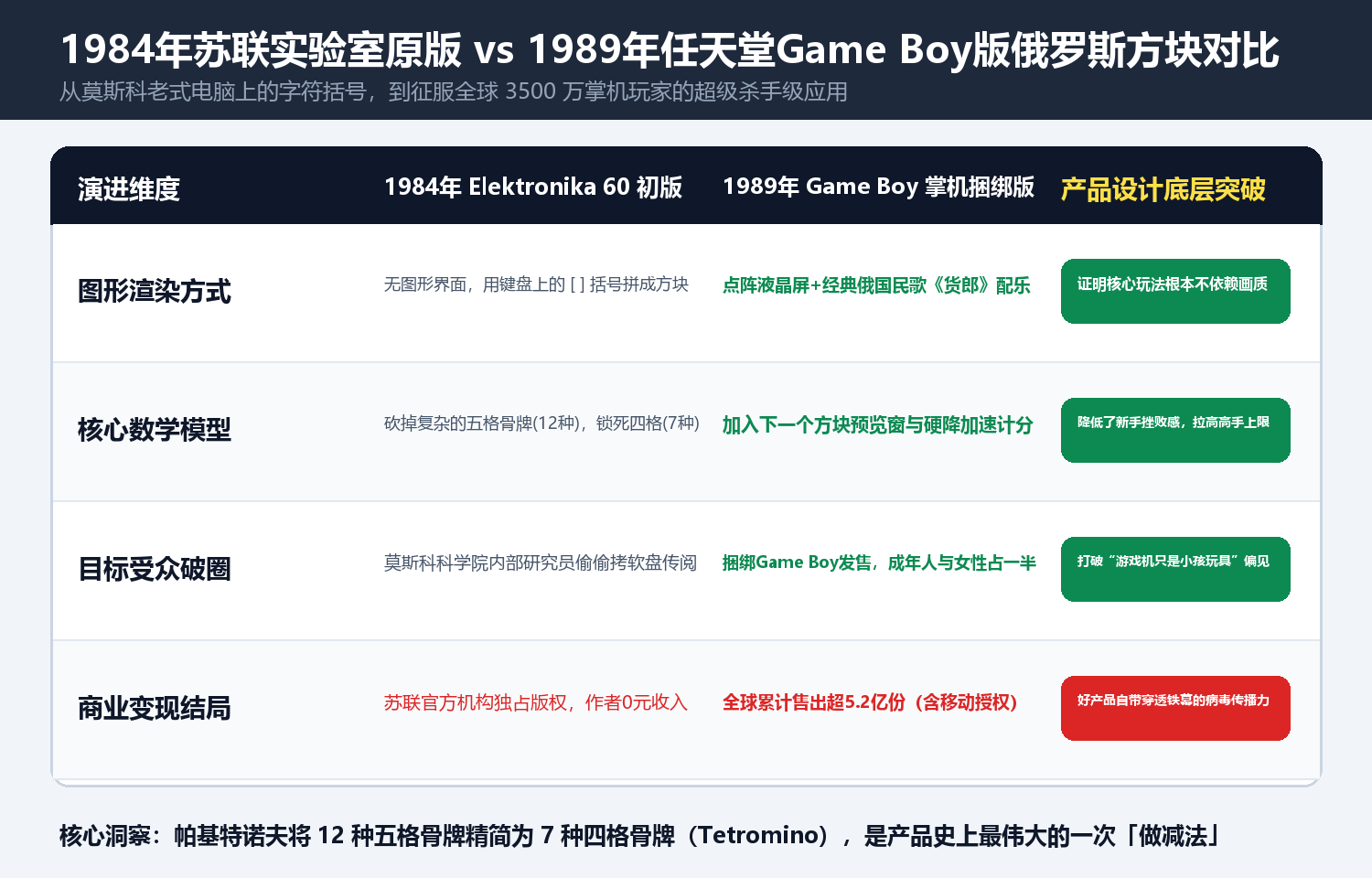
The computer had no color monitor, no sound card, and no graphics processor—it could only display green text characters. To adapt his favorite childhood puzzle, Pentominoes, Pajitnov used pairs of square brackets [ ] to represent blocks.
Within two afternoons, Tetris was born. Ranking #51 on the 100 Products That Changed the World (Overall 84: ORG 90, SCL 88, IMP 88, EXP 86, DUR 86, BIZ 64), Tetris is perhaps the closest humanity has ever come to a mathematically perfect digital product.
1. The Greatest Subtraction in Game History: From 5 Squares to 4
Pajitnov originally tried to use 5-square pentominoes, which have 12 distinct shapes. He quickly realized 12 complex shapes overwhelmed human working memory under time pressure.
By cutting one square—moving from 5-square pentominoes to 4-square tetrominoes—the number of shapes dropped from 12 to 7. Seven shapes sit right at the sweet spot of human short-term memory, making the game instantly intuitive for a child yet infinitely deep at high speeds.
2. The Zeigarnik Effect: Turning Order into Dopamine
Unlike arcade games built around shooting enemies, Tetris tapped into the Zeigarnik Effect—the human brain’s compulsion to resolve incomplete patterns. Every cleared line delivers instant relief while immediately leaving behind a new irregular skyline to solve.

3. Ten Years of Zero Royalties Behind a 520-Million-Copy Phenomenon
Bundled with Nintendo’s Game Boy in 1989 after Henk Rogers convinced Minoru Arakawa that “Mario sells to boys; Tetris sells to everyone,” Tetris went on to sell over 520 million copies across platforms. Yet because Soviet state agency ELORG held the rights, Pajitnov received $0 in royalties for the first decade until co-founding The Tetris Company in 1996.
Discussion