Product Rank #47 The Linux Kernel (86 OVR): How a 21-Year-Old's Bedroom Hobby Swallowed 96% of the World's Servers and Every Android Phone
Ranking #47 on our list of the 100 Products That Changed the World is the most improbable triumph in software engineering history: The Linux Kernel (1991, 86 OVR: Originality 85 / Scale 96 / Impact 97 / Experience 68 / Business 74 / Durability 96).
An ordinary consumer might think they have never touched Linux. Yet in 2026, no modern human goes sixty seconds without relying on it:
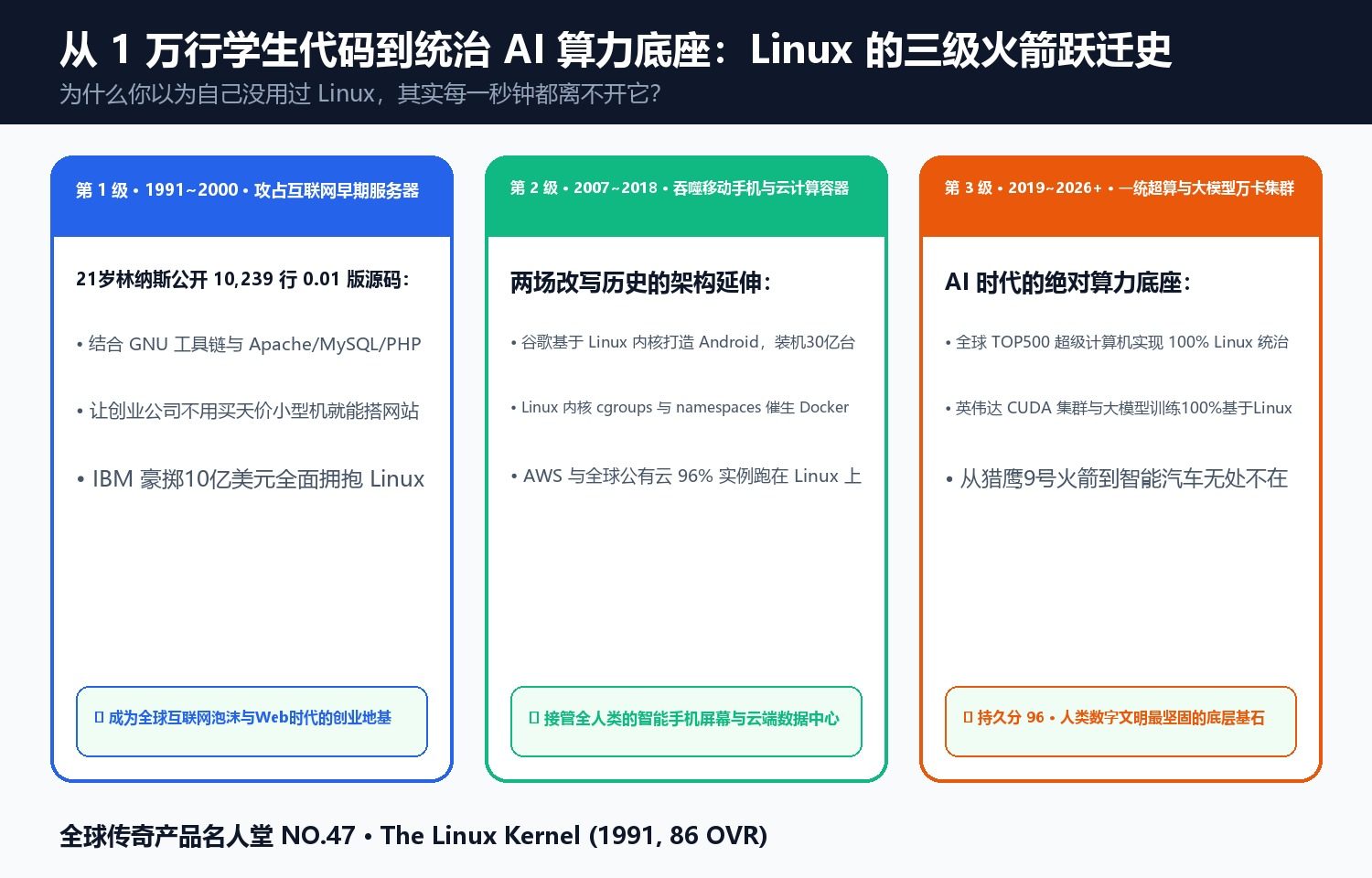
- Every Android smartphone on earth runs on the Linux kernel;
- 96.3% of the world’s top web servers and 100% of the TOP500 supercomputers run Linux;
- Every major frontier AI training cluster, from NVIDIA DGX pods to cloud containers, and even SpaceX Falcon 9 flight computers, beats with the heart of a penguin named Tux.
And the wildest part? This foundational substrate of modern civilization was not built by a trillion-dollar corporation. It started in 1991 as a bedroom hobby project written by a 21-year-old Finnish college student who couldn’t afford commercial UNIX.
1. The Most Humble Usenet Post in History (August 25, 1991)
In early 1991, University of Helsinki sophomore Linus Torvalds bought an Intel 386 PC on credit. Frustrated by the licensing limits of the educational MINIX system and priced out of commercial UNIX, he pulled his bedroom curtains shut and wrote his own operating system kernel from scratch.
On August 25, 1991, he posted to comp.os.minix:
“Hello everybody out there using minix - I’m doing a (free) operating system (just a hobby, won’t be big and professional like gnu) for 386(486) AT clones…”
Version 0.01 was just 10,239 lines of code. Today, the Linux kernel exceeds 35 million lines, contributed by tens of thousands of developers across competing tech giants.
2. The Cathedral vs. The Bazaar: Why Open Source Crushed Proprietary UNIX
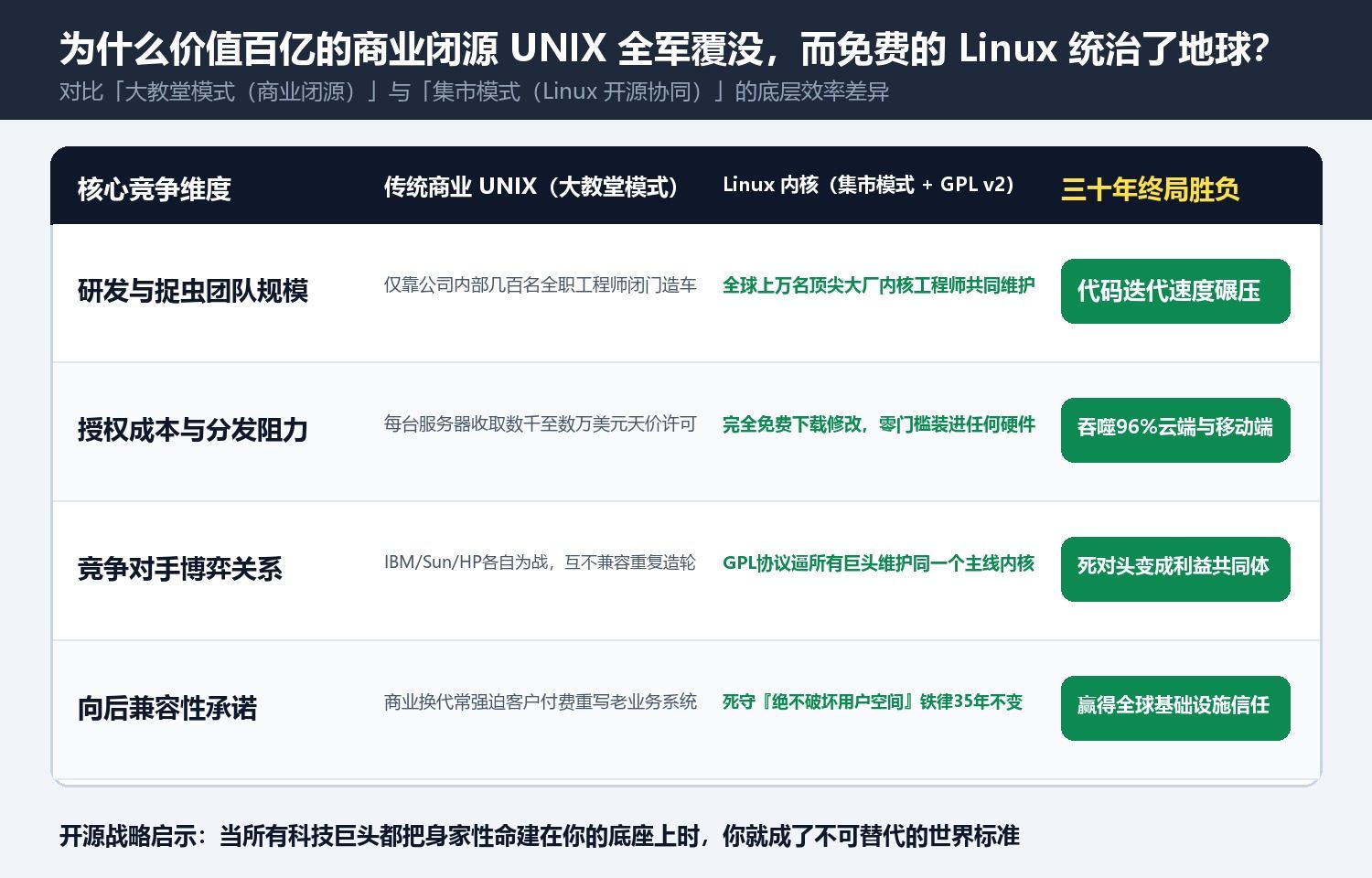
How did a loosely coordinated global network of developers (The Bazaar) defeat the multi-billion-dollar proprietary UNIX divisions of Sun, IBM, HP, and Microsoft (The Cathedral)?
- Linus’s Law (“Given enough eyeballs, all bugs are shallow”): Instead of hiding source code behind NDAs, Linux released early and often, turning millions of production sysadmins into real-time co-debuggers.
- The Strategic Genius of GPL v2: Anyone could use Linux commercially for free, provided that any modifications to the kernel were contributed back under the same open license. This prevented proprietary fragmentation and forced fierce rivals—Intel, IBM, Google, Red Hat, Microsoft, and NVIDIA—to pool their best engineers into maintaining one shared kernel.
- Rule #1: “We Do Not Break Userspace”: Torvalds enforced an ironclad product contract—kernel upgrades must never break existing user applications, earning unmatched enterprise trust over 35 years.
100 Great Products #47: Explore the full interactive leaderboard at DO AI PM Great Products.
Discussion