CUDA: Ten Years of Wall Street Ridicule That Turned Gaming Graphics Cards into the Trillion-Dollar Foundation of AI
Across the generative AI boom, one reality has haunted every chip startup and cloud giant trying to break NVIDIA’s dominance:
Even when a rival accelerator boasts higher theoretical TFLOPS on paper at a 40% lower price, AI engineers almost always shake their heads: “Don’t buy it. Our training pipeline will break on day one, and rewriting custom kernels will cost us six months—just get us NVIDIA GPUs.”
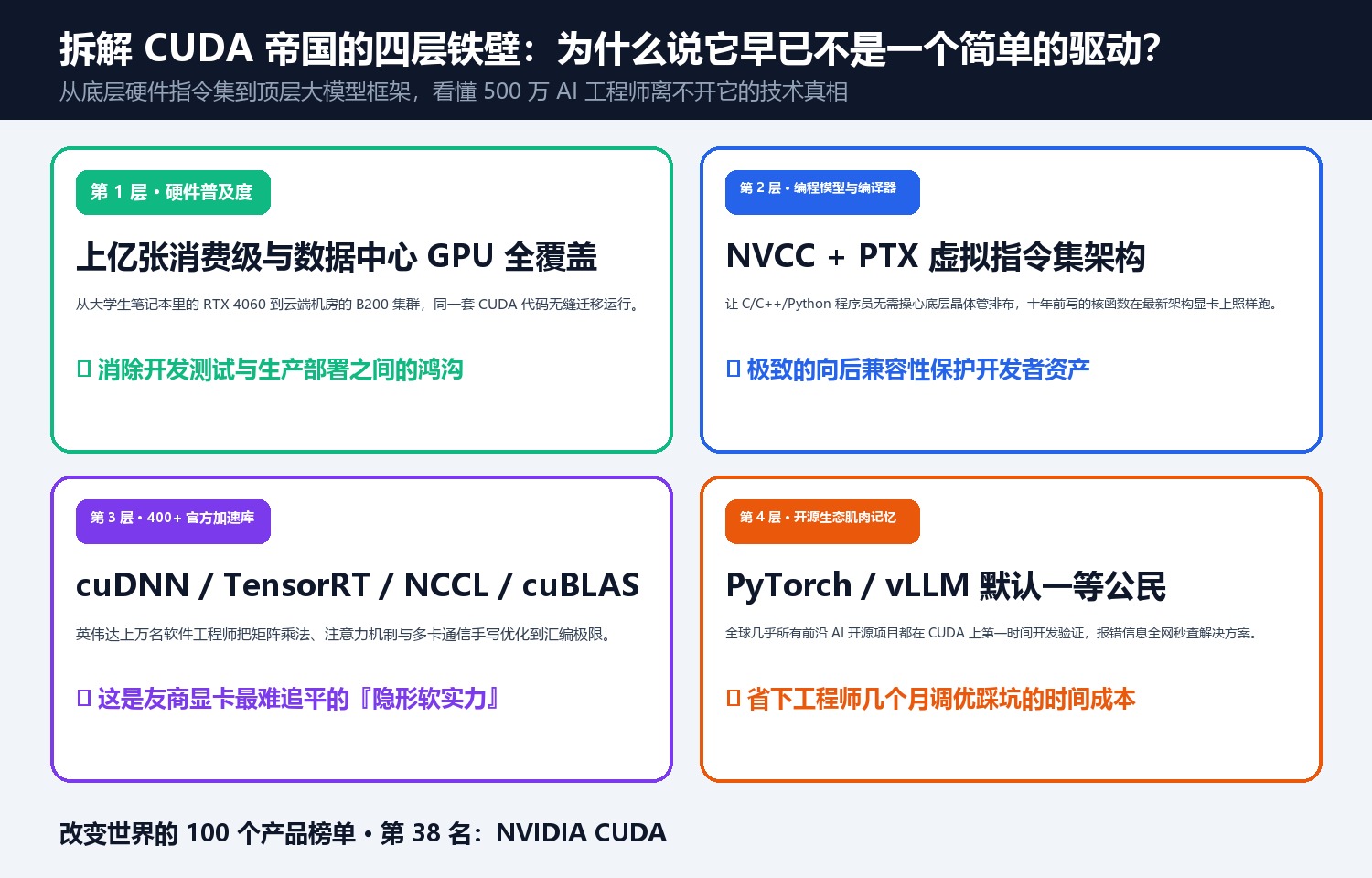
What locks the world’s AI labs onto NVIDIA is not TSMC’s silicon lithography alone—it is a parallel computing platform and programming model launched twenty years ago in 2006: CUDA (Compute Unified Device Architecture).
On the 100 Products That Changed the World ranking, CUDA stands at No. 38 (Overall OVR 89: Impact 97 / Originality 95 / Business 92 / Durability 92 / Scale 82 / Experience 69). Here is how a decade-long, seemingly money-losing software bet turned gaming graphics cards into the foundation of a $4 trillion empire.

1. The 2004 Stanford Hack: Why PhD Students Were Disguising Matrix Math as Video Game Textures
In the early 2000s, Stanford computer science researchers led by Ian Buck noticed a massive compute asymmetry: while a CPU is like four brilliant math professors solving complex serial problems one at a time, a 3D gaming GPU is like 2,000 elementary schoolers doing simple arithmetic simultaneously across millions of pixels.
To harness GPU parallelism for scientific computing, researchers had to disguise matrix equations as video game textures and write arcane OpenGL pixel shaders. Jensen Huang recruited Ian Buck in 2004 with a clear mission: let any C programmer command thousands of GPU cores directly without knowing a single word of graphics jargon.
Launched in November 2006 alongside the GeForce 8800 GTX (G80), CUDA 1.0 let developers write standard C functions (__global__ kernels) to execute massively parallel workloads.
2. Six Years in the Wilderness: Baking CUDA into Every Gaming Card
Between 2006 and 2012, Wall Street despised CUDA. Jensen Huang made the radical decision to include CUDA hardware circuitry inside every single consumer GeForce gaming GPU:
- Die size swelled by 15%–20%, dragging gross margins down from 46% to 35%;
- NVIDIA spent $500M+ annually on CUDA compilers and libraries while generating near-zero direct revenue;
- NVIDIA’s stock plunged 70% between 2008 and 2012.
Yet Huang stood firm on his “Zero-Billion Dollar Market” thesis: by shipping CUDA inside 100 million gaming PCs, every university dorm room on Earth already had a CUDA supercomputer waiting to be programmed.
3. The 2012 AlexNet Spark and the 400-Library Fortress
On September 30, 2012, Geoffrey Hinton and his students Alex Krizhevsky and Ilya Sutskever trained AlexNet on two $500 consumer GTX 580 gaming cards in a bedroom using CUDA, shattering the ImageNet benchmark and igniting the modern deep learning revolution.
Over the next decade, NVIDIA compounded its lead by building 400+ domain-specific acceleration libraries (cuDNN, NCCL, TensorRT-LLM, cuBLAS) on top of CUDA. Rivals can tape out a fast chip in two years—but replicating 20 years of software libraries and 5 million developers’ muscle memory is another matter entirely.
Discussion