Instagram: How a 1:1 Square Frame and One-Tap Filters Dropped the Cost of a Beautiful Photo to Zero — and Set the Visual Taste of the Smartphone Era
In July 2010, on a quiet beach in Todos Santos, Mexico, 26-year-old founder Kevin Systrom was walking along the sand with his fiancée, Nicole Schuetz, trying to figure out how to save his startup.
For months, Systrom and his co-founder Mike Krieger had been pouring their lives into an app called Burbn. Despite raising $500,000 in seed funding from Baseline Ventures and Andreessen Horowitz, Burbn had fewer than 1,000 users, and growth was flatlining.
Systrom and Krieger had just decided to strip Burbn down to its studs and rebuild it purely around mobile photo sharing. As they walked along the water, Systrom asked Nicole whether she would use the new app.
She shook her head and gave him an answer that changed the visual culture of the 21st century:
“Probably not. My photos never look as good as the ones your friend Greg takes.”
Systrom asked why Greg’s photos looked so much better. She replied: “Because he uses filter apps.”
That night, back in their beach bungalow, Systrom opened his laptop. Drawing on his college semester studying photography in Florence, Italy—where a professor had traded away his DSLR and forced him to shoot with a cheap plastic Holga medium-format film camera—Systrom coded a high-contrast, warm-toned, vignetted filter and named it X-Pro II.
Less than three months later, at midnight on October 6, 2010, the newly renamed Instagram (Instant Camera + Telegram) went live on the Apple App Store:
- Within 24 hours, 25,000 people signed up, nearly melting Krieger’s singleserver setup;
- Within 18 months (April 2012), with just 13 employees and $0 in revenue, Mark Zuckerberg bought Instagram for $1 billion;
- Today, Instagram exceeds 2 billion monthly active users, generates over $60 billion a year in advertising revenue, and has physically reshaped how restaurants plate food, how hotels design lobbies, and how human beings curate their lives.
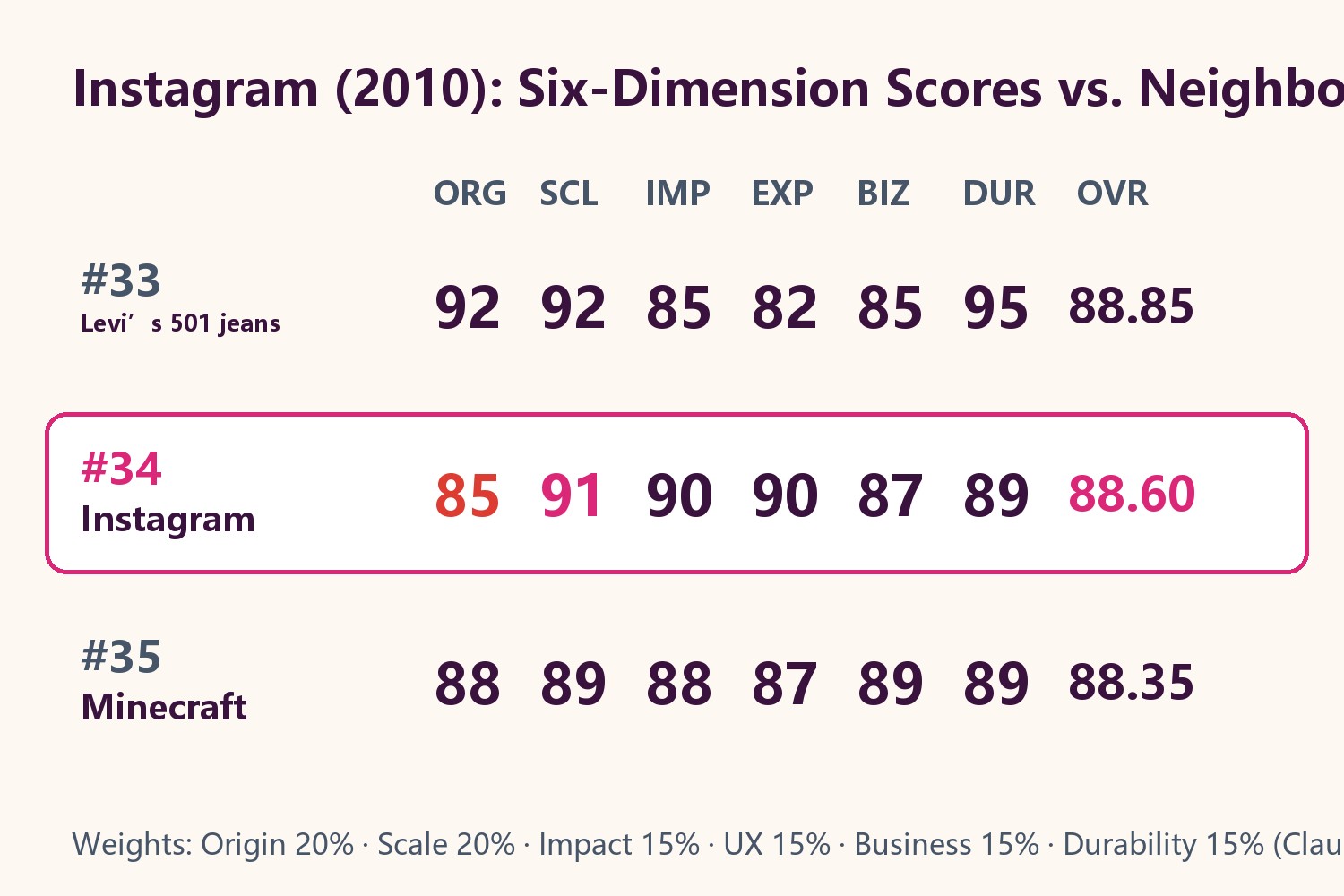
On our 100 Products That Changed the World leaderboard, Instagram (2010) ranks #34 with an overall score of 88.60 (evaluated by Claude AI across our six-pillar rubric): Scale 91, Impact 90, Experience 90, Durability 89, Business 87, and Originality 85.
It sits right behind #33 Levi’s 501 jeans (OVR 88.85) and #32 The Gillette safety razor (OVR 88.85). Where Levi’s 501 gave the 20th century its physical uniform, Instagram gave the smartphone century its visual vernacular.
1. The Most Famous Surgical Cut in Silicon Valley History: Throwing Out 90% of Burbn
Before it was Instagram, the product was Burbn—named after Systrom’s love of Kentucky bourbon whiskey.
In early 2010, location-based check-in apps like Foursquare and Gowalla were the hottest trend at SXSW. Systrom, a Stanford graduate who had worked at Odeo (where Twitter started) and Google before teaching himself to code HTML5 at night, built Burbn as a Swiss Army knife of social features: users could check into bars, make future hangout plans with friends, earn points on leaderboards, and attach photos to their check-ins.
After recruiting fellow Stanford alum Mike Krieger as co-founder and engineer, they turned Burbn into a native iPhone app.
And almost nobody used it. Retention was terrible because the app was cluttered and confusing.
Sitting down at Dogpatch Labs in San Francisco, Systrom and Krieger pulled up their analytics and asked a brutal question: Out of the dozen features inside Burbn, what is the one thing our tiny group of power users actually does every day?
The data was unmistakable: users barely cared about future plans or leaderboard points, but they were attaching photos to almost every single post.
So Systrom and Krieger executed a textbook product pivot:
- They deleted check-ins;
- They deleted future plans;
- They deleted points and badges;
- They threw away 90% of the code they had spent months writing, kept only photos, comments, and likes, and challenged themselves to make posting a mobile photo take no more than three taps.
2. Why a 1:1 Square and Retro Filters Worked: Turning Hardware Flaws into Emotional Art
Today it is easy to forget how mediocre smartphone cameras were in 2010.
Even the brand-new iPhone 4, released in June 2010, had a tiny 5-megapixel sensor that struggled in dim restaurant lighting, produced washed-out skies, and suffered from digital noise. Worse, when people uploaded raw rectangular phone photos to Facebook or Flickr, the mix of portrait and landscape rectangles looked like a messy bulletin board.
Instagram solved both problems with two brilliant constraints:
1. The Mandatory 1:1 Square Frame
Inspired by classic Polaroid instant film and Holga 120 medium-format cameras, Instagram forced every photo into a 1:1 square.
- For composition: The square eliminated the decision between landscape and portrait. Centering a coffee cup, a dog, or a sunset inside a square frame instantly made an amateur snapshot feel intentional and balanced.
- For the mobile feed: On a 3.5-inch iPhone screen, a 1:1 square filled the exact width of the display while leaving room for the username header above and the heart/comment bar below—creating a hypnotic vertical scrolling rhythm.
2. Filters That Hid Low Resolution Behind Nostalgia
Instead of trying to make blurry phone photos look sharper, Systrom’s filters (X-Pro II, Earlybird, Lomo-fi, Nashville, Toaster) leaned into imperfection. By boosting contrast, warming highlights, cooling shadows, and adding vignette borders, a grainy indoor photo of a plate of pasta suddenly looked like a 1970s Kodachrome memory.
Instagram dropped the skill floor of visual self-expression to zero. You didn’t need a $1,500 Canon DSLR or Adobe Lightroom anymore; anyone on earth could produce a frame-worthy image in five seconds.
3. Mike Krieger’s Speed Illusion: Why Instagram Uploaded Photos Before You Pressed “Share”
There was a second, invisible reason why Instagram felt magical in 2010 while competing apps felt sluggish: perceived latency.
In 2010, mobile users were on slow, congested 3G and EDGE networks. Uploading a photo typically took 5 to 15 seconds. In every other photo app, you picked your photo, applied effects, typed your caption, pressed “Upload”—and then stared at a spinning progress wheel for ten seconds while praying your connection wouldn’t drop.
Mike Krieger realized he could hide those ten seconds in plain sight:
The moment you finished picking your filter and landed on the caption screen, Instagram immediately started uploading the compressed JPEG in the background while you were still typing your caption and choosing hashtags!
By the time you finished typing five words and tapped Share, 99% of the image bytes were already sitting on Instagram’s servers. The final tap only had to send a few bytes of text metadata—so the post appeared on your feed instantaneously.
Users raved about how “impossibly fast” Instagram’s servers were. The network wasn’t faster; the UX choreography had simply hidden the physics of 3G wireless behind human typing time.
4. Refusing to Die: Surviving Both the Stories Era and the Short-Video Era
Most consumer social apps peak and fade within five years (MySpace, Vine, Clubhouse, Hipstamatic). Instagram earned an 89 in Durability on our rubric because it twice cannibalized its own sacred cows before competitors could kill it:
- 2016: Launching Instagram Stories to Defeat Snapchat By 2015, Instagram’s own success had created a new problem: because people’s profile grids had become so polished and curated, users stopped posting casual everyday moments—deleting any photo that didn’t get enough likes. Teenagers were fleeing to Snapchat, where ephemeral 24-hour stories removed all social pressure. In August 2016, Systrom swallowed his pride and launched Instagram Stories at the very top of the app, openly crediting Snapchat for inventing the format. Within ten months, Instagram Stories surpassed Snapchat’s entire daily active user base.
- 2020–Present: Unbundling the Square and Pivoting to Reels First by relaxing the 1:1 square requirement in 2015, and then by integrating Reels and AI-driven discovery to counter TikTok’s rise, Instagram transformed from a chronological reverse-photo-album for friends into the world’s premier visual entertainment and commerce graph.
5. Three Product Lessons from Instagram (OVR 88.60)
- If Your Product Does Ten Things Poorly, Find the One Thing Users Actually Love and Burn the Other Nine Had Systrom and Krieger tried to “fix” Burbn’s check-in points, they would have run out of seed money by Christmas 2010. Courage in product management is measured by what you delete.
- Come for the Tool, Stay for the Network Hipstamatic had great filters before Instagram, but it was a paid utility that saved photos to your camera roll. Instagram made the filter tool free and attached it to a public social graph (Follow, Double-Tap Like, Feed)—turning a utility into an unbreakable network effect.
- Choreograph UX Around Human Latency Krieger’s background pre-upload remains one of the greatest UX hacks in mobile history. Whenever your product involves slow network or AI inference steps, overlap the machine’s work with the user’s thinking time.
Related Reading
- Previous Rank (#33): Levi’s 501 Jeans: How a Two-Cent Copper Rivet Kept Miner Workwear Alive for 150 Years
- Neighbor Rank (#32): The Gillette Safety Razor: Sell the Handle Cheap, Sell the Blades Forever
- Full Leaderboard: 100 Products That Changed the World
Discussion