Dropping Out at 19 to Spend 4 Years Coding in a Browser: How Dylan Field Turned Design Into a Multiplayer Game and Forced Adobe to Offer $20 Billion
If you walked into any software company in 2015 and looked at a UI designer’s desktop, you would see a graveyard of filenames that induce instant PTSD:
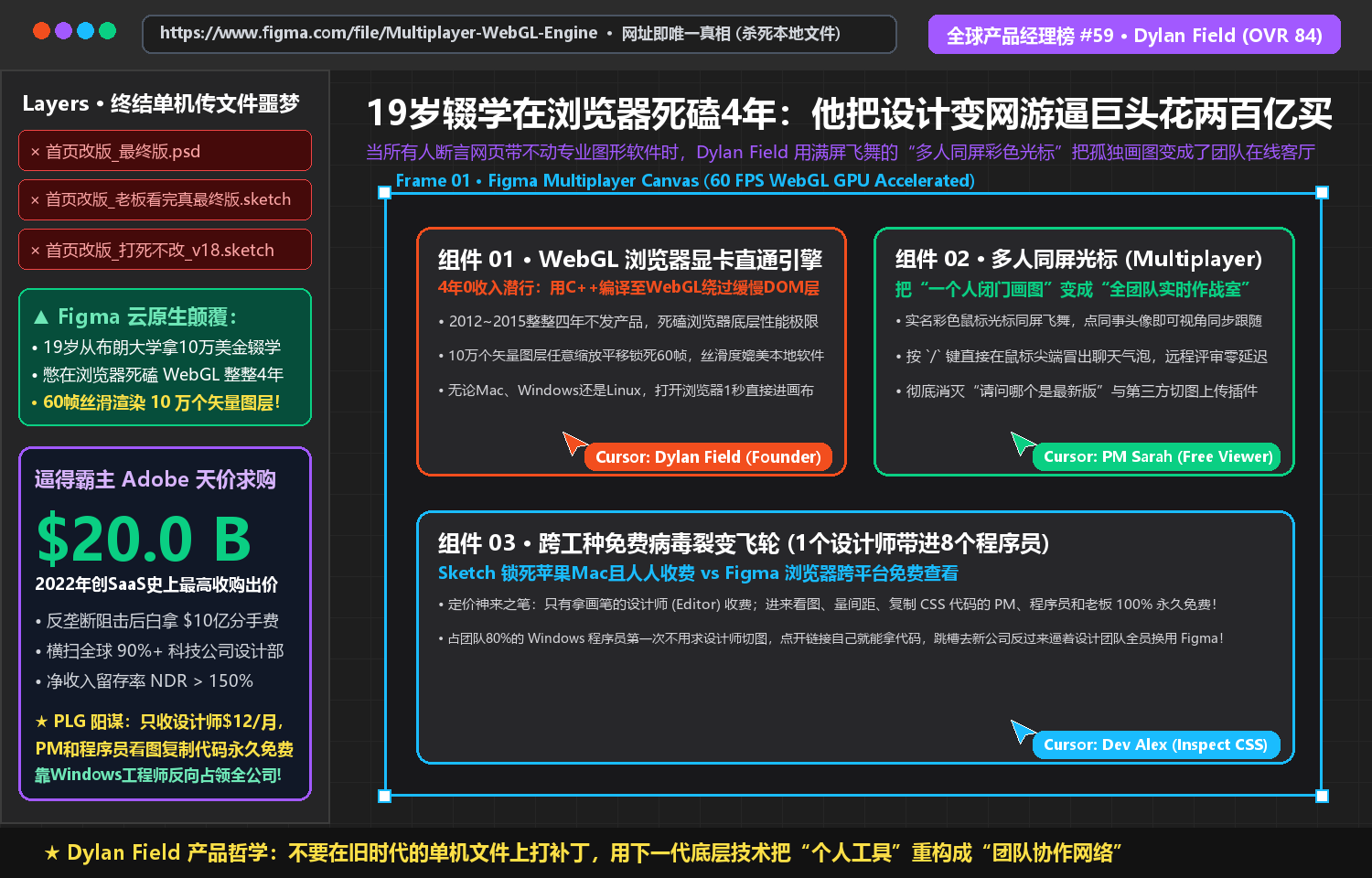
Checkout_Redesign_v1.psdCheckout_Redesign_Final.sketchCheckout_Redesign_CEO_Feedback_Final_v14.sketchCheckout_Redesign_USE_THIS_ONE_0328.sketch
For thirty years, creative software—dominated by Adobe (Photoshop / Illustrator) and later Sketch—treated design as an isolated, single-player desktop priesthood.
Designers worked alone on heavy local files on high-end Macs. Whenever a product manager or front-end engineer needed to check a spec or grab an icon, the designer had to export static PNGs, upload gigabytes to Dropbox, or sync to third-party handoff plugins like Zeplin or InVision. Half the time, engineers spent days building the wrong screen because someone forgot to upload v15.
Everyone hated the workflow, yet everyone assumed professional graphics software had to live on the desktop—until a 19-year-old college dropout named Dylan Field asked a deceptively simple question:
“Google Docs already lets ten people edit a document simultaneously inside a browser tab. Why is software design still stuck in the Stone Age of emailing local files back and forth? What if the entire design tool lived inside a single URL?”
A decade later, that “impossible” browser tab—Figma—captured over 90% of the world’s product design market and terrified industry titan Adobe so deeply that Adobe offered $20 billion (the largest software acquisition bid for a private SaaS company in history) just to avoid being disrupted by it.
On our Top 100 Product Managers Who Changed the World leaderboard, Dylan Field ranks #59 globally with an OVR of 84 (Vision 86 / Insight 86 / Taste 90 / Business 80 / Scale 80 / Originality 86). Here is how a 20-year-old founder rewrote the laws of creative software.
1. The $100,000 Thiel Fellowship & Four Brutal Years in the WebGL Wilderness
Born in 1992 in Sonoma County, California, Dylan Field grew up obsessed with math, robotics, and design. While studying computer science at Brown University and interning at LinkedIn and Flipboard, he witnessed firsthand the daily friction between PMs, designers, and engineers fighting over outdated mockups.
In 2012, at age 20, Field accepted the $100,000 Thiel Fellowship, dropped out of Brown, and teamed up with his brilliant Brown CS teaching assistant Evan Wallace (a computer graphics prodigy).
In a Silicon Valley culture obsessed with “ship a quick MVP in two weeks,” Figma’s first four years looked like slow-motion suicide:
- From 2012 through late 2015—nearly four full years—Figma shipped zero public products, earned $0 in revenue, and stayed in closed stealth.
- Why? Because standard browser HTML DOM and 2D Canvas choked the moment a designer zoomed in on a file with 5,000 vector layers.
- Field and Wallace refused to compromise on performance: “If a browser tool is even 10% laggier than a native Mac app, designers will never switch.” They built a custom, C++-compiled WebGL rendering engine inside the browser that talked directly to the GPU—capable of panning and zooming across 100,000 vector objects at a locked 60 frames per second.

2. Three Product Decisions That Killed the .sketch File
Once the WebGL engine was bulletproof, Dylan Field executed three masterstrokes of product strategy:
1. Killing the “File”: The URL Is the Single Source of Truth
Before Figma, software was built around files—and every time you copied or exported a file, it immediately began rotting out of sync. In Figma, there is no file to email or export; there is only a live URL. When a designer pastes a Figma link into Slack, the PM on an iPad, the engineer on a Windows ThinkPad, and the CEO on a MacBook all open the exact same live canvas in 1 second with zero software installation. The question “Wait, is this the latest version?” vanished overnight.
2. Multiplayer Cursors: Turning a Lonely Tool Into the Company’s Living Room
When Figma introduced live multiplayer cursors in 2016, veteran designers initially rebelled: “Why would I want my PM hovering over my canvas watching me move pixels?!” Field saw past the initial discomfort: software design is not a solo art project; it is a team sport of continuous alignment.
- He added Observation Mode (click any teammate’s avatar in the top bar to lock your viewport to their cursor during design reviews) and Cursor Chat (press
/to type live speech bubbles right next to your pointer). - When remote work exploded in 2020, Figma’s canvas became the primary virtual war room where entire product organizations brainstormed, critiqued, and shipped together.
3. Charging Only the “Pen Holders” while Turning PMs & Engineers Into Free Evangelists
Sketch was macOS-only (locking out 70% of the world’s Windows-using engineers and PMs) and charged every user a license fee. Field engineered the ultimate cross-functional PLG (Product-Led Growth) Trojan horse:
- Editors (designers) paid $12–$15/month; Viewers (PMs, engineers, executives, copywriters) were 100% free forever on any operating system.
- Every time 1 designer shared a Figma link, 5 engineers and 2 PMs clicked in for free to inspect CSS values, measure padding, and leave comments. Within months, it was the engineers and PMs demanding that their entire company standardize on Figma!
3. The $20 Billion Adobe Panic and the Victory of Independence
By 2022, Figma’s net dollar retention exceeded 150%, and Adobe—watching its own clone (Adobe XD) collapse into irrelevance—offered $20 billion to acquire Figma. When European and UK antitrust regulators blocked the deal in late 2023—declaring that Figma was so dominant that letting Adobe buy it would eliminate competition in digital design—Adobe had to wire Figma a $1 billion cash breakup fee. Unfazed, Dylan Field pocketed the billion dollars, launched FigJam, Dev Mode, and Figma AI, and cemented Figma as one of the greatest standalone software platforms of the 21st century.
Discussion