Top 100 Product Managers · #56 Ivan Zhao: From Near-Bankruptcy in Kyoto to a $10B Empire Built on 'Everything is a Block'
In the summer of 2015, Ivan Zhao faced a founder’s worst nightmare. After two years in San Francisco building a visual no-code app builder, his startup was nearly out of money, the app crashed constantly, and everyday users had zero interest in “building their own software.”
To survive, Zhao made a radical move: he let go of his small team, gave up their San Francisco lease, borrowed $150,000 as a lifeline from his mother, and moved with co-founder Simon Last to a cheap rental house in Kyoto, Japan.
Working 18 hours a day in their pajamas, they threw away every line of old code and rebuilt from scratch. What emerged from that year in Kyoto was Notion—now a $10 billion productivity powerhouse used by over 100 million people worldwide.
1. From Urumqi to UBC: Combining Art and Early Computing Philosophy
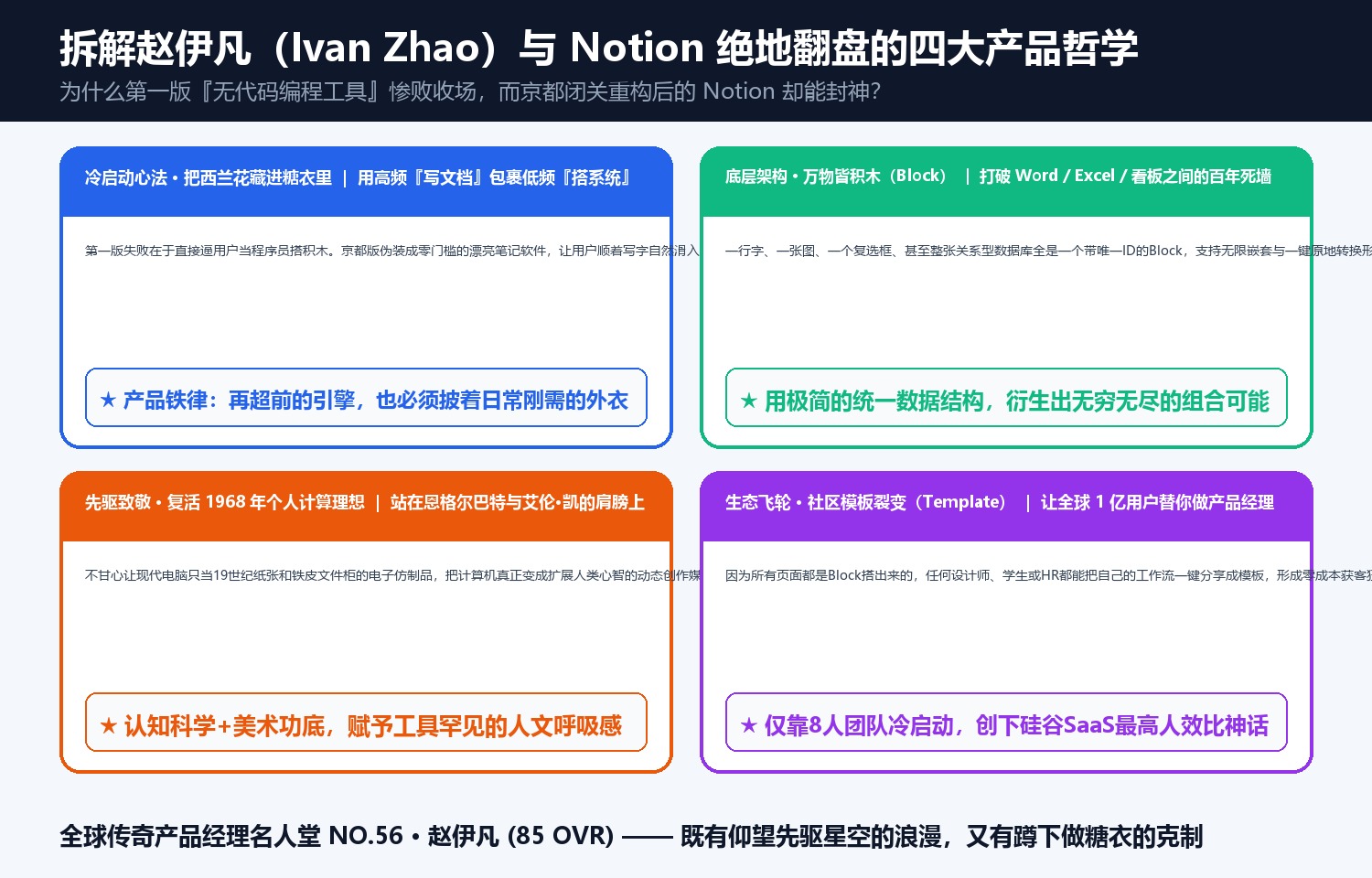
Born in Urumqi, China, and educated at the University of British Columbia in cognitive science and fine arts, Zhao was obsessed with the 1960s–70s computing visions of Doug Engelbart and Alan Kay. Why, forty years after Xerox PARC, were office workers still trapped inside digital imitations of 19th-century paper and filing cabinets (Word, Excel, PowerPoint)?
2. “Hide the Broccoli in the Sugar” & “Everything is a Block”
Why did Notion’s first version fail while its Kyoto rebuild succeeded?
- Hide the Broccoli in the Sugar: Relational databases and custom workflows are “broccoli”—good for you, but nobody wakes up wanting to build a database. Docs, notes, and to-do lists are “sugar.” Notion disguised a full relational software engine inside a clean, frictionless note-taking editor triggered by a simple
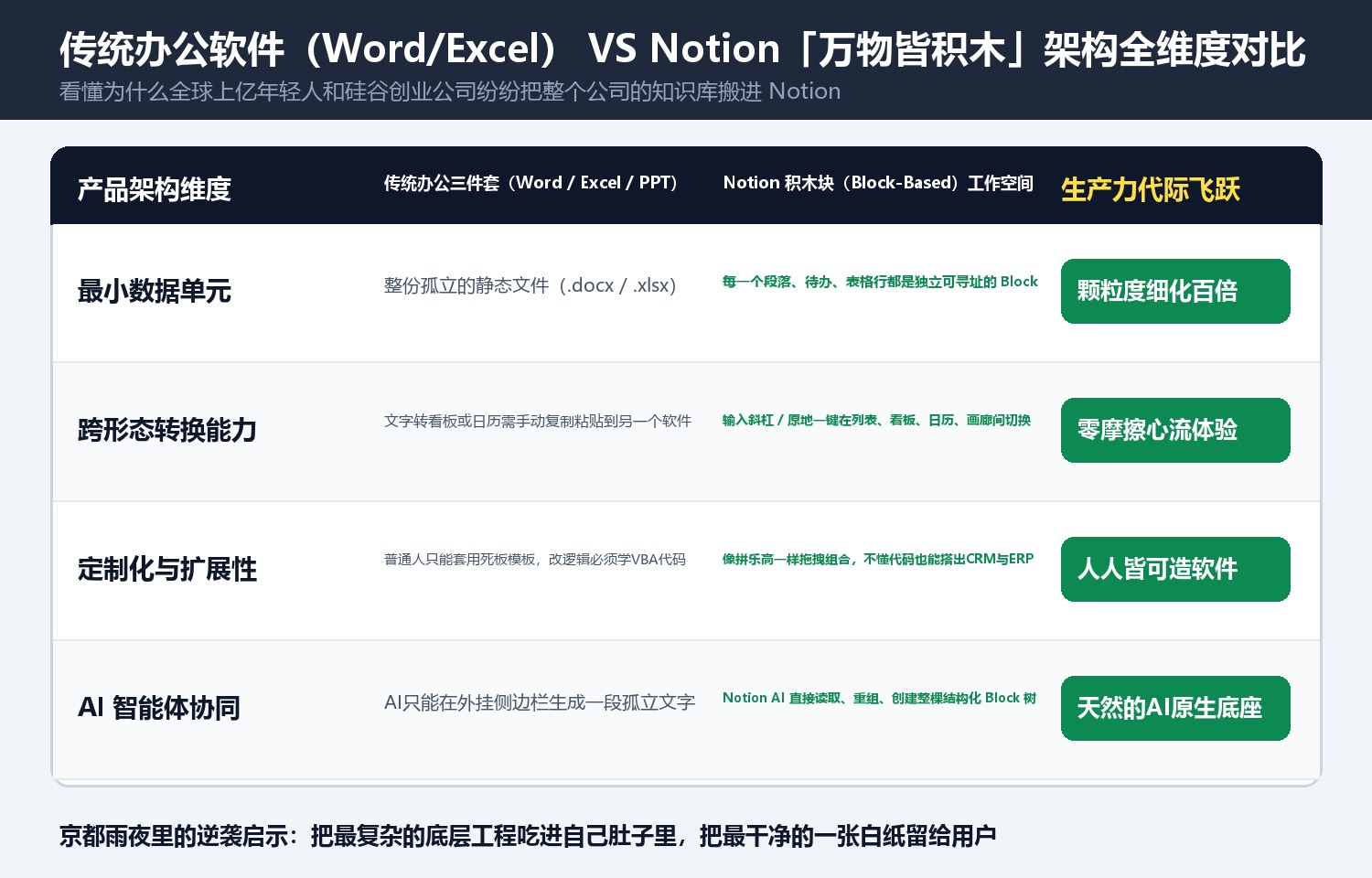
/slash command. - Everything is a Block: In Notion’s unified data model, a paragraph, a checkbox, an image, a Kanban card, and an entire database are all Blocks with unique IDs and tree pointers—allowing any piece of thought to transform (
Turn Into) and nest infinitely.
Discussion