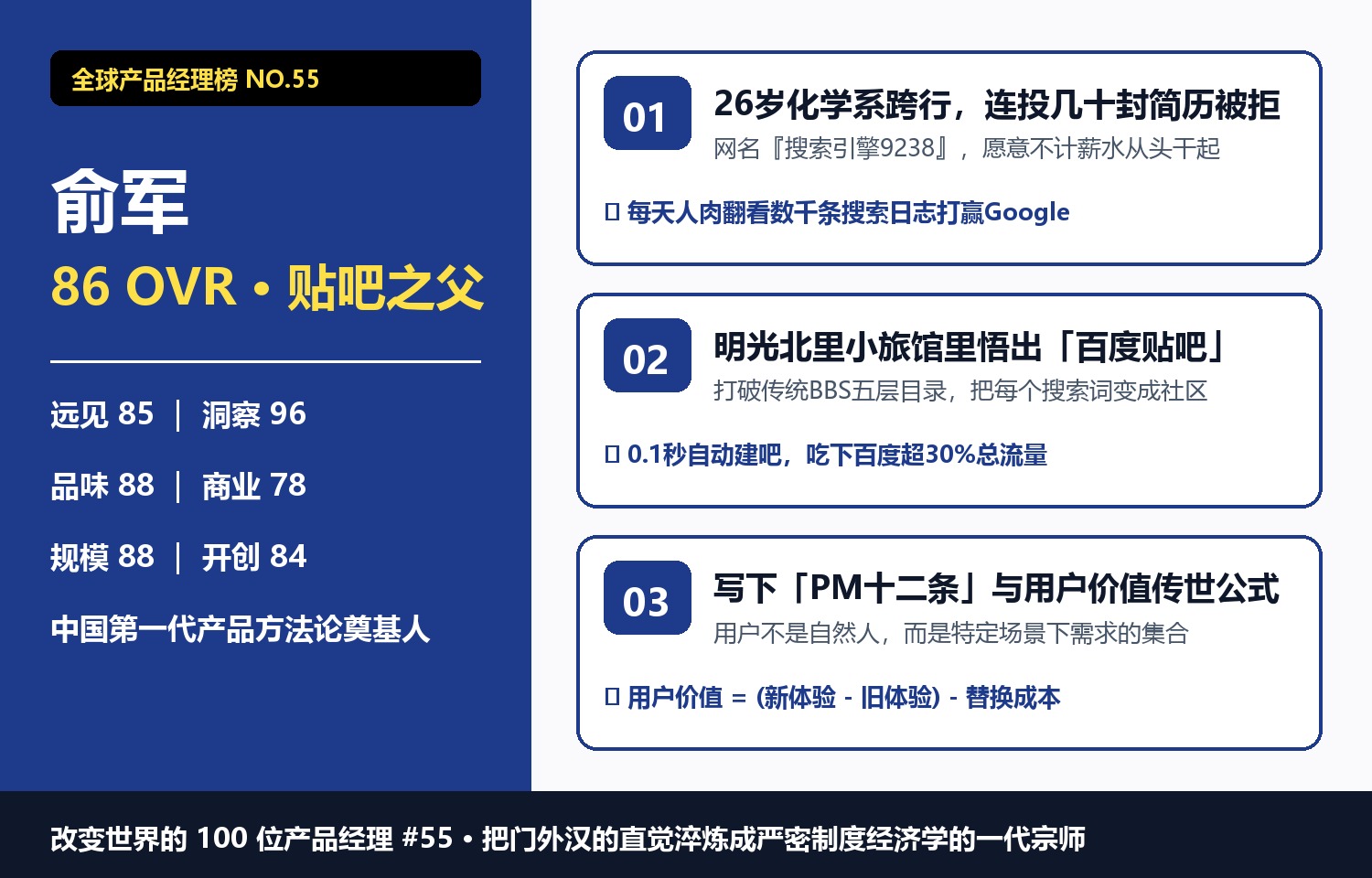
PM Rank #55: Yu Jun (86 OVR) — Rejected Dozens of Times at 26, the Chemistry Grad Who Built Baidu Tieba and Wrote China's First Product Methodology
In 2000, a 26-year-old chemistry graduate from Tongji University sat in front of a CRT monitor in Shanghai, sending out dozens of resumes to every internet portal in China. His cover letter began: “I love search engines so much that I am willing to give up everything in Shanghai and start from scratch at any search company, regardless of salary.”
Nearly every company ignored him. Yet a few months later, early-stage Baidu hired him. Over the next nine years, Yu Jun helped Baidu Search overtake Google in China, invented Baidu Tieba (Post Bar)—turning every search keyword into an instant interest community for hundreds of millions of users—and authored the foundational methodology for an entire generation of Chinese product managers.
In the doaipm.com Global PM Hall of Fame, Yu Jun ranks #55 with an 86 OVR (and a staggering 96 in User Insight).
1. Keyword as Community: How Baidu Tieba Captured the Long Tail
In 2003, traditional BBS forums required editors to manually pre-create rigid directory trees. Holing up in a modest Beijing hotel, Yu Jun asked a radical question: Why not turn every search query directly into a community forum? If a user searched for an obscure novel, a band, or a high school name, Tieba either took them straight into the community or created it in 0.1 seconds. Within two years, Tieba generated over 30% of Baidu’s total page views with zero external customer acquisition cost.
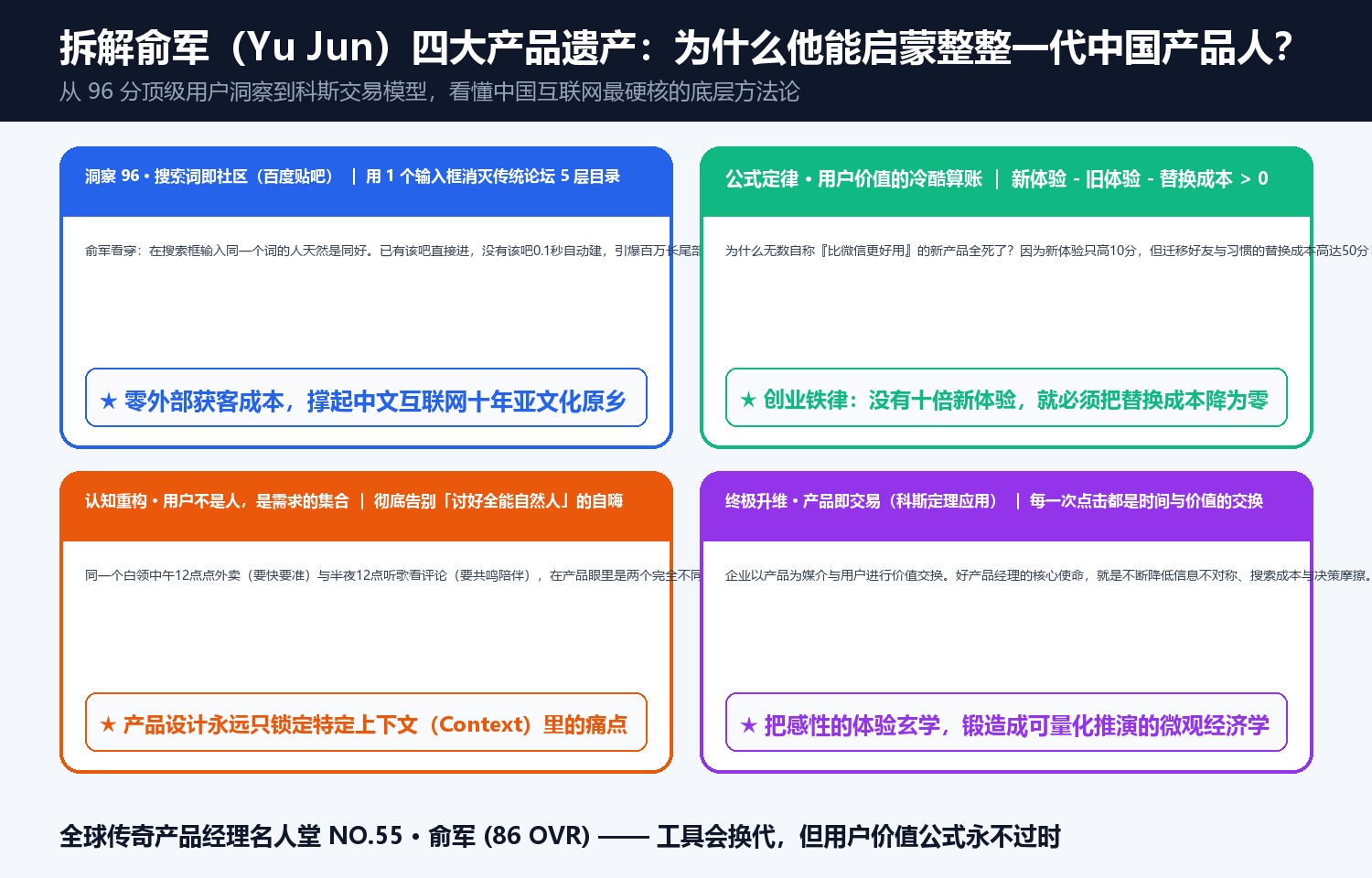
2. The Immortal Formula: User Value = (New Experience - Old Experience) - Switching Cost
Yu Jun transformed Chinese product management from gut-feel guesswork into applied microeconomics:
- Users Are Not People, But Bundles of Context-Specific Needs: The same person ordering lunch at noon and listening to music at midnight represents two distinct demand vectors.
- The User Value Equation: Even if your new product is 20% better than the incumbent, if the user’s switching and learning cost is 30%, net user value is negative—and your product dies.

Discussion