Tobi Lütke: From a Frustrated Snowboard Shop Owner to the Man Arming Millions of Rebels Against Amazon
Ranked #45 on the DO AI PM Global Top 100 Product Managers List is Tobi Lütke, Founder and CEO of Shopify, with an overall six-dimension score of 87.2 (VIS 90, BIZ 90, INS 87, TST 86, SCL 85, ORG 85).
For two decades, conventional wisdom in global e-commerce held one truth to be self-evident: online retail is a winner-take-all marketplace monopoly. Whether Amazon in the West or Taobao and JD in China, the playbook was identical—build a massive digital mall, aggregate all consumer traffic, and charge millions of merchants rent and advertising tolls to reach those shoppers.
Against that seemingly invincible orthodoxy, Tobi Lütke built Shopify on the exact opposite premise: you will never see a cardboard box with a Shopify logo on your doorstep, and most shoppers have no idea that the sneaker, coffee, or cosmetics brand they just bought from runs on Shopify—yet Shopify powers over $230 billion in annual Gross Merchandise Volume (GMV), representing more than 10% of all US e-commerce, second only to Amazon.
He proved one of the most compelling product truths of our era: when giants are busy building an Empire to rule over merchants, arming the Rebels who want to own their own name is an equally massive hundred-billion-dollar opportunity.
1. Driven Crazy by Bad Software: When the Shovel Outsold the Snowboards
Born in Koblenz, Germany in 1980, Tobi Lütke started modifying computer games at age 11 and left school at 16 to enter a coding apprenticeship at a Siemens subsidiary.
In 2002, at age 22, he moved to Ottawa, Canada to be with his girlfriend (now wife). Lacking a work permit for a corporate job at first, the avid snowboarder and his friends decided to launch an online snowboard shop called Snowdevil.
As a seasoned programmer, Lütke assumed setting up an online store meant buying an off-the-shelf software package. After testing a dozen enterprise e-commerce tools—from Yahoo! Stores to Miva—he was appalled:
- Every tool was designed for corporate IT committees, burying simple layout changes under hundreds of bloated configuration screens;
- Buying a single snowboard forced a customer through five or six separate checkout pages, bleeding conversions at every click.
At that exact moment, the open-source web framework Ruby on Rails had just been released, and Lütke was one of its earliest core contributors. Out of sheer frustration, he spent two months building a clean, three-step online store engine for Snowdevil from scratch.
Then something unexpected happened: while snowboard sales were modest, Lütke’s inbox flooded with emails from surfboard makers, indie apparel designers, and coffee roasters asking: “Hey, nice snowboards—but what software is running your checkout? Can we license it?”
Recognizing that the shovel was far more valuable than the gold mine, Lütke pivoted in 2006, packaging his internal store engine into a SaaS platform called Shopify.
2. Three Product Doctrines That Built the Anti-Amazon
Why do millions of independent brands—from Allbirds and Gymshark to solo creators—choose Shopify? It comes down to three product rules Lütke has enforced for twenty years:
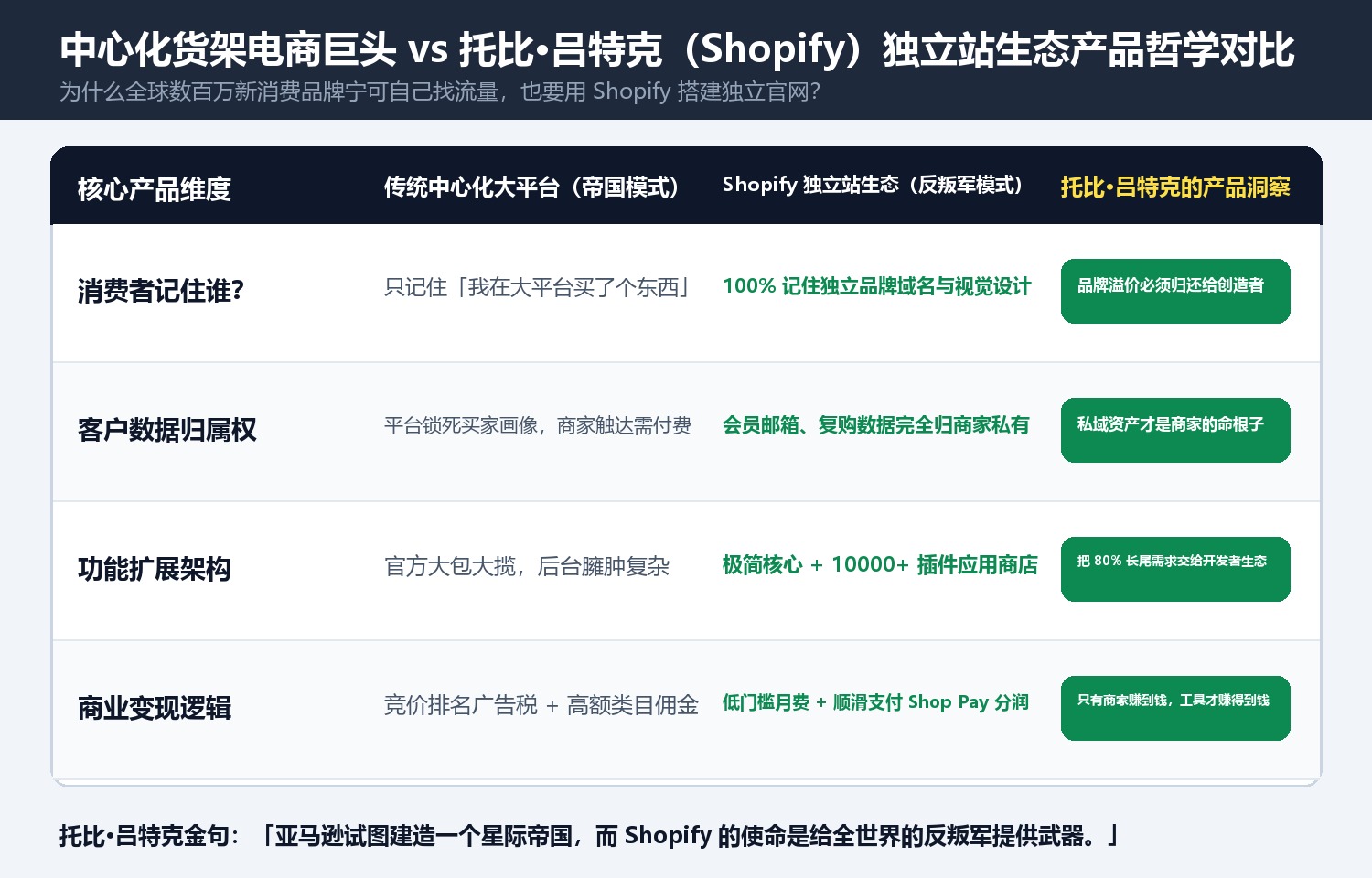
1. “Arming the Rebels”: Leave the Spotlight 100% to the Merchant
Centralized marketplaces suffer from a structural conflict of interest: the stronger the marketplace becomes, the more replaceable the merchant becomes. When you buy a water bottle on Amazon, you tell your friends, “I bought it on Amazon,” not the brand’s name. Worse, if a merchant’s product becomes a runaway hit, the marketplace controls the customer relationship and can launch a private-label knockoff right above the original creator in search results.
In 2019, Lütke crystallized his product worldview in a single sentence: “Amazon is trying to build an Empire, and Shopify is trying to arm the Rebels.” On Shopify, the custom domain, brand identity, customer emails, and repeat-purchase data belong 100% to the merchant. Shopify stays invisible in the background, turning enterprise-grade infrastructure—global CDNs, tax compliance, fulfillment, and working capital—into a $29/month utility any founder can turn on in ten minutes.
2. Keep the 80% Simple, Make the 20% Possible via Ecosystem
Enterprise software usually dies from feature bloat—cramming every edge-case button into the main dashboard until novices can no longer use it.
Lütke enforced a strict architectural boundary: if a feature is not needed by at least 80% of merchants every day, it does not belong in Shopify’s core admin.
- A first-time founder can pick a theme, upload three product photos, and accept payments within 10 minutes;
- For the remaining 20% of complex, vertical-specific workflows, Lütke launched the Shopify App Store and Liquid templating engine in 2009—allowing over 10,000 third-party apps to serve specialized needs without bloating the core product.
3. Killing Checkout Friction with Shop Pay
On mobile screens, typing a 16-digit credit card number and billing address kills up to 70% of independent-store shopping carts. To give independent Rebels the same frictionless weapon as Amazon’s 1-Click ordering, Lütke built Shop Pay—a network-wide identity wallet where buying once at any Shopify merchant lets you check out in 1.5 seconds via SMS code at millions of other independent stores, boosting mobile conversion rates by 1.72x and turning merchant financial solutions into over 70% of Shopify’s total revenue.
Discussion