Jensen Huang Steps Down After 33 Years: Why NVIDIA's 60-Direct-Report CPU and the CFO Trap Are the Real Crisis
On November 12, 2026, Silicon Valley and Wall Street witnessed the most seismic leadership shock of the AI era: NVIDIA officially announced that founder Jensen Huang has stepped down as President, Chief Executive Officer, and member of the Board of Directors, effective immediately, ending a legendary 33-year run. Executive Vice President and CFO Colette Kress has been named Interim CEO, while Harvey Jones becomes the company’s first Chairman of the Board.
Just four days earlier, on November 8, when the 63-year-old Huang sent an all-hands email admitting infidelity to his wife of 41 years amid scrutiny over multi-billion-dollar GPU allocations to Singapore-based Megaspeed, the board had pledged its “full support” for his continued leadership. Ninety-six hours later—under mounting congressional and regulatory pressure—that firewall collapsed completely.
While Wall Street fixates on the 10%+ pre-market plunge, the deeper structural crisis lies inside NVIDIA’s unique organizational architecture and semiconductor history: Why removing the sole CPU of a 60-direct-report empire with zero succession planning—and handing the reins to a CFO—marks the end of the ‘Leather Jacket FOMO Tax.’
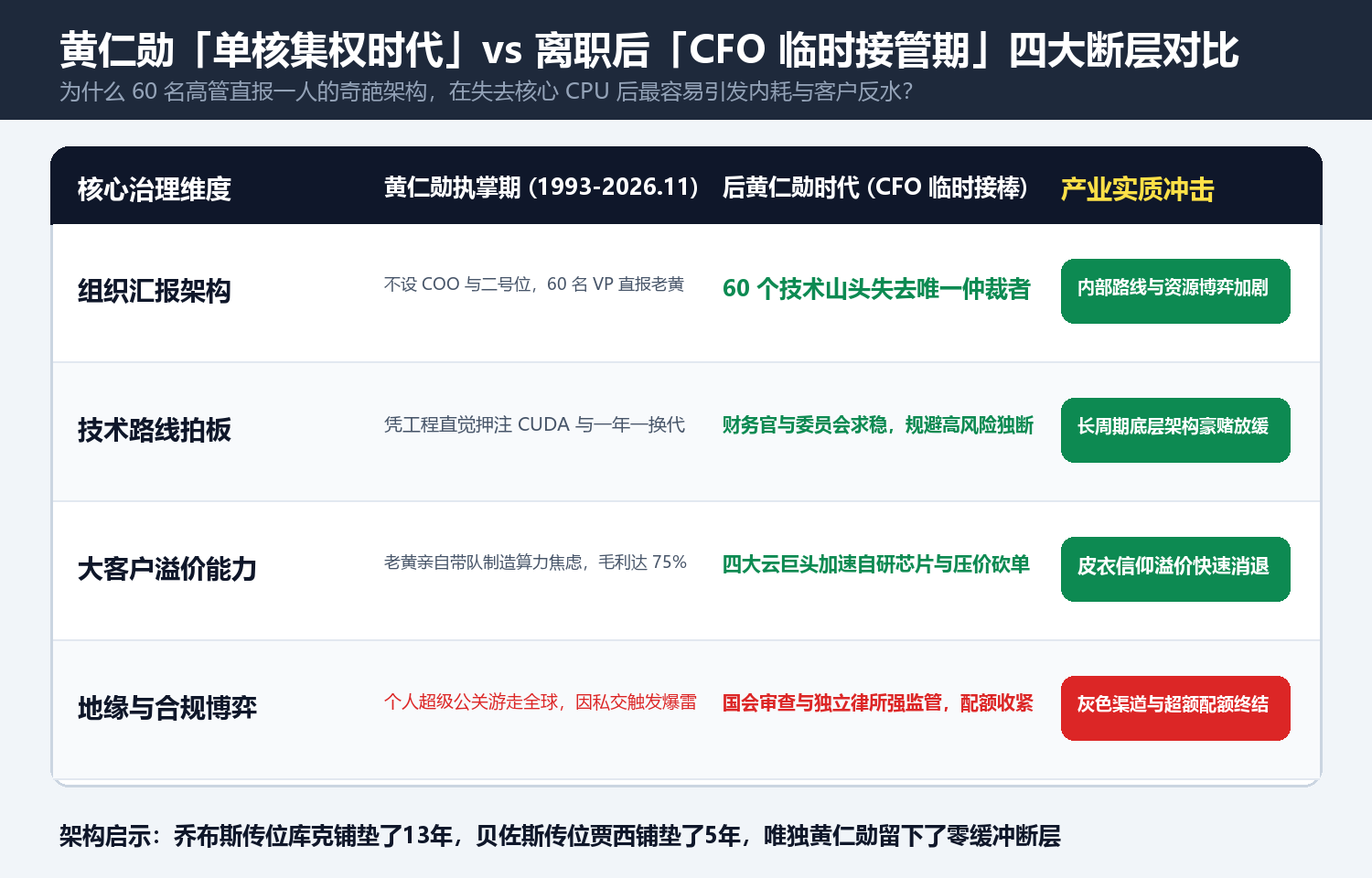
1. Unplugging the Sole CPU: 60 Direct Reports and Zero Heir Apparent
Unlike Apple (where Tim Cook served as COO for years before Steve Jobs passed), Microsoft, or Amazon (where Andy Jassy was groomed to succeed Jeff Bezos), Jensen Huang famously ran a $3 trillion empire with no COO, no division presidents, and 60 vice presidents reporting directly to him.
Huang was the human System Bus connecting 60 specialized engineering silos. Removing that single node overnight without an heir apparent creates an immediate power vacuum among 60 world-class engineering heads who previously answered only to Huang’s technical intuition.
2. When a CFO Takes Over a Chip Empire: The Intel & Boeing Curse
Throughout semiconductor and aerospace history, a recurring law holds true: when a hardcore engineering empire transitions from a paranoid engineer-founder (like Intel’s Andy Grove) to a finance-first executive (like Intel’s Bob Swan or post-merger Boeing), short-term margin protection and risk aversion inevitably replace decade-long architectural moonshots like CUDA.

3. The End of the ‘Leather Jacket FOMO Tax’
Half of NVIDIA’s 75% gross margin was sustained by Jensen Huang’s personal ability toorchestrate FOMO among hyperscalers. With Huang gone and compliance committees tightening GPU allocation oversight, Microsoft, Google, Meta, and Amazon now have the ultimate opening to accelerate their custom silicon (TPU, Trainium, Maia, MTIA) and negotiate down GPU pricing, while algorithmic efficiency breakthroughs like DeepSeek shift the industry from brute-force GPU hoarding to real-world application ROI.
Discussion