At 63, Jensen Huang Sends an All-Hands Email Admitting Infidelity: The AI Compute Shadow War Behind the Collapse of a 40-Year Persona
On November 8, 2026, a bombshell detonated at the very top of Silicon Valley.
Jensen Huang, the 63-year-old founder and CEO of NVIDIA, sent a deeply personal internal email to tens of thousands of employees—subsequently released publicly by the company—admitting that he had been unfaithful to his wife, Lori Mills:
“I owe my family and all of you an apology. I was unfaithful to my wife. My actions hurt her and our children. There is no excuse for what I did. I am deeply sorry… I take full responsibility for my actions and the hurt I have caused, and I accept the criticism that comes with it.”
For three decades, Jensen Huang’s public image rested on two pillars: his trademark black leather jacket and his legendary 46-year romance with Lori Mills, whom he met at age 17 in an electrical engineering lab at Oregon State University and married in 1985.
Why did the leader of a $3 trillion AI compute empire suddenly confess personal infidelity in a company-wide memo? When we examine the concurrent investigations into Singapore data center firm Megaspeed and its former executive Alice Huang (Huang Le) alongside the NVIDIA board’s official statement, a deeper reality emerges: this is not merely a personal scandal, but a calculated crisis-containment maneuver amid a multi-billion-dollar GPU allocation storm and a stark warning about single-point-of-failure governance.

1. The 1980 Lab Promise and 41 Years of Marriage: Wall Street’s Ultimate Credibility Anchor
To understand why this memo shook Silicon Valley and Wall Street, one must understand what Lori Mills represented in NVIDIA’s founding mythology.
In 1980, 17-year-old Jensen Huang entered Oregon State University’s electrical engineering program, where only three of the 250 students were women. One of them was 19-year-old Lori Mills. Huang famously asked her to be his lab partner, promising that if she did homework with him every Sunday, he would guarantee she got straight A’s. They married in 1985, and she stood by him through NVIDIA’s near-bankruptcy in 1996 when the NV1 chip failed and the company had only 30 days of payroll left.
For institutional investors, a founder’s personal stability is an implicit governance metric. After high-profile divorces shook Amazon and Microsoft in previous years, Huang’s 41-year marriage was widely viewed as proof of extraordinary personal discipline and zero personal-conduct tail risk.
2. Megaspeed and the Multi-Billion-Dollar GPU Allocation Shadow War
No CEO of a $3 trillion public company sends an all-hands email about marital infidelity purely over a private domestic dispute. The timing of the November 8 confession was directly catalyzed by investigative reporting from The New York Times, Bloomberg, and Axios, as well as inquiries from U.S. congressional committees.
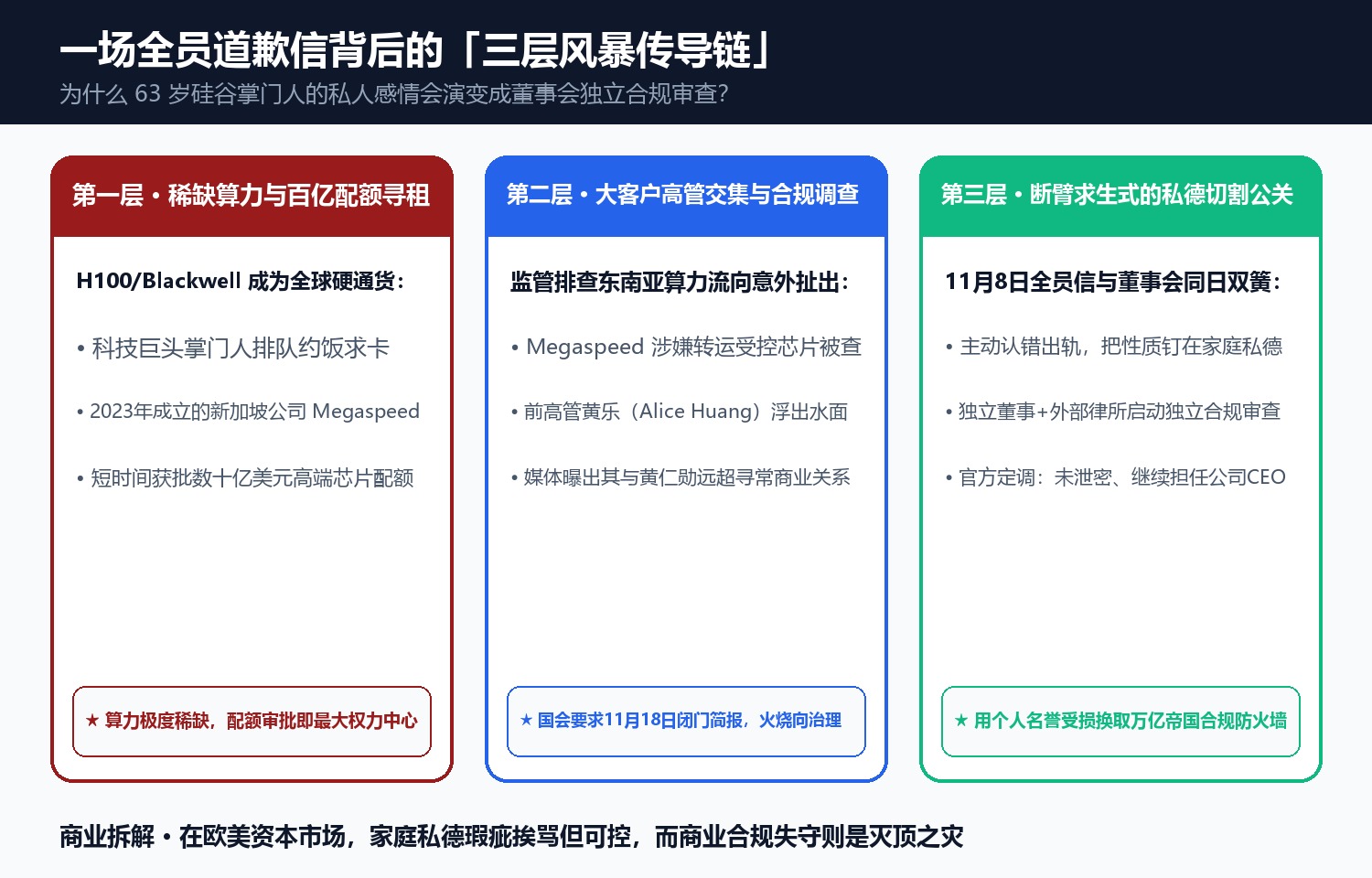
1) When GPUs Become Sovereign Currency, Quota Approval Becomes the Ultimate Power Center
Between 2023 and 2026, NVIDIA’s H100, H200, and Blackwell clusters became the scarcest strategic resource on Earth. Against that backdrop, Megaspeed International, a young Singapore-based data center firm, secured billions of dollars’ worth of coveted NVIDIA AI chips—only to come under regulatory scrutiny over allegations of chip diversion.
2) Surgical Crisis Containment: Drawing a Firewall Between Personal Conduct and Corporate Security
When investigative reporters scrutinized Megaspeed, they uncovered a close personal relationship between Huang and former Megaspeed executive Alice Huang. Before critics and lawmakers could frame the narrative around corporate compliance failure or compromised supply chains, Huang and NVIDIA’s board executed a classic crisis-management split:
- Owning the Moral Failing: By publicly confessing marital infidelity first, Huang anchored the story firmly in the realm of personal family misconduct rather than corporate malfeasance.
- Independent Board Ring-Fencing: On the same day, NVIDIA’s board announced an independent committee backed by outside legal counsel, explicitly stating that there is no reason to believe national security or NVIDIA’s trade secrets were compromised and reaffirming full confidence in Huang’s continued leadership as CEO.
3. Single Point of Failure: The Limits of 60 Direct Reports
While NVIDIA’s board stabilized the immediate leadership question, the crisis exposed the structural vulnerability of NVIDIA’s famous management model: 60 executives reporting directly to Jensen Huang with no COO and no clear #2 successor.
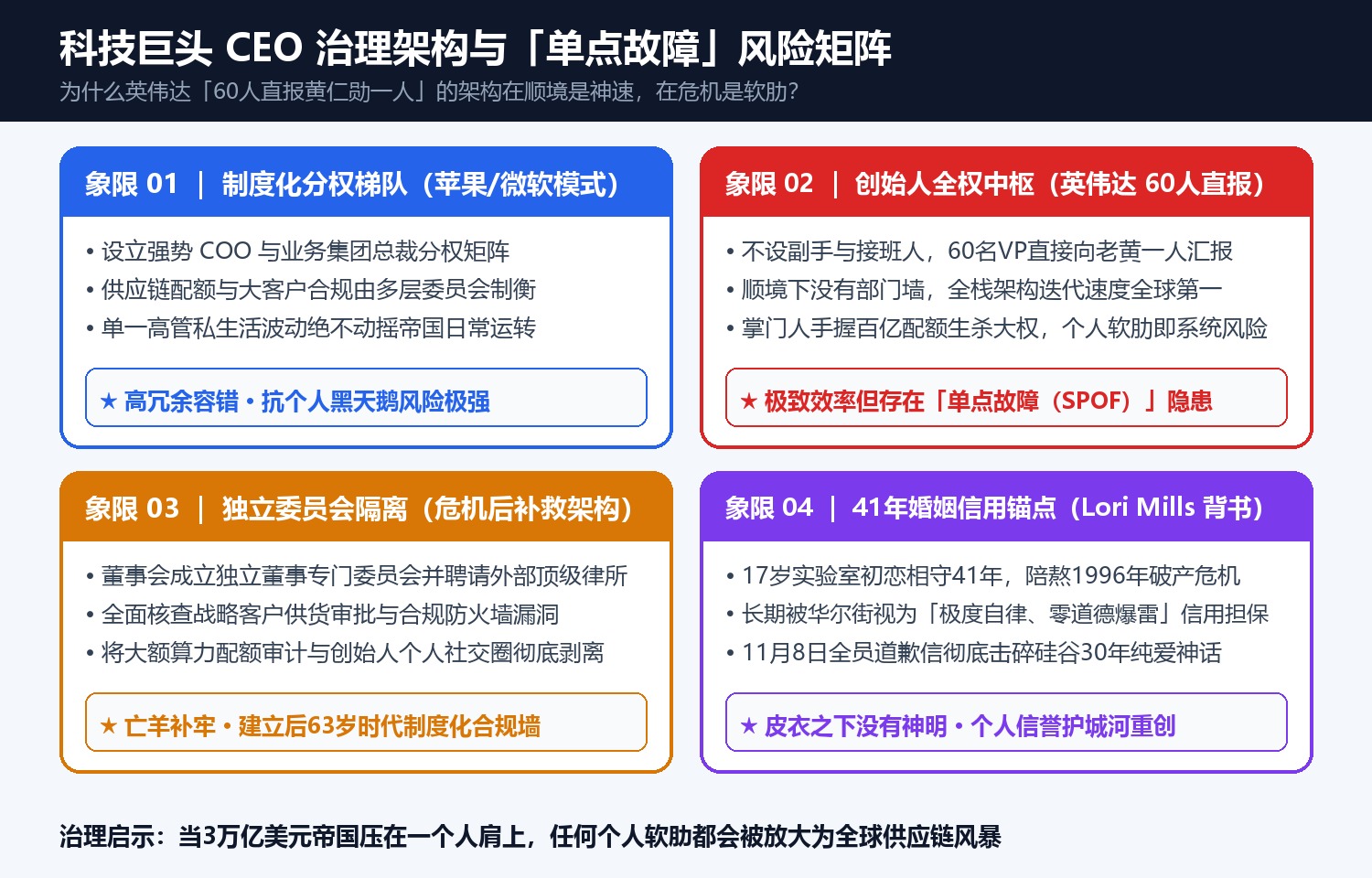
In distributed systems engineering, concentrating all routing and authorization authority into a single node maximizes speed in fair weather—but creates a catastrophic Single Point of Failure (SPOF) if that node is targeted or compromised. As NVIDIA enters an era of intense geopolitical scrutiny and independent board oversight, institutionalizing supply-chain compliance and succession governance away from a single founder’s personal orbit is no longer optional.
Discussion