Why Jack Ma Spent Two Years Studying Farms and Fisheries: Tech Billionaires' Quiet Bet on Food
If you connect the dots of Jack Ma’s public appearances over the past two years since stepping back from Alibaba, a striking pattern emerges.
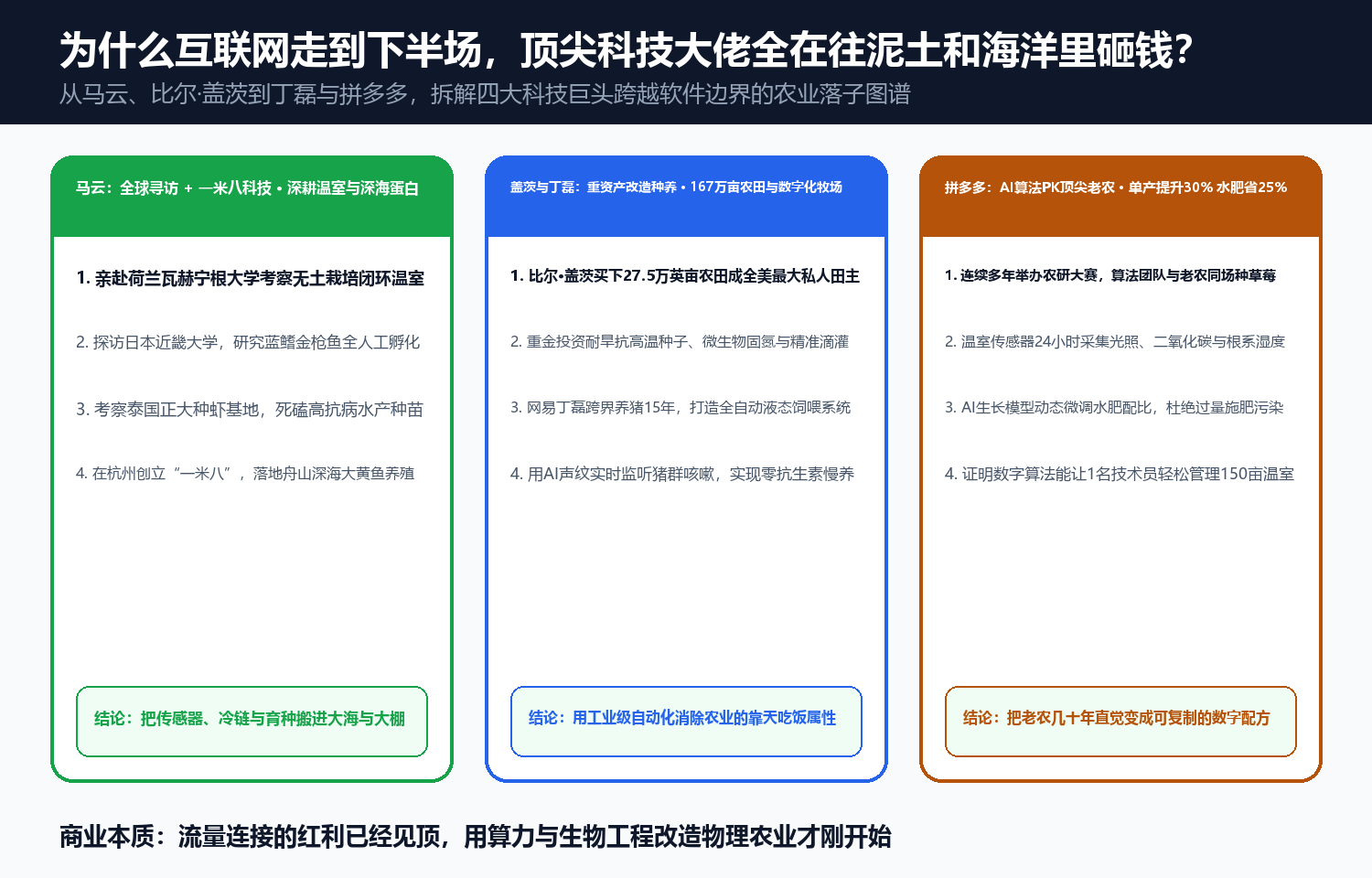
The founder of China’s largest e-commerce and digital payment empire did not head to Silicon Valley to bankroll another chatbot startup, nor did he set up a Wall Street hedge fund. Instead, wearing a casual baseball cap, he has been touring the world’s most advanced agricultural laboratories, glass greenhouses, and offshore aquaculture stations.
In the Netherlands, he walked through the climate-controlled greenhouses of Wageningen University & Research, inspecting hydroponic pipelines that yield 75 kilograms of tomatoes per square meter annually. In Japan, he visited the Aquaculture Research Institute of Kindai University to study how researchers spent 32 years mastering full-cycle artificial hatching of Pacific bluefin tuna. In Thailand, he toured Charoen Pokphand Group’s shrimp breeding labs. Back in Hangzhou, he backed the launch of “1.8 Meters Marine Technology”, setting up deep-sea ecological cages off Zhoushan to raise yellow croaker and mussels.
Why are the sharpest minds in software and internet history—from Jack Ma and Bill Gates (who quietly acquired 275,000 acres of U.S. farmland) to NetEase’s Ding Lei and Pinduoduo’s algorithmic farming teams—suddenly obsessed with soil, seeds, and fish?
The answer lies in three hard physical and economic ledgers.
Ledger 1: The Dutch Miracle and the 60% Waste in Traditional Farming
With just 41,500 square kilometers of land—a quarter of it below sea level—the Netherlands is the world’s second-largest net exporter of agricultural products by value, trailing only the United States (which has 220 times its land area).
In Wageningen’s closed-loop greenhouses:
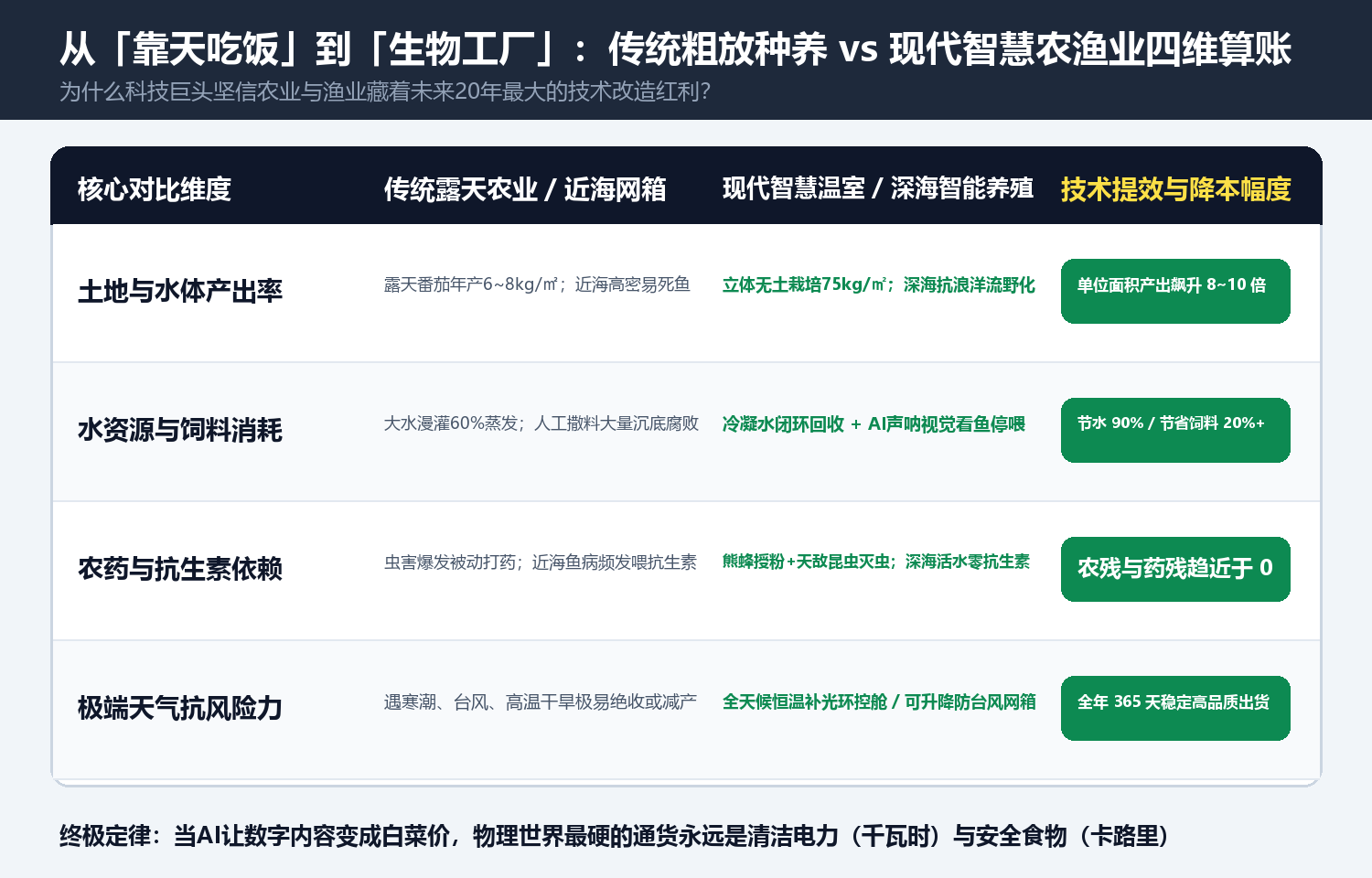
- Water consumption drops by 90%: Open-field tomato farming consumes 60–100 liters of water per kilogram of harvest, while closed-loop Dutch greenhouses condense and recycle transpired water to use just 4–8 liters.
- Yields per square meter jump 10x: Using spectrum-tuned LED lighting, CO2 enrichment, and biological pest control via bumblebees and predatory mites, yields hit 70–80 kg/m² per year compared to 6–8 kg/m² outdoors.
While e-commerce has already squeezed every penny of inefficiency out of parcel delivery, traditional farming still loses 60% of irrigation water to evaporation, wastes 70% of sprayed pesticides, and loses 30% of fresh produce to post-harvest spoilage. Where there is 50%+ systemic waste, there is massive room for technological disruption.
Ledger 2: Seeds and Hatchery Genetics Are the “Lithography Machines” of Biology
Just as 3nm semiconductors are the bottleneck of digital hardware, molecular seed breeding and full-cycle aquaculture broodstock are the “biological chips” of the food supply chain.
High-end indeterminate greenhouse tomato seeds sell by the individual seed—often costing more per gram than pure gold. Likewise, as wild ocean fisheries deplete, sustainable protein depends on offshore mariculture combined with genomic selection and AI-driven acoustic feeding systems that halt feed dispersion the instant fish stop actively feeding.
Ledger 3: When AI Pushes Digital Content to Zero Cost, Kilowatts and Calories Are King
Generative AI is driving the marginal cost of code, text, and digital media toward zero. Anything that can be digitized is becoming infinitely abundant.
In a world flooded with synthetic digital output, two physical commodities remain irreplaceable: kilowatt-hours (clean energy) and calories (safe, nutrient-dense food and protein). As extreme weather events destabilize open-air farming, building weather-resilient, antibiotic-free, sensor-driven food production systems is the ultimate long-term moat of the 21st century.
Discussion