GitHub Copilot Proved Autocomplete Was Worth Paying For Five Years Ago. This Week It Dodged the Blow Cursor Just Took
On November 12, OpenAI will remove Cursor from its list of supported models.
OpenAI published a blog post on August 28 announcing this, and the stated reason is blunt: it cannot trust SpaceX to honor its terms of service. The post names Musk-controlled companies’ track record — X (formerly Twitter) breached its contract terms after Musk acquired it, and xAI admitted in litigation this year to distilling its own models from OpenAI’s outputs. Further back, Musk sued in 2024 to block OpenAI’s conversion to a for-profit entity; a jury ruled against him this past May.
All of it traces back to August 14 — the day SpaceX closed its all-stock acquisition of Cursor’s parent company, Anysphere, for $60 billion, the largest startup acquisition in history. Cursor was folded into a new SpaceXAI division; its shares converted into roughly 389 million shares of SpaceX Class A stock.
Cursor CEO Michael Truell’s response: OpenAI’s models account for only 5% of Cursor’s user traffic, and his team is negotiating with OpenAI. Anthropic’s response was more direct — Tom Brown said the company would “continue to increase compute to support Claude models in Cursor.”
That 5% figure tells you something: this cut doesn’t go deep, it’s more a warning shot. But it set a precedent — for the first time, a foundation model lab has publicly turned “supply cutoff” into a political weapon against a product built on top of its models.
That is exactly the position GitHub Copilot was born into, five years ago.
June 29, 2021: a bet with no fallback
Copilot entered technical preview inside VS Code running on exactly one engine — OpenAI’s Codex, a version of GPT-3 fine-tuned on public code. No backup model, no second supplier. Whether the product worked at all depended entirely on one company’s willingness to keep supplying it.
Plenty of people were skeptical at the time. How big a business could code autocomplete really be? Would developers pay for a tool that guesses what you’re about to type? GitHub spent a full year collecting real-world usage data to tune suggestion quality before it dared to charge for it — general availability didn’t land until June 21, 2022, at $10 a month.
On our board of the 100 Products That Changed the World, Copilot ranks 98th, OVR 81. Originality and impact both score 90 — it really was the first product to prove AI didn’t have to replace anyone; autocomplete alone was worth paying for. Scale, experience and business sit at a middling 77. Durability, at 72, is among the lowest on the whole board — the call we made when scoring it was that a product completely dependent on a single model supplier had an uncertain long-term survival rate.
Five years later, the bet paid off — in numbers
On the January 28, 2026 earnings call, Microsoft disclosed the actual figures for the first time: 4.7 million paid GitHub Copilot subscriptions, up roughly 75% year over year, with analysts estimating annual recurring revenue between $900 million and $1.1 billion. About 90% of Fortune 100 companies use it.
The bet that autocomplete was worth paying for turned, five years on, into a business closing in on a billion dollars.
But the product architecture underneath that business hadn’t changed a single word in those five years: it still only ran on OpenAI’s models.
April 27: Microsoft cut the rope first
In the first half of 2026, everyone’s attention was on whether Cursor or Claude Code was the better coding tool. In the same stretch, Microsoft was quietly doing something less visible.
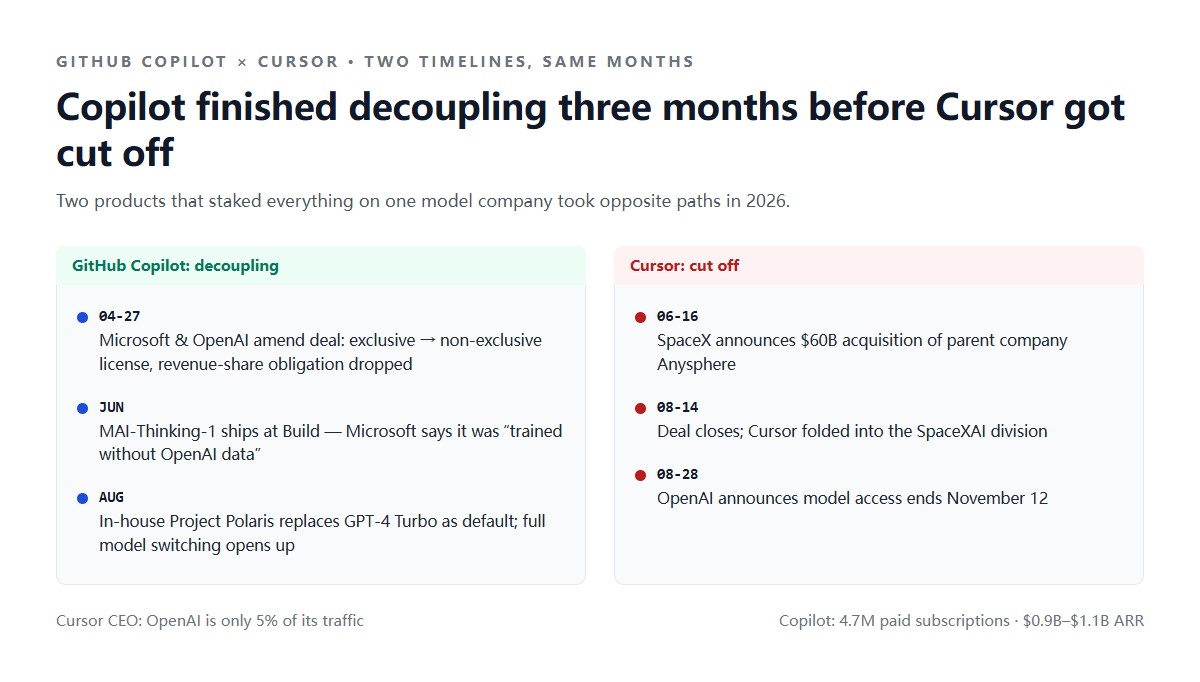
On April 27, Microsoft and OpenAI amended their partnership agreement. Two changes decided everything that followed: Microsoft’s license to OpenAI’s models went from exclusive to non-exclusive, running through 2032, and Microsoft was no longer obligated to share revenue with OpenAI (in exchange, OpenAI keeps paying Microsoft at the existing rate through 2030, now capped). A clause referencing “artificial general intelligence” was struck from the agreement entirely.
Two months later at Build 2026, Microsoft shipped MAI-Thinking-1 — its first in-house reasoning model, which the company specifically noted was “trained without OpenAI data.” By August, that model family, code-named Project Polaris, had replaced GPT-4 Turbo as Copilot’s default across every paid tier, and Copilot’s model routing opened up entirely: OpenAI, Anthropic, xAI’s Grok, Google’s Gemini — users could switch to whichever they wanted.
Four months, three moves, one result: a product born able to run on exactly one company’s model became a product no model company could hold hostage.
What Cursor is living through now, Copilot had already outrun by three months
Line the two timelines up:
- Cursor: announced acquisition by SpaceX on June 16 → deal closed August 14 → publicly cut off by OpenAI on August 28
- Copilot: broke exclusivity to OpenAI on April 27 → shipped its own model in June → defaulted to its own model, fully switchable, by August
Copilot finished decoupling roughly three months before OpenAI moved against Cursor.
That’s not to say Microsoft foresaw this exact drama — when the April agreement was signed, SpaceX hadn’t announced any intention to buy Cursor. The real explanation is more mundane: the Microsoft-OpenAI relationship had been loosening since 2023, and Microsoft wanted model capability it didn’t have to answer to anyone else for. This amendment was the natural result of both sides pursuing their own interests; Copilot’s model diversification was simply a byproduct of that loosening.
But a byproduct is still a product. The first time “total dependency on one model company” was publicly proven to be a weaponizable weakness, the product that had staked everything on that exact weakness five years earlier happened to already be the product that had fixed it. The causality isn’t perfectly clean. The outcome is what it is.
Models aren’t a utility. They’re a bargaining chip
What’s actually worth remembering here isn’t how badly Cursor is hurt — a 5% traffic share means it barely got scratched. What’s worth remembering is the announcement itself: for the first time, a major model lab publicly tied “whether you get to use our model” to “who owns you.”
For years, the industry defaulted to treating model APIs like electricity or water — whoever pays gets access, regardless of who the customer is or who backs them. That default broke, once. Any product from here on that stakes its existence on someone else’s model has one more line item to calculate: whether a rival might one day decide that being your supplier is itself a card worth playing.
Writing this, I kept circling an uncomfortable question of my own: the cover images we generate for this blog run through exactly one API right now. Whether that deserves a backup line of its own, I haven’t decided. I’m leaving the question here.
Discussion