Soichiro Honda: a motorcycle for people who didn't ride motorcycles, 100 million times over
On 19 October 2017, Honda held a ceremony at its factory in Kumamoto. Cumulative worldwide production of the Super Cub series had reached 100 million.
It had taken 59 years from the first one in 1958. By then it was built in 16 factories in 15 countries and sold in more than 160. Honda calls it a world record for a single series of motorcycles.
One line from the bike’s brief has travelled furthest: a soba delivery boy should be able to carry a stack of trays in one hand and ride with the other.
Honda’s own material describes this as “words frequently quoted as those Soichiro Honda used”. Some researchers say the requirement came from his partner, Takeo Fujisawa. Whoever said it first, the bike was built to that sentence. It was not made for people who loved motorcycles. It was made for people who didn’t ride them at all.
In November 2024 Honda announced the Super Cub 50 Final Edition at 297,000 yen. That was the end of the 49cc Super Cub, killed by new Japanese emission rules taking effect in November 2025. A year later Honda launched the Super Cub 110 Lite: a 109cc engine capped at 3.5 kW, which under Japan’s new rules can be ridden on a moped licence.
The engine changed and the legal category changed. Riding it one-handed did not.
A blacksmith’s shop, a garage, an apprentice minding the baby
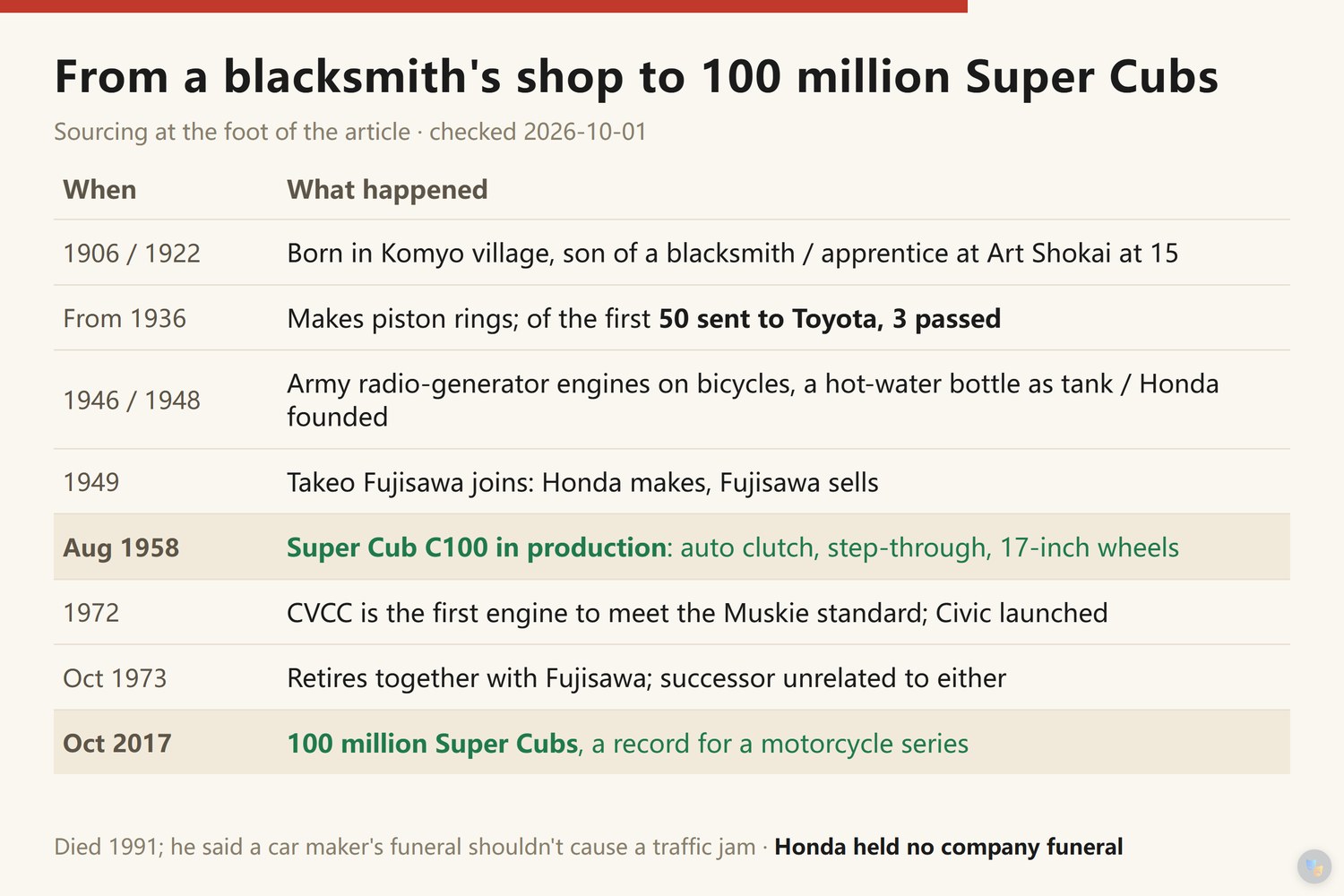
Soichiro Honda was born on 17 November 1906 in Komyo village, Shizuoka, now part of Hamamatsu. His father, Gihei Honda, ran a blacksmith’s shop and repaired bicycles.
In later life he often said he never forgot the smell of oil from the first car he saw in the village as a boy.
In 1922, finished with upper primary school, he saw a job advert in a magazine called Rin-gyo no Sekai and went alone to Tokyo, to a car repair shop in Yushima, Hongo, called Art Shokai. He was 15. For the first six months his job was looking after the owner’s baby.
In November 1924 Art Shokai built a racer, the “Curtiss”, around a second-hand Curtiss aircraft engine, and won the fifth Japan Automobile Competition. The 17-year-old Honda rode along as the riding mechanic.
After six years as an apprentice, in 1928 he became the only one the shop ever allowed to open a branch of his own, the Art Shokai Hamamatsu branch.
In 1936 he raced a supercharged Ford he had modified himself, crashed, and was injured.
Fifty piston rings, three good ones
The repair business made money, and he wanted to make parts himself. He chose piston rings.
His investors were against it, so he asked an acquaintance, Shichiro Kato, to be president of a separate company, Tokai Seiki Heavy Industry, and spent his days fixing cars and his nights on piston rings.
They didn’t work. He went to sit in on classes at Hamamatsu Higher Technical School, now Shizuoka University’s engineering faculty, and started again from metallurgy.
Of the first fifty piston rings he sent to Toyota for inspection, three passed.
He went on to earn 28 patents, and it took about two more years before supply was steady. At its peak Tokai Seiki had more than 2,000 employees, supplying Toyota and Nakajima Aircraft. In 1942 Toyota took a 40% stake and Honda was moved down from president to managing director.
In 1945 Hamamatsu was bombed, and the Mikawa earthquake of 13 January brought down the Iwata plant. After the war he sold all his Tokai Seiki shares to the Toyota side for 450,000 yen.
Then he declared himself on “human holiday” and spent a year at home making his own liquor and building a salt-making machine and a shaved-ice machine.
A hot-water bottle for a fuel tank
In September 1946, at a friend’s house, he saw a small engine that had powered the generator of the old Imperial Army’s No. 6 radio set.
His thought was to put it on a bicycle.
That autumn he put up a wooden shack in Yamashita-cho, Hamamatsu, hung up the sign “Honda Technical Research Institute”, and had a dozen or so people including himself. He bought up nearly all the remaining stock of these surplus engines, about 500, and took each one apart, modified it, test-rode it and sold it.
The fuel tank on the first one was a Japanese hot-water bottle he took from his house.
The test rider was his wife, Sachi. Honda later said he built it because he felt sorry for her cycling to buy food. Sachi’s own view was that this was a nice story made up afterwards.
Honda Motor Co. was founded on 24 September 1948, with capital of 1 million yen.
He made, Fujisawa sold
In August 1949 the Dream D-Type, Honda’s first proper motorcycle, went on sale.
The same month, through an introduction, the 42-year-old Honda met the 38-year-old Takeo Fujisawa. In October Fujisawa joined as managing director, and in November the capital was raised to 2 million yen, a quarter of it put in by Fujisawa.
Honda’s official history sums up the division of labour in one line: “Soichiro Honda did the making and Takeo Fujisawa did the selling.”
Honda handed the company seals to Fujisawa and is said never to have seen them again. Their first impressions of each other were the same: “He’s got what I haven’t got.”
The split never changed. Money, sales, dealers and whether to go to America were Fujisawa’s calls; engines, racing, frames and wheels were Honda’s.
On 20 March 1954 Honda issued a declaration that it would enter the Isle of Man TT races and win them. It went out over president Honda’s name; Fujisawa wrote it. In January that year, a Honda rider had raced in Brazil and finished 13th out of 25.
Seven years later, at the 1961 Isle of Man TT, the top five in both the 125cc and 250cc classes were all Hondas.
The Super Cub: first decide who rides it
In 1956 Honda and Fujisawa toured Europe together. When they came back they set three requirements for a new bike:
- Small enough that even a woman could handle it easily
- Gear changes with no clutch lever
- An advanced design that still felt friendly
Not one of the three is about speed or power. All three are about who is riding.
Every design decision after that follows from them:
- Centrifugal automatic clutch: no clutch to squeeze, so the left hand is free. The engineer who designed it went through eight versions
- Step-through frame: the main beam dropped low so it’s easy to get on, the engine laid horizontally
- 17-inch wheels: the tyre team calculated an ideal outer diameter of about 21 inches and settled on 2.25-17. No such tyre existed in Japan, so for the prototypes they cut 18-inch tyres down and stitched them back together
- Polyethylene leg shield: the front mudguard and leg shield used polyethylene resin, then brand new, lighter than fibreglass and nearly unbreakable. The supplier had never made a part that big, so Honda provided the moulds
At the end of 1957 Fujisawa saw the final prototype and said it would sell at least 30,000.
The developers assumed he meant a year. Fujisawa corrected them: 30,000 a month.
At the time the whole of Japan was buying about 40,000 motorcycles a month.
In August 1958 the Super Cub C100, with 4.5 horsepower, went into production.
In America, “the nicest people”
American Honda was set up in Los Angeles on 11 June 1959, led by the 39-year-old Kihachiro Kawashima. The decision to go was Fujisawa’s. His reasoning: “To succeed in the U.S. is to succeed worldwide.”
In 1963 Honda launched an American campaign with the line “You meet the nicest people on a Honda.” The agency was Grey, and the campaign ran for about 12 years.
It was the same idea as the three requirements of 1956: sell motorcycles to people who don’t ride motorcycles.
A fight with the government
In May 1961 Japan’s Ministry of International Trade and Industry proposed what became the Special Industries Promotion Temporary Measures Bill, meant to keep new companies out of the car industry. Honda had not yet built a car.
In a 1983 television interview Honda recalled his argument with MITI’s vice-minister Shigeru Sahashi:
I had the right to manufacture automobiles… if MITI wanted us to merge… they should buy our shares… The government couldn’t tell me what to do.
The bill went to the Diet in 1963 and failed; it was submitted again in 1964 and failed again.
In June 1962 Honda himself drove the S360 onto the Suzuka circuit for its debut. In 1963 the T360 became Honda’s first production car, followed in October by the S500 sports car.
In August 1964 Honda entered Formula One for the first time. On 24 October 1965, at the Mexican Grand Prix, Richie Ginther won Honda’s first race in the RA272.
”Will you stay as president, or as an engineer?”
Honda believed in air-cooled engines all his life.
In 1969 Honda’s air-cooled H1300 sedan sold poorly. A group of young engineers led by Tadashi Kume argued that tightening emission rules meant switching to water cooling. Honda held out for air.
In the end Fujisawa went to the research centre and asked him to his face:
Will you stay at Honda as president, or as an engineer?
After a silence Honda answered: “I’ll stay as president, then.”
That ended the argument, and Honda moved to water cooling.
A founder who had been an engineer all his life gave way on engineering. What came next:
In December 1972 Honda’s CVCC engine was tested at the US Environmental Protection Agency’s lab in Ann Arbor and became the first engine to meet the 1975 Muskie Act emission standard, without a catalytic converter. For the test it was fitted to a Nissan Sunny, because Honda didn’t yet have a car big enough.
On 12 July that year, the Honda Civic went on sale.
”Not bad, was it”
In March 1973 Fujisawa sent word through a colleague that he intended to resign.
Honda had just flown back from a trip to China. Hearing the news at Haneda airport, he said:
I’m only president because of Takeo Fujisawa. If the vice-president goes, I go with him.
In October 1973, Honda’s 25th anniversary, the two stepped down together at the shareholders’ meeting. Their successor, Kiyoshi Kawashima, was 45 and related to neither of them. Honda’s eldest son, Hirotoshi Honda, later went off and founded the tuning brand Mugen.
In his farewell message that August, Fujisawa recorded a private exchange between them:
He signalled with his eyes for me to come over, and we walked off together. He said: “Not bad, was it.” (まあまあだな) I said: “Yes, not bad.” He said: “We were happy.” I said: “Truly happy. Thank you, from the bottom of my heart.” He said: “Thank you too. It’s been a good life.”
Fujisawa died on 30 December 1988. In 1989 Honda was inducted into the Automotive Hall of Fame in the US; by Honda’s account, the first Japanese automotive executive to be so honoured.
Soichiro Honda died in Tokyo on 5 August 1991, aged 84.
He had once said: “I’m a car man. If my funeral caused a traffic jam, I’d feel terrible.”
Honda held no company funeral. Instead there was a “thank-you gathering” at the Aoyama headquarters over three days, from 10am to 5pm each day. The hours were stretched out so that visitors wouldn’t all arrive at once and block the roads.
Why he ranks here
| Dimension | Score | Why |
|---|---|---|
| Vision VIS | 93 | Set out in 1956 to build a motorcycle for non-riders; the 1963 American ads said the same thing |
| Insight INS | 92 | All three requirements are about who rides it; none are about power |
| Taste TST | 92 | 17-inch wheels, step-through frame, polyethylene leg shield: one silhouette for over sixty years |
| Business BIZ | 90 | Lowest, tied with originality. Sales, dealers and America were Fujisawa’s calls |
| Scale SCL | 95 | Highest. 100 million Super Cubs; 500 million Honda motorcycles in total |
| Originality ORG | 90 | He didn’t invent the motorcycle; automatic clutches and small engines existed before |
Overall OVR 92.10, 19th place.
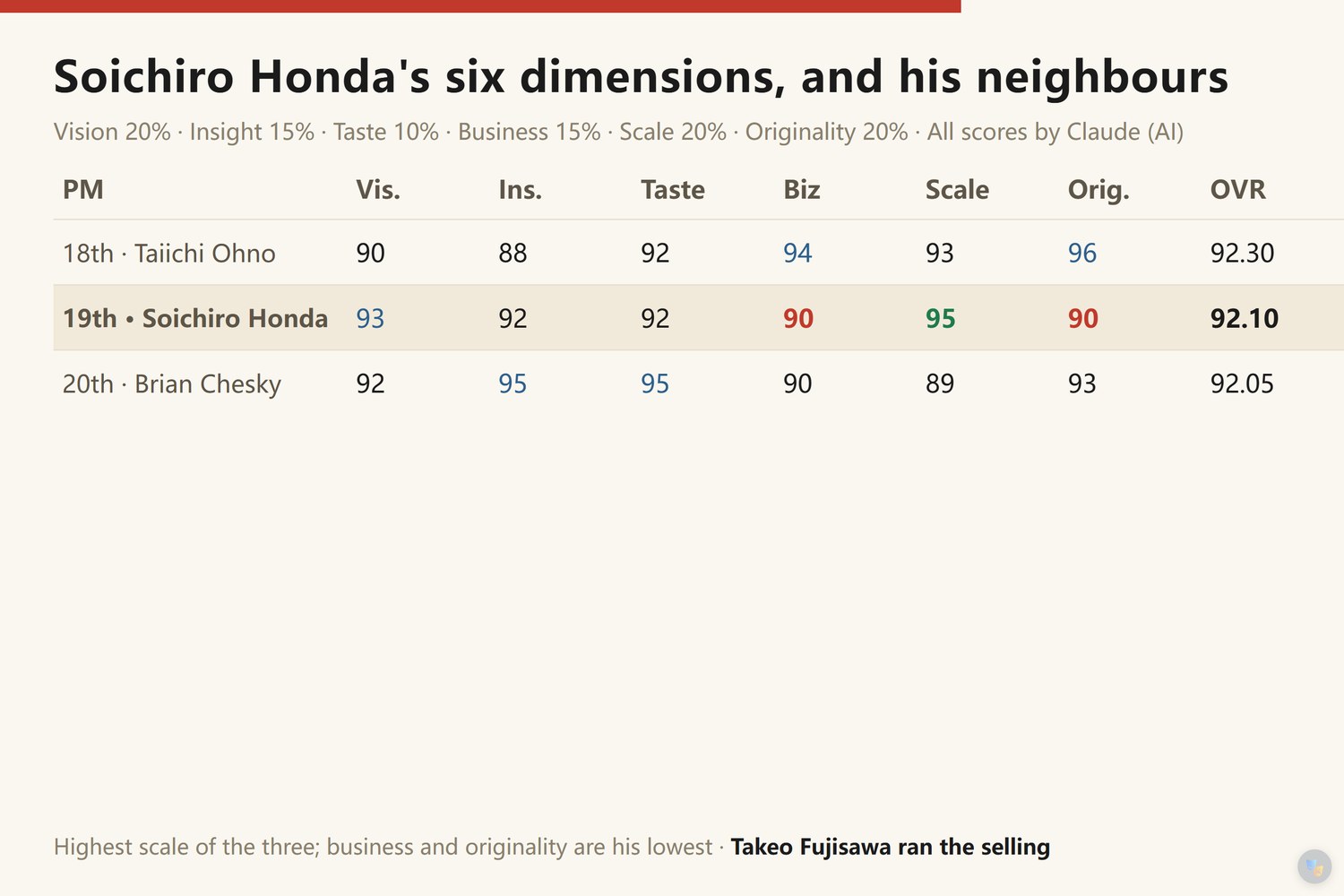
He sits between Taiichi Ohno (92.30) and Brian Chesky (92.05), just 0.05 ahead of Chesky.
Scale, at 95, is his highest score and the highest of the three. In May 2025 cumulative Honda motorcycle production reached 500 million, counted from the 1949 Dream D-Type.
Business and originality are his lowest, both 90.
Business is low because half of Honda’s business wasn’t his. The money, the sales network and the move into America in 1959 were Fujisawa’s decisions. This list rates one person, and Honda never treated selling as his job.
Originality is low because motorcycles already existed, and Honda wasn’t first with automatic clutches or small engines. What was new about the Super Cub wasn’t any single part. It was pointing all of them at one person: someone whose other hand was busy.
Ohno scores 96 on originality because he overturned how things are made; Honda scores 90 because he overturned who a motorcycle is for. The first went deeper. The second sold 100 million.
In March 1953, on the front page of the company newsletter Honda Monthly, Honda wrote:
For the customer who buys one of these products, it is not one in 2,200, nor one in 10,000. It is one in one.
The Super Cub didn’t exist yet.
All scores and rankings were produced by Claude (AI).
Cover photo: Soichiro Honda, photographed in 1954 and published in the Asahi Shimbun’s Asahigraph New Year issue of 1955; Wikimedia Commons records it as public domain in both Japan and the United States.
Sourcing: 100 million Super Cubs (19 October 2017), 16 factories in 15 countries and 160+ markets come from Honda’s 2017 press release; the Super Cub 50 Final Edition, the end of the 49cc model and the Super Cub 110 Lite come from Honda Japan releases of 1 November 2024 and 16 October 2025, with the emissions-rule timing from Kyodo; birth, his father’s trade, Art Shokai in 1922 and the 1928 Hamamatsu branch come from Japanese Wikipedia and Honda’s heritage pages; 3 of 50 piston rings, Tokai Seiki’s size, Toyota’s 1942 stake and the 1945 bombing and earthquake come from Honda’s heritage pages, with 28 patents and roughly two years to stable supply from Toyota’s GAZOO; the 450,000-yen sale comes from GAZOO and J-Net21 (Organization for Small & Medium Enterprises and Regional Innovation, Japan); the radio-generator engines, about 500 units, the hot-water bottle and Sachi’s test ride come from Honda’s heritage pages; the 1948 founding and capital, the 1949 Dream D-Type, Fujisawa’s arrival, the division of labour and the TT declaration come from Honda’s heritage pages; the 1961 TT results come from English Wikipedia; the three requirements, centrifugal clutch, 17-inch tyres, polyethylene leg shield and Fujisawa’s “30,000 a month” come from Honda’s official Cub Stories; the origin of the soba line comes from Cub Stories and English Wikipedia; American Honda and the “Nicest People” campaign come from Honda’s pages and English Wikipedia; the MITI bill and 1983 interview, the S360 debut and the F1 debut come from Honda’s heritage pages, the RA272 win from English Wikipedia; the air-versus-water dispute, Fujisawa’s question, the 1973 retirement and the farewell dialogue come from Honda’s official 50-year history pages; the CVCC test and Civic launch date come from Honda’s 75-year history; the Automotive Hall of Fame comes from Honda’s 2023 press release; his death and the thank-you gathering come from Japanese Wikipedia and Honda’s 50-year history pages; “one in one” comes from Honda Monthly, March 1953, as reproduced in Honda’s 75-year history; 500 million Honda motorcycles comes from Honda’s 22 May 2025 press release. The list scores product decisions, not people.
Discussion