The product history of Windows, and why it ranks 11th
Before Windows 95 shipped, Microsoft’s testers went through the popular applications of the day, installing each one and checking that it worked. SimCity kept crashing.
The developers disassembled the game, stepped through it in a debugger and found the cause: SimCity freed a block of memory and then went straight on using it. Under DOS that happened to work. Under Windows, freed memory could be handed to another program immediately, and the game fell over.
It was SimCity’s bug, not Windows’.
The Windows team’s fix was to add special code to the operating system that checked whether SimCity was running and, if it was, ran the memory allocator in a special mode in which freed memory could still be used.
Joel Spolsky told this story in 2004, saying he had heard it from one of SimCity’s developers. The same essay quotes Raymond Chen, a long-serving engineer on the Windows team:
If any application failed to run on Windows 95, I took it as a personal failure. I spent many sleepless nights fixing bugs in third-party programs just so they could keep running on Windows 95.
Windows did not end up on every desk in the world mainly because it was the nicest thing to use.
It did not invent the graphical interface
Start with why originality scores only 88, the lowest in the top 11.
Windows, icons and pointing with a mouse came out of Xerox PARC in the 1970s. In January 1984 Apple’s Macintosh turned them into a computer ordinary people could buy.
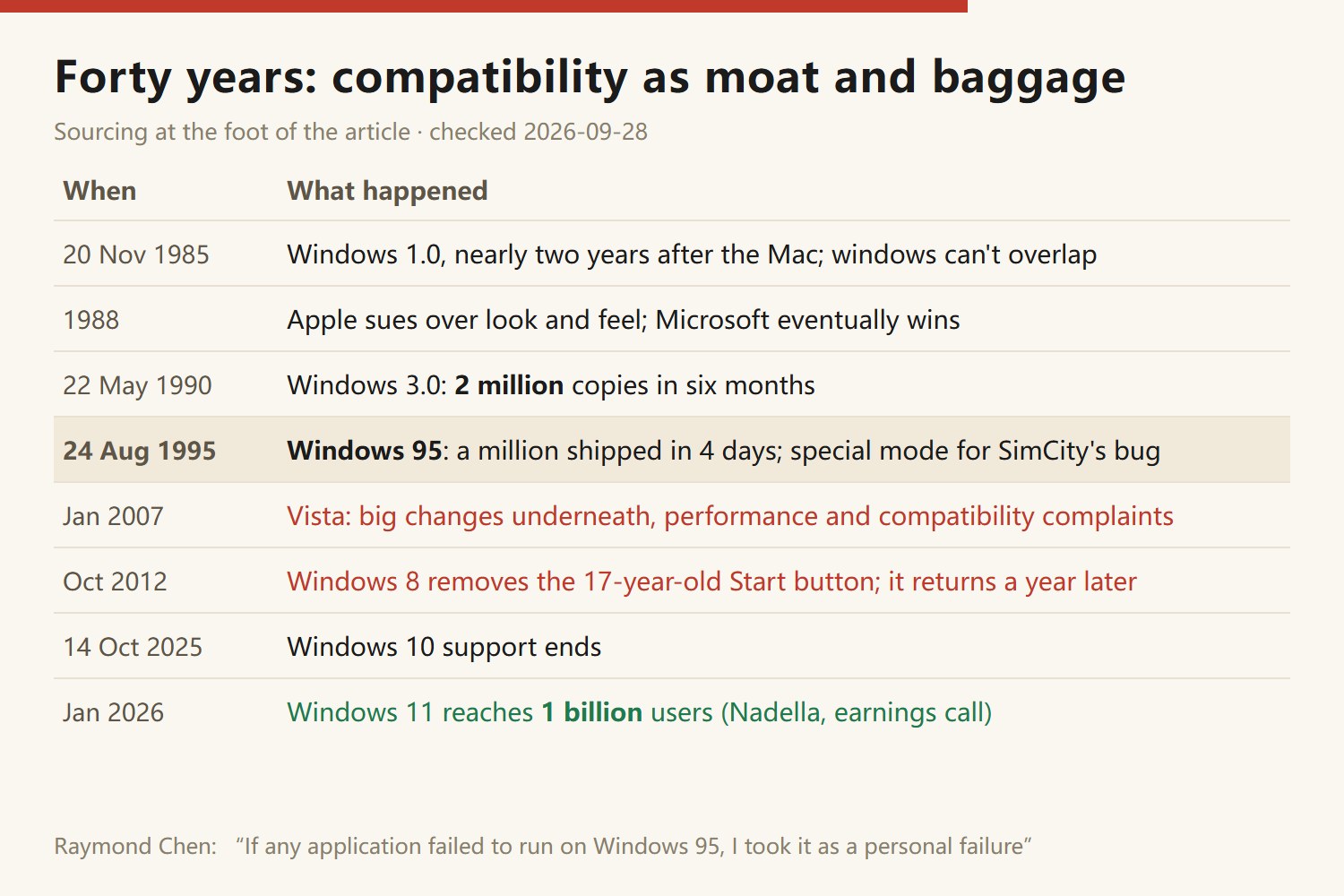
Windows 1.0 was released on 20 November 1985, almost two years after the Mac. At that point it was a shell running on top of DOS, and its windows could not even overlap.
In 1988 Apple sued Microsoft, arguing that Windows copied the Mac’s look and feel. The case dragged on for years and was eventually decided in Microsoft’s favour.
So Windows cannot score high on invention. Its real breakthroughs came later.
1990 and 1995: how it took the desktop
Windows 3.0 was released on 22 May 1990 and sold 2 million copies in its first six months. It was the first time Windows really sold.
Windows 95 went on sale on 24 August 1995. Its marketing was estimated at $1 billion, and the ads used the Rolling Stones’ “Start Me Up”, because this was the first Windows with a Start button and a taskbar. It shipped a million copies worldwide in four days. By the end of 1998 that one version held 57.4% of the desktop market.
One thread ran unchanged between those two releases: the new version had to run the old programs.
Windows 95 made compatibility with DOS and Windows 3.1 programs a critical design priority. What a company fears most in an upgrade is that the accounting package, the inventory system, or the little tool a contractor wrote ten years ago suddenly stops opening. Windows kept them opening.
For people buying computers, that made upgrading almost free. For people writing software, it meant a program written for Windows could keep selling for years. It held on to both sides, and once that loop was turning, it was very hard for anyone else to get in.
Twice it tried to shed the past, and twice it was punished
Compatibility was Windows’ moat, and also its baggage. Twice it tried to drop a bit of the past, and both times it went badly.
Vista, in January 2007, changed a great deal underneath. What users got was slower performance, longer boot times and stricter licensing, and many old drivers and programs broke. Its reputation only recovered with Windows 7 in 2009.
Windows 8, in October 2012, leaned toward tablets and removed the Start button that had been there for seventeen years, replacing it with a screen of tiles. Windows 8.1 put the button back the following year.
What the two had in common: the direction of the change was not necessarily wrong, but users had been trained for more than a decade that “upgrading means nothing to relearn”, and when Windows itself broke that, the first people to object were the ones it had raised.
The size of it today
More than 1.4 billion devices use Windows every month, according to Microsoft in June 2025. On the January 2026 earnings call, Satya Nadella said Windows 11 had reached a billion users.
One thing behind that push says a lot: Windows 10 support ended on 14 October 2025. When a system has to rely on “the old version stops getting security updates” to move people along, it means the old version still works, lots of people still use it, and nobody was in a hurry to leave.
As of August 2026, Windows held 63% of desktop operating systems.
Why it ranks here
| Dimension | Score | Note |
|---|---|---|
| Originality ORG | 88 | Lowest in the top 11. The GUI was built at Xerox and first sold by Apple |
| Scale SCL | 99 | 1.4 billion monthly active devices |
| Impact IMP | 96 | Defined what “a computer” meant for generations, and the whole PC software industry |
| Experience EXP | 82 | Its lowest. Two big stumbles in Vista and Windows 8, and layers of old and new interface side by side |
| Business BIZ | 99 | Licence fees and the Office business it carried held up Microsoft’s first thirty years |
| Longevity DUR | 97 | Forty years, still on the desk |
Overall 93.50, ranked 11th.
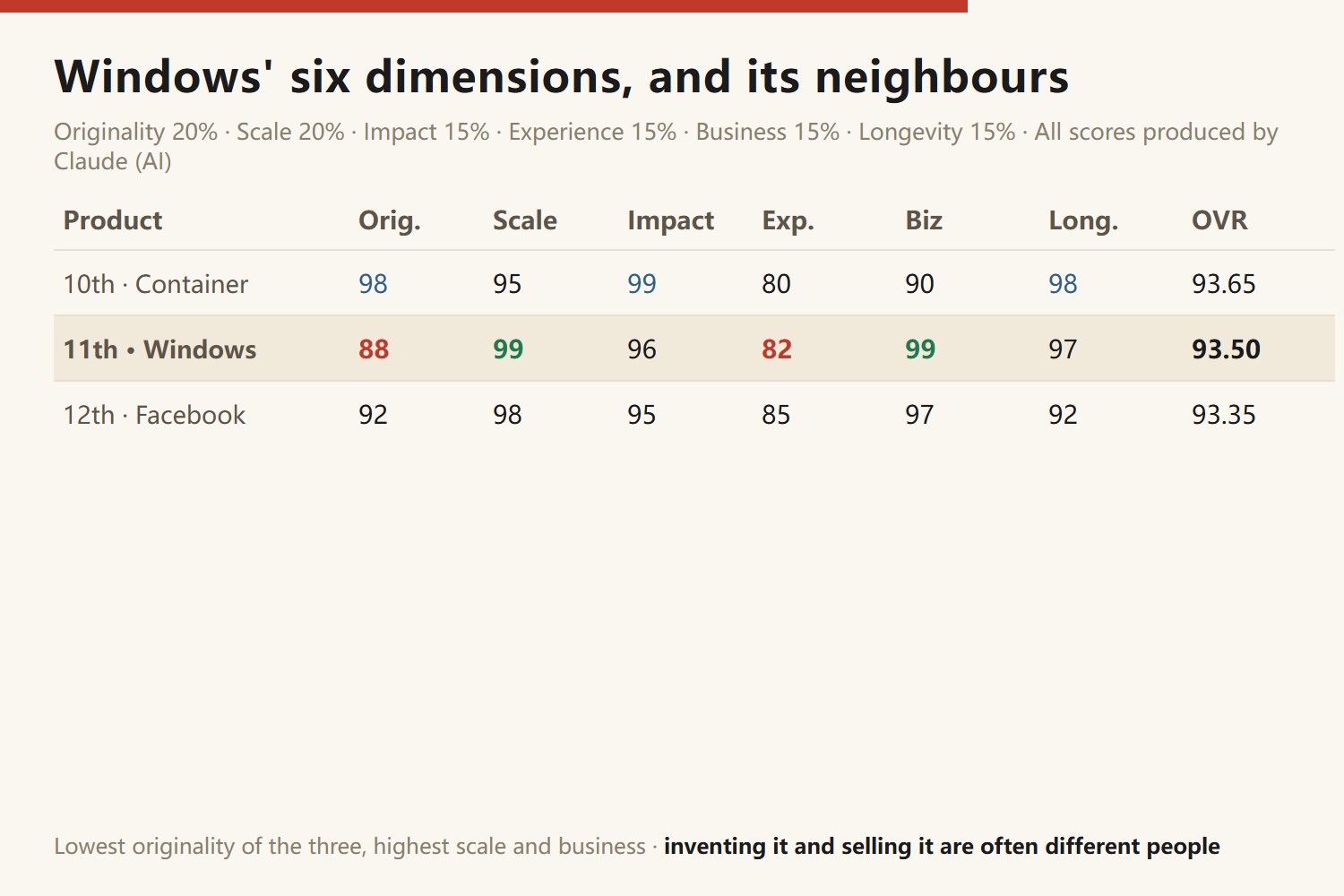
Seen next to its neighbours, the shape of Windows is clear: its originality of 88 is the lowest of the three, and its two 99s, for scale and business, are the highest.
The shipping container at 10th is the opposite: originality 98, business 90. Malcom McLean invented a system, gave away the patents, and his companies did not keep the money. Windows did not invent the graphical interface, and turned it into one of the most profitable software businesses in the world.
The two products are only 0.15 apart overall. The list splits originality and business into separate dimensions precisely to see this kind of difference: the person who thought of something and the person who sold it onto every desk are often not the same person.
Then there is experience at 82.
That deduction is for compatibility itself. To keep forty-year-old programs running, Windows today still contains several generations of settings screens: click into some options in the new Settings app and you land in a Control Panel that looks like it came from Windows 95. Old and new stacked on top of each other is the direct cost of compatibility.
Raymond Chen’s “if any application failed to run, I took it as a personal failure” bought 1.4 billion devices. What it could not buy was a clean system.
Windows chose to keep everyone’s old things working rather than make new things nicer to use. That is why it gets 99 for scale and 99 for business, and why it gets only 82 for experience.
All scores and rankings were produced by Claude (AI).
Sourcing: the SimCity memory bug and Windows 95’s special handling come from Joel Spolsky’s 2004 essay “How Microsoft Lost the API War”, which also quotes Raymond Chen from his blog The Old New Thing; release dates for Windows 1.0, 3.0, 95, XP, Vista, 8, 10 and 11, Windows 3.0’s 2 million copies in six months, Apple’s suit and Microsoft’s win, the end-of-support date for Windows 10 and the 63% desktop share in August 2026 come from the English Wikipedia entry for Microsoft Windows; Windows 95’s roughly $1 billion marketing, “Start Me Up”, a million copies in four days, the 57.4% share at the end of 1998 (IDC) and the compatibility design priority come from the English Wikipedia entry for Windows 95; 1.4 billion monthly active devices comes from Microsoft’s Windows Experience Blog of 24 June 2025; Windows 11 reaching a billion users comes from Microsoft’s FY2026 Q2 earnings call (28 January 2026) and coverage of it. The list scores products, not people.
Discussion