The product history of the McDonald's fast-food system, and why it ranks 8th
In 2025 the McDonald’s system sold $139.4 billion of food.
In the same year, McDonald’s Corporation’s own revenue was $26.9 billion.
Where did the other hundred-and-ten-odd billion go? Into other people’s pockets — of the 45,356 McDonald’s restaurants open at the end of the year, about 95% were not opened by McDonald’s Corporation. The figures come from the 10-K it filed on 24 February 2026.
The McDonald’s fast-food system ranks 8th on the board at 93.75. Originality 95, longevity 97, and experience only 85.
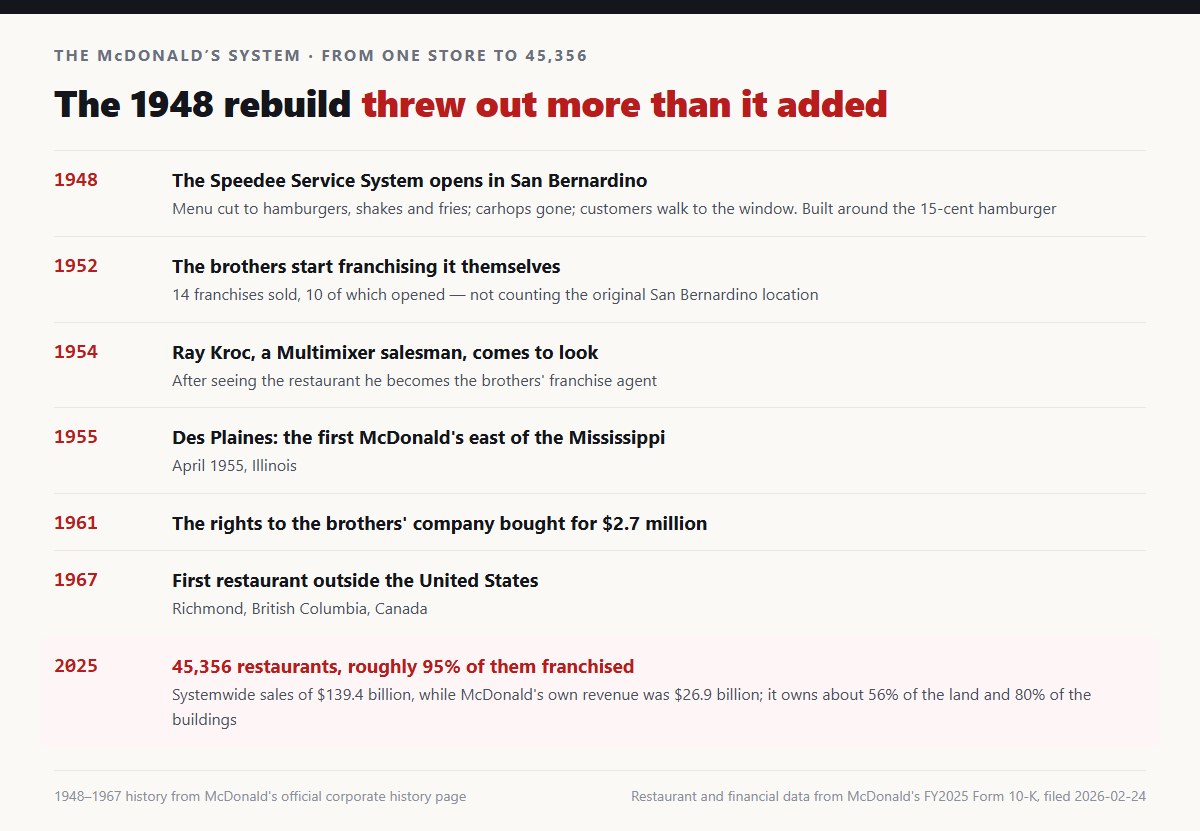
The 1948 rebuild threw out more than it added
McDonald’s own history page puts it this way: in 1948 Dick and Mac “took a risk by streamlining their operations and introducing their Speedee Service System featuring 15 cent hamburgers.”
The load-bearing word is streamlining.
The restaurant was in San Bernardino, and it was already a successful drive-in. Almost everything the rebuild did was subtraction: the menu cut to hamburgers, shakes and fries; the carhops let go; customers walking to a window to order and collect their own food.
A restaurant cutting its menu to three things and letting its waiting staff go was not an efficiency innovation in 1948. It read as suicide.
But the subtraction is what made everything left over decomposable: one person to a task, one way to do each task. The kitchen stopped depending on a cook’s skill and started depending on the design of a process.
That is where originality 95 comes from. Ford put the assembly line into building cars in 1913; in 1948 these two brothers put it into making food.
The brothers were selling franchises themselves — they just never spread it
This part usually gets skipped: the first people to turn the system into a product were the brothers.
The company history says they sold 14 franchises, 10 of which actually opened — not counting the original San Bernardino restaurant. By 1952 they had a franchise sales brochure in print.
Ray Kroc was selling Multimixer milkshake machines at the time. He went to look at the San Bernardino restaurant in 1954, then became the brothers’ franchising agent. In April 1955 he opened the first McDonald’s east of the Mississippi, in Des Plaines, Illinois.
In 1961, McDonald’s bought all rights to the brothers’ company for $2.7 million.
In 1967 it opened in Richmond, British Columbia — the start of its move outside the United States.
The people who invented the system and the people who took it to more than 100 countries were not the same people. That is not unique in product history, but the line is rarely drawn this cleanly.
Its users were not the people eating hamburgers. They were the people opening restaurants
This is the sentence that matters most for understanding the product.
A customer buys a hamburger. But the real product of the McDonald’s fast-food system is a manual anyone can follow to open an identical restaurant — site selection, floor movement, equipment models, operating sequence, ingredient specifications, cleaning frequency, all of it fixed in writing.
The food is the manual’s output, not the thing itself.
That explains the shape of the whole score table. Originality 95, scale 97 and longevity 97 are all high, because the manual has been copied more than forty thousand times, across more than a hundred countries, and has been running for 78 years. Experience is only 85, because the manual’s goal was always “the same”, never “the best tasting”.
Standardisation and a peak experience point in different directions. A Michelin restaurant cannot be identical; McDonald’s is not chasing best. That is not a failure to reach it — it never aimed there.
So where the money comes from
The 10-K is blunt about it. Under the conventional franchise arrangement, “the Company generally owns or secures a long-term lease on the land and building for the restaurant location.” The franchisee puts up the equipment, the signs, the seating and the décor.
By the end of 2025, across the markets covered by the consolidated statements, McDonald’s owned about 56% of the land and 80% of the buildings.
What franchisees pay it is mainly two things: rent, and a percentage of sales, with minimum rent provisions attached.
In 2025 that revenue was $16.548 billion, over 60% of the $26.9 billion it took in for the year.
Put another way, the heaviest thing on McDonald’s balance sheet is not hamburgers. It is land. It licenses the system out, then rents you the ground the system has to sit on.
That is where business 95 comes from, and the structure is close to impossible for a later entrant to copy — it takes decades of buying land one parcel at a time.
Why 8th and not higher
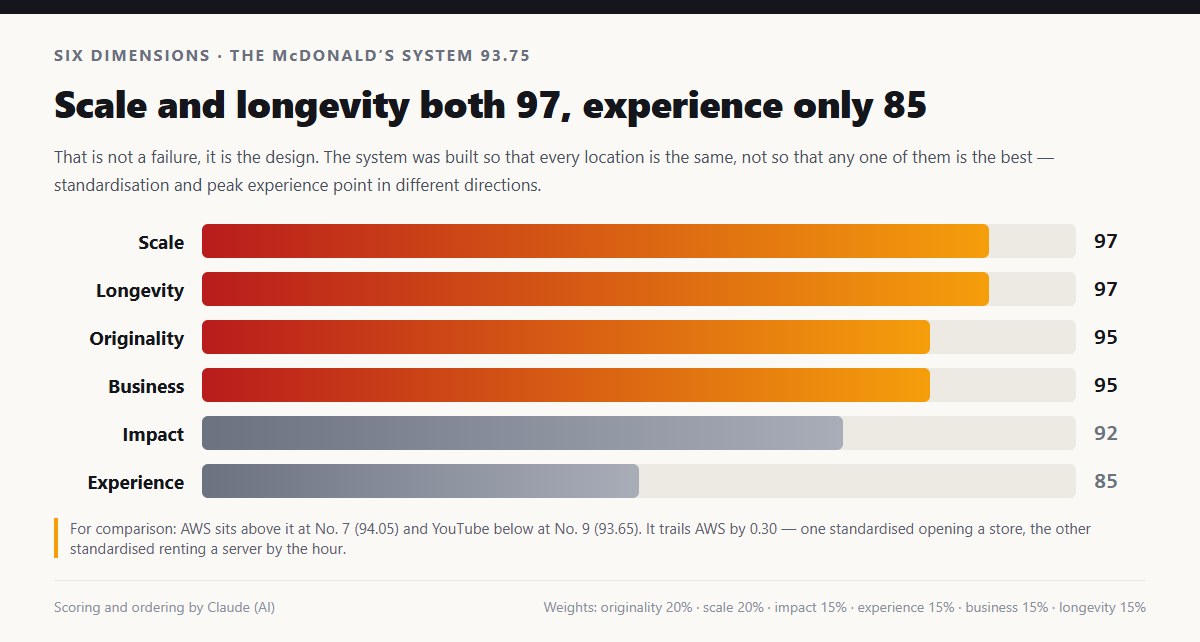
Above it sits AWS at 7th (94.05), below it YouTube at 9th (93.65). Less than half a point in either direction.
Two scores hold it down.
Experience 85, the lowest of its six. In the top ten only the standardised shipping container, at 80, sits below it. The reason is the one above: the system was designed for consistency, not for delight. On this board that has to be scored honestly.
Impact 92, the second lowest of its six. This dimension measures how much a product changed the products and the industry rules that came after it. McDonald’s impact on food service is close to full marks, but its influence stayed largely inside its own industry — against AWS’s impact of 97, which changed every industry that needs computing, not one.
The 0.30 points between it and AWS are worth sitting with. One standardised opening a restaurant until it could be copied; the other standardised buying a server until it could be rented by the hour. Neither won by making the end user happier. Both took something that used to require professional skill and turned it into following instructions.
| Dimension | Score | Reasoning |
|---|---|---|
| Originality | 95 | The assembly line moved into the kitchen in 1948, with subtraction breaking cooking down into a repeatable process; before it, a restaurant’s output depended on its cook, after it on its process |
| Scale | 97 | 45,356 restaurants at the end of 2025, across more than 100 countries, $139.4 billion of systemwide sales |
| Impact | 92 | Second lowest of its six. It defined the operating model for the entire fast-food industry, but the influence stayed largely within food service |
| Experience | 85 | Its lowest, and in the top ten above only the shipping container’s 80. The system’s goal is “every one the same”, not “this one the best” |
| Business | 95 | 95% of restaurants franchised; the company owns about 56% of the land and 80% of the buildings; 2025 franchised revenue of $16.548 billion, over 60% of total revenue |
| Longevity | 97 | 78 years since 1948. The American drive-ins of the same era are almost all gone, and the system is still the whole industry’s default |
Weighted, that’s 93.75 — 8th.
The scoring method is written out in full on the ranking page: six dimensions, 0–99 each, weighted into an overall score, sorted descending. All dimension scores and the ranking are produced by Claude (AI) — I set the dimensions, the weights and the inclusion criteria; Claude scores independently, and I revisit after the long-form piece is written.
The history here comes from the company history page on McDonald’s own site; financial and restaurant figures come from the fiscal 2025 10-K McDonald’s filed on 24 February 2026. Ray Kroc, who took the system worldwide, ranks 37th among the 100 product managers who changed the world, covered separately.
Discussion