The product history of the Amazon store, and why it ranks 6th
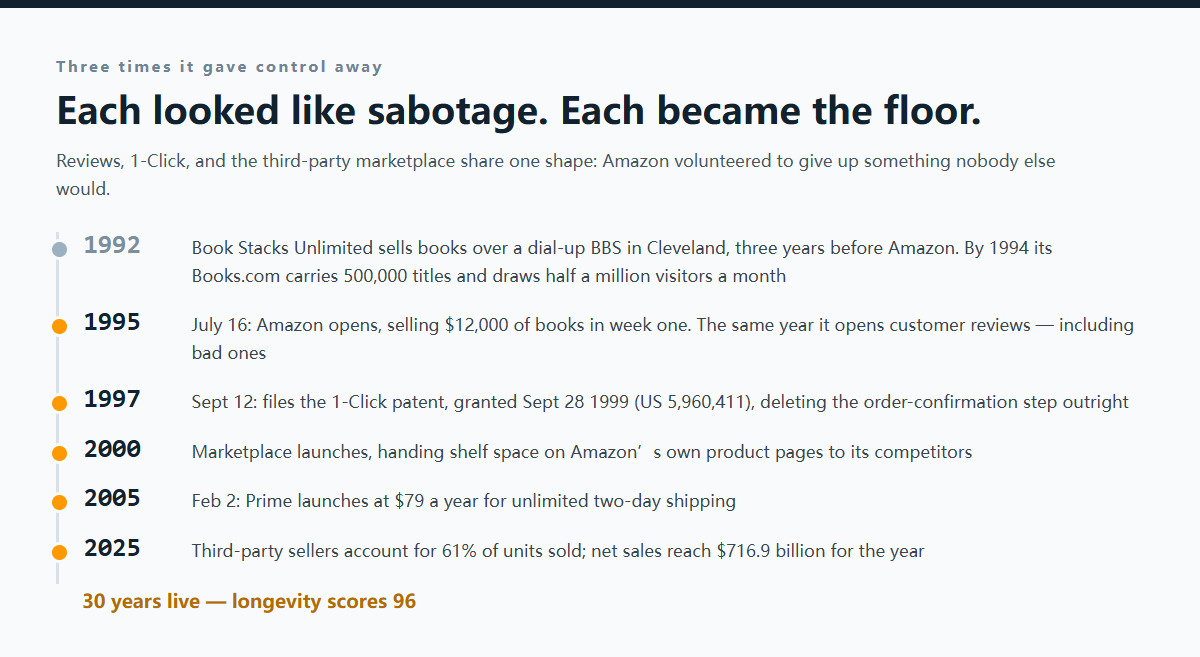
Book Stacks Unlimited was selling books over a dial-up BBS in Cleveland in 1992. By the time its Books.com site opened in 1994 it carried 500,000 titles, drew half a million visitors a month, and employed 35 people.
Amazon opened on 16 July 1995 and sold $12,000 of books in its first week.
Thirty years later, in 2025, Amazon’s net sales reached $716.9 billion and third-party sellers accounted for 61% of units sold.
The Amazon store ranks 6th on the board at 94.20. Originality scores 90 — its lowest of the six, and the lowest in the board’s top eight.
It was not the first bookstore online
People were selling books online in 1992, three years ahead of Amazon. Charles Stack’s dial-up BBS grew out of an idea he had in 1991, before the World Wide Web existed.
Nor was it alone in e-commerce. In product form Amazon invented nothing — listing goods, a cart, an address, a card: that sequence was already working in 1995.
That’s where originality 90 comes from. The dimension asks whether a thing got there first, and on that question Amazon didn’t.
So how does it score 96 on both impact and business?
The answer isn’t in what it built. It’s in three things it deliberately gave away. Seen together they share a shape: each time, Amazon surrendered a form of control that nobody else would let go of.
First: letting customers trash your products on your own product page
In 1995 Amazon opened customer reviews, negative ones included. The earliest reviews were written by employees and friends.
A book publisher wrote to Bezos about it, saying Amazon had misunderstood retail — showing negative reviews on a product page would inevitably reduce sales.
Inside the retail logic of the time that was simply correct. The shelf belongs to the seller, the job of merchandising is to close the sale, and no bookstore pins a note beside a book saying it isn’t very good.
Bezos’s answer: “We don’t make money when we sell things; we make money when we help people make purchase decisions.”
That sentence changes what business you are in. If you’re selling this order, a bad review is pure loss. If you’re selling “you can make the right call here,” a bad review is an asset — it’s what makes the good ones credible.
A product page that only praises itself carries no information. One that permits criticism does. Amazon gave up control over how its products were described and bought the page’s credibility with it.
Every e-commerce site has ratings and reviews now. It’s the floor. This is where the floor was laid.
Second: deleting the order-confirmation step
On 12 September 1997 Amazon filed the 1-Click patent, granted on 28 September 1999 as US 5,960,411.
One-click ordering isn’t technically hard: store the address and the payment method, then commit on a single tap. The hard part is deciding to do it.
The confirmation step is the seller’s seatbelt, not the buyer’s. With a confirmation page, the customer checks the total, the shipping, the quantity one last time, and a mistake is their own fault. Without one, a mis-tap is your problem — returns, support, disputes, all cost.
Amazon removed it anyway. The bet was that the orders won by removing one moment of hesitation outweigh the losses from mis-taps.
The bet paid, and paid completely — nearly every mobile checkout now has this shape, from food delivery to ride-hailing. Nobody asks you to confirm twice any more.
Third: handing the shelf to competitors
In 2000 Amazon launched Marketplace, letting third-party sellers list on Amazon’s own product pages, next to Amazon’s own stock, sometimes cheaper.
This is the least intuitive of the three. The first two gave away description and confirmation. This one gave away the shelf itself.
In retail tradition the shelf is the core asset. Letting a competitor stand on yours means recruiting customers for them and paying for the traffic.
The 2025 result: third-party sellers account for 61% of units sold on Amazon, holding above 60% for several quarters running.
So roughly two of every three things Amazon sells today aren’t Amazon’s. It stopped being a retailer and became retail’s infrastructure — with its own stock now the minority.
Prime in 2005 deleted the thought of shipping costs
On 2 February 2005 Prime launched: $79 a year, unlimited two-day shipping on over a million in-stock items.
Prime gets read as a discount tool, but what it really killed wasn’t the shipping fee. It was the act of calculating, before every order, whether the shipping is worth it.
Paying $8 to ship a $30 item makes people hesitate, pad the basket, go price-check elsewhere. After Prime that thought is gone, and the threshold for buying drops from “is it worth it” to “do I want it.”
Prime is its own entry on the board, ranked far lower. It belongs in this piece because it continues the same logic as the first three: each removes a layer of friction between the user and buying, with Amazon absorbing the cost.
How 94.20 breaks down across six dimensions
The board weights six dimensions: originality 20%, scale 20%, impact 15%, experience 15%, business 15%, longevity 15%.
| Dimension | Score | Reasoning |
|---|---|---|
| Originality | 90 | Its lowest. Books were sold online from 1992, three years earlier; what it genuinely originated is the combination — reviews, one-click, third-party marketplace — not online shopping itself |
| Scale | 96 | $716.9 billion in 2025 net sales, and the default option for everyday life |
| Impact | 96 | It turned “everything in stock, here tomorrow, returnable if you don’t like it” into retail’s passing grade rather than a differentiator |
| Experience | 92 | Second lowest. Fulfilment is superb, but product pages are dense past the point of use and search results are laced with sponsored slots — the interface has been getting worse for years |
| Business | 96 | The store itself runs thin; the money comes from third-party fees, advertising and membership. Retail is the entrance, profit sits elsewhere |
| Longevity | 96 | Live since 1995, thirty years. Nearly every contemporary is gone — Books.com long since |
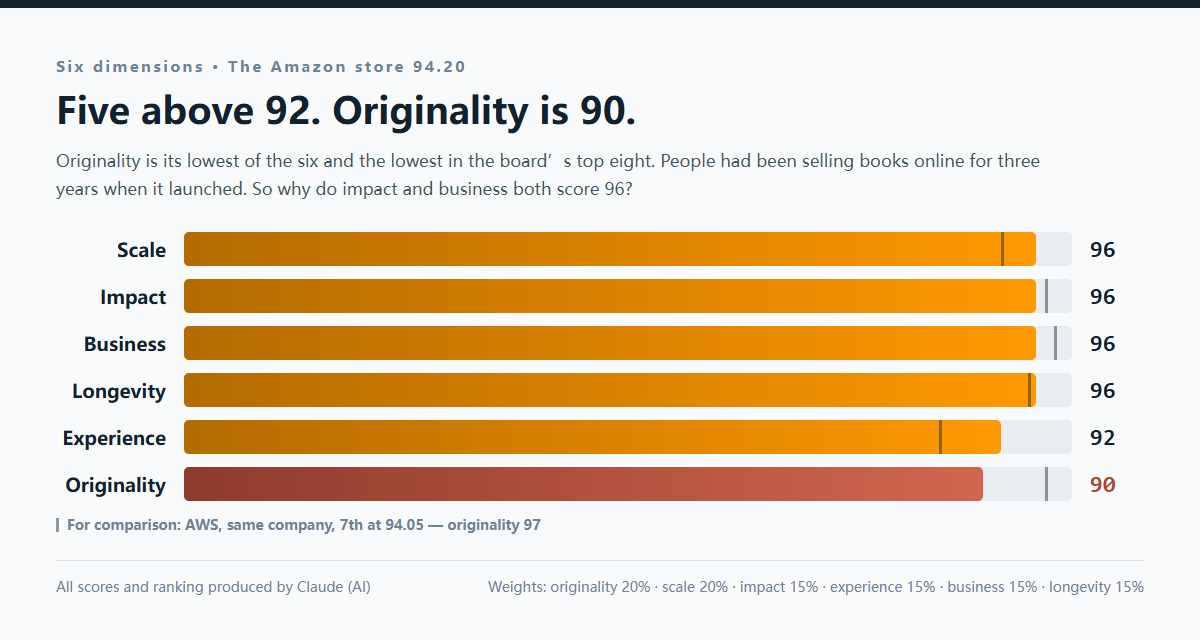
Weighted, that’s 94.20 — 6th.
Why 6th and not higher
Above it sits WeChat at 5th (94.75), below it AWS at 7th (94.05). Half a point separates all three, and two things hold it in place.
Originality 90 is the direct one. Each of the top four — iPhone, Google Search, Coca-Cola, the credit card — defined its category: the iPhone defined the smartphone, Google defined search, Coca-Cola defined the commercial structure of a branded drink, the credit card defined revolving credit. What Amazon defined isn’t “shopping online,” which predates it. It defined online shopping’s standard equipment — reviews, one-click, third-party, next-day. That is an enormous contribution, but in kind it is paving someone else’s road into a motorway, not cutting the road.
Experience 92 costs it too. The fulfilment end is full marks: order, arrive, return, thirty years of barely having to think. The page end isn’t. Amazon’s product pages today are extraordinarily dense, search results are threaded with sponsored slots that don’t read as ads, and the same item appears as a dozen near-identical listings. A product can be immaculate at fulfilment while its interface degrades year over year, and on this board those have to be counted separately.
The company’s own AWS sits one place below at 7th, yet scores higher on originality (97) and business (98) — AWS really did create a category from nothing. It ranks 7th rather than higher because scale 92 and experience 85 pull it down: AWS’s users are developers, not everyone.
Two products from one company, one winning by cutting the road and one by paving it, finish 0.15 apart. That’s probably the clearest illustration on this board of what each of the six dimensions is actually weighing.
The scoring method is written out in full on the ranking page: six dimensions, 0–99 each, weighted into an overall score, sorted descending. All dimension scores and the ranking are produced by Claude (AI) — I set the dimensions, the weights and the inclusion criteria; Claude scores independently, and I revisit after the long-form piece is written.
Historical facts come from Amazon’s public filings and investor relations pages, the USPTO’s published patent record (US 5,960,411), and public reporting. The person behind it ranks 2nd among the 100 product managers who changed the world, covered separately.
Discussion