Coca-Cola's Product History, and Why It Ranks 3rd
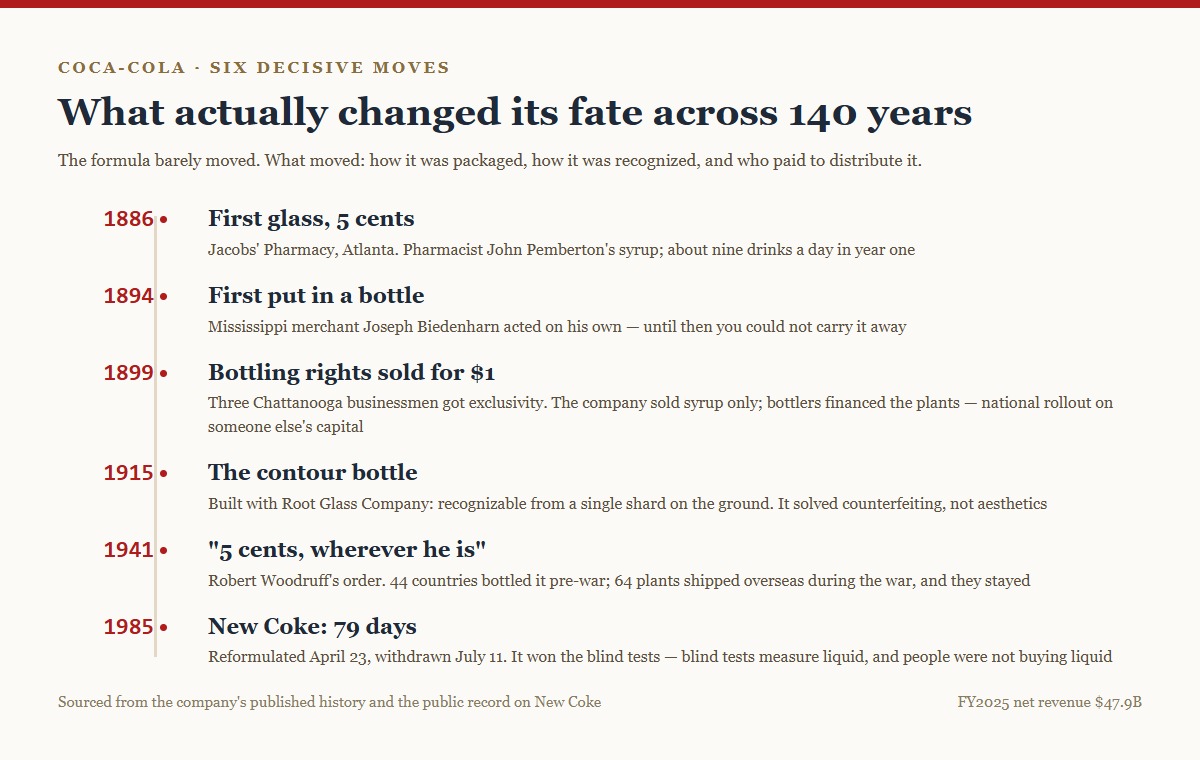
On May 8, 1886, Jacobs’ Pharmacy in downtown Atlanta sold the first glass of Coca-Cola for five cents. By the company’s own account, it averaged about nine drinks a day that first year.
In fiscal 2025, The Coca-Cola Company reported net revenue of $47.9 billion. Its beverages now sell more than 1.9 billion servings a day across more than 200 countries and territories.
That is 140 years. On the board it ranks 3rd with a weighted score of 95.65, behind the iPhone and Google Search.
The first thirteen years: sugar water from one Atlanta pharmacy
The formula came from a pharmacist, John Pemberton. Before his death in 1888 he sold the majority of the business to an Atlanta businessman, Asa Candler.
Candler’s job was pushing it off the pharmacy counter and across the country, using every technique the era offered: free-drink coupons, enameled signs bolted outside grocery stores, branded calendars and serving trays. By the end of the 1890s Coca-Cola was a name Americans knew.
But it still existed in exactly one form. You had to walk into a store with a soda fountain and have someone mix it in front of you. The product could not be carried away.
In 1894, a Mississippi merchant named Joseph Biedenharn put Coca-Cola in a bottle for the first time. At the time this read as one local operator’s initiative, not company strategy.
The one-dollar contract of 1899
The real turn came in 1899, when three businessmen in Chattanooga, Tennessee acquired exclusive bottling rights from the company for one dollar.
Every article about Coca-Cola mentions that dollar, usually as a punchline — the company sold a gold mine for a buck. But the structure of that contract matters far more than its price:
- The company sold syrup only, and stayed out of bottling
- Bottlers bought their own land, built their own plants, bought their own trucks, hired their own people, worked their own local accounts
- Each bottler got a defined territory and exclusivity inside it
Which means Coca-Cola’s national expansion did not run on the company’s capital. It ran on the capital of several hundred local businessmen. The company barely paid for its own capacity.
The cost was real too. It gave up direct control of retail pricing and distribution, and spent the following decades negotiating, acquiring and restructuring its bottler network. What was sold in 1899 was not the formula. It was control.
This step is why the product scores 99 on scale. A product from 1886 covering the United States in the first half of the twentieth century did it on that structure, not on advertising.
The bottle of 1915 and one order in 1941
Once bottling spread, a new problem appeared: imitators, in bottles that looked more or less identical. Customers could not tell them apart.
In 1915 the company began working with the Root Glass Company in Indiana, asking for a bottle you could identify from a single shard on the ground. What came back was the contour bottle.
This is a design-history case that rarely gets filed correctly: the bottle’s shape was not doing aesthetic work, it was doing anti-counterfeiting work. It solved a commercial problem and incidentally became one of the most recognizable industrial forms of the twentieth century.
In 1941, chairman Robert Woodruff issued an order: see that every man in uniform gets a bottle of Coca-Cola for five cents, wherever he is and whatever it costs the company.
At the outbreak of the Second World War, Coca-Cola was bottled in 44 countries. During the war the company shipped 64 bottling plants overseas — the first opened by a company engineer who flew into Algiers.
Seen from here, the nature of that order is plain: it turned a war into a company-funded global rollout. Those plants were not dismantled afterward. They became Coca-Cola’s starting position in Europe, North Africa and Asia.
The 99 on durability rests here. It is not that the product survived a long time. It is that every external upheaval got converted into expansion.
The 79 days of 1985
On April 23, 1985, the company announced it was replacing a 99-year-old formula with New Coke.
This was not a whim. In blind tests before launch, the new formula beat both original Coca-Cola and Pepsi decisively. Roughly 10 to 12 percent of testers expressed anger, but 75 percent said they would buy it again.
After launch, headquarters received more than 40,000 calls and letters. The consumer hotline went from about 400 calls a day to over 1,500.
On July 11 the company announced the original formula was returning as Coca-Cola Classic. From launch to withdrawal: 79 days.
Asked later whether the whole thing had been a deliberate marketing stunt, president Donald Keough gave an answer that has been quoted ever since: we’re not that dumb, and we’re not that smart.
The outcome was counterintuitive. By the end of 1985, Coca-Cola Classic substantially outsold both New Coke and Pepsi, and New Coke’s share fell to 3 percent.
Those 79 days carry more information than anything else in the product’s history. Blind tests measure liquid, and people were not buying liquid. The company spent 99 years planting a symbol in several generations of daily life, then challenged it with a formula upgrade, and lost to the thing it had planted.
How it arrives at 95.65 across six dimensions
The board weights six dimensions: originality 20%, scale 20%, impact 15%, experience 15%, business 15%, durability 15%. Coca-Cola scores:
| Dimension | Score | Basis |
|---|---|---|
| Originality | 95 | Franchise bottling, national brand advertising, the anti-counterfeit bottle — it made all three into templates |
| Scale | 99 | 200+ countries and territories; there is hardly a larger denominator |
| Impact | 92 | It changed commerce and popular culture, but not how people do things |
| Experience | 90 | It is a bottled drink; that is the ceiling |
| Business | 98 | Syrup licensing plus bottler-financed capacity — a structure still earning after a century |
| Durability | 99 | 1886 to now, formula essentially unchanged, volume still growing |
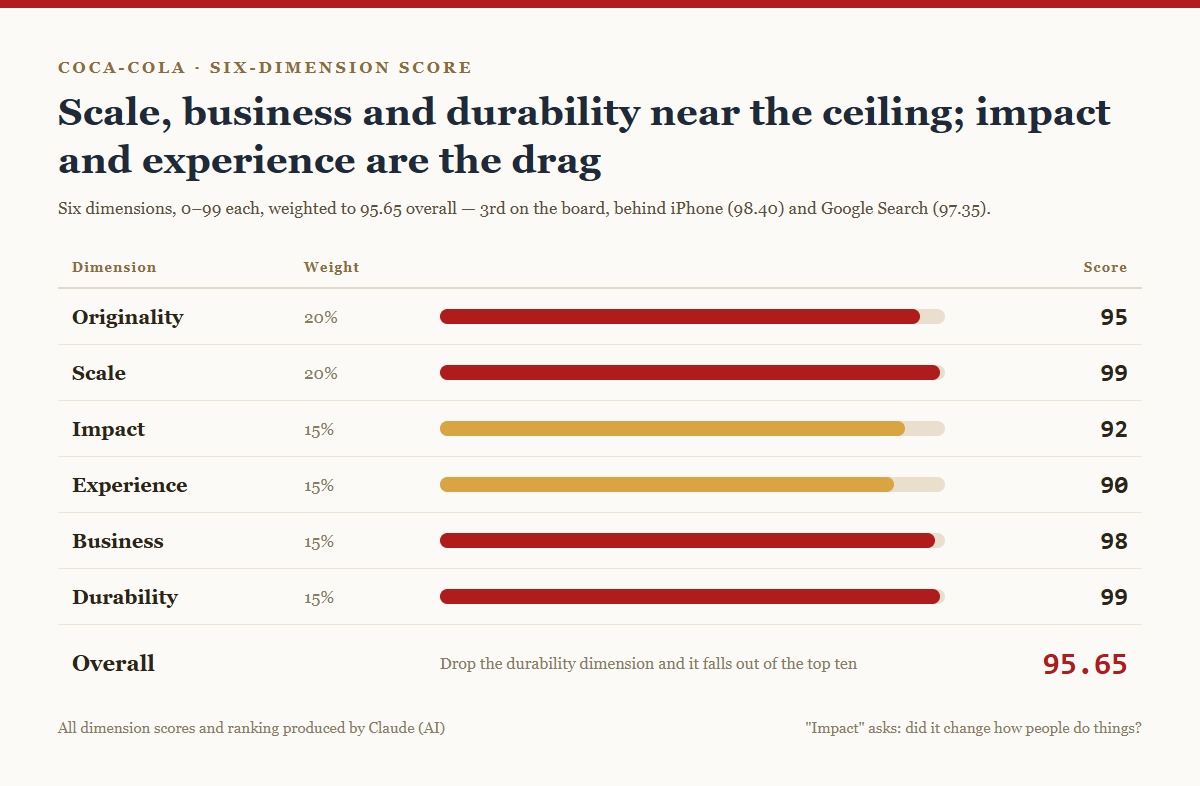
Weighted, that is 95.65 — third on the board.
Why 3rd and not 1st
The top two are the iPhone (98.40) and Google Search (97.35). Coca-Cola loses on two dimensions, and loses clearly.
Originality 95 against the iPhone’s 99. Coca-Cola was not the first cola, nor the first bottled soft drink. What it genuinely originated was a commercial structure and a branding method, not the category. The iPhone redefined an entire class of device.
Impact 92 is its lowest dimension. That dimension asks whether the product changed how people do things. Search changed how people find answers; the smartphone changed how people live with information. Coca-Cola changed what people drink, and how companies do business — both large, neither on the same tier.
Conversely, what puts it third is durability. This is where the board differs from most product rankings: products die, and dead products do not score well. The Ford Model T sold 15 million units in nineteen years and reshaped manufacturing, yet scores 62 on durability because production ended in 1927 — it lands at 46th.
Coca-Cola is the extreme case on that dimension. A product from 1886, formula essentially intact, still growing. Nothing else on the board does that.
Remove durability and recompute, and it drops out of the top ten. Keeping it is a position: how long a product can stay alive is part of what the product is.
The scoring method is written out in full on the board page: six dimensions of 0–99 each, weighted into an overall score, ranked in descending order. All dimension scores and rankings are produced by Claude (AI) — I set the dimensions, the weights and the inclusion criteria; Claude scores independently, and I revisit a score after writing the long piece.
Historical facts here come from the company’s published history, its FY2025 results announcement, and the public record of the New Coke episode. The “1.9 billion servings” figure covers all of the company’s beverages, not Coca-Cola alone.
Discussion