100 Products That Changed the World · #16: Air Conditioning
In August 2026, China’s national power load set a record: 1.56 billion kilowatts, according to figures the National Energy Administration published in September.
That same summer, on August 6, Beijing’s grid peaked at 29.399 million kilowatts, a record for the second day running. Chinese state media reported one detail: cooling loads such as air conditioning made up 45% of it.
On a city’s hottest day, nearly half its electricity went to making rooms cooler. The machine that does this was invented to solve a problem that had nothing to do with comfort.
1902: paper that would not hold its shape
The Sackett-Wilhelms Lithographing & Publishing Company in Brooklyn printed color images. Each sheet went through the press up to four times, once for each ink.
Summer was the problem. In humid air the paper absorbed moisture and swelled, then shrank as it dried, so the four colors never lined up and the images came out blurred.
On July 17, 1902, Willis Carrier, a 25-year-old engineer at the Buffalo Forge Company, submitted drawings for a fix. His design did not just cool the air; it controlled humidity. That addition is why the field dates modern air conditioning to 1902, and why air conditioning came to be defined by four jobs: control temperature, control humidity, control air circulation and ventilation, and clean the air.
On January 2, 1906, Carrier received U.S. patent 808,897 for an “Apparatus for Treating Air.” The same year, Stuart Cramer, a textile-mill owner in North Carolina, coined the term “air conditioning” in a paper. Carrier later put the term into the name of his company.
In 1915, Carrier and six colleagues pooled $32,600 to found the Carrier Engineering Corporation.
1932: a window unit for $10,000
The first air conditioners went into factories, print shops and textile mills: customers who needed to control a production environment. In the 1920s, centrifugal refrigeration machines made it possible to cool whole buildings, and commercial use grew.
Homes came later. In 1931, H. H. Schultz and J. Q. Sherman designed a single-room unit that sat on a window ledge, which became the most common home form. It went on sale in 1932 for $10,000 to $50,000, about $200,000 to $1.2 million in 2025 dollars.
Cheaper, smaller window units brought it into ordinary homes. Henry Galson’s simplified version had sold more than 43,000 units by 1947. At the 1939 New York World’s Fair, Carrier built an igloo-shaped pavilion to show visitors a future of air-conditioned living. Then the war came, and mass adoption waited for the postwar boom of the 1950s.
It changed where people live
The biggest effect of air conditioning was not inside any one room. It was on the map.
From the 1950s, air conditioning helped the American South industrialize and fill air-conditioned office towers. Historians rank it alongside highways, cars, shopping malls and suburban housing as one of the forces that shaped postwar American cities.
| Measure | Figure |
|---|---|
| Share of Americans living in the Sun Belt, early 20th century | 24% |
| Same share in 2007 | 30% |
| US homes with air conditioning, 2015 | about 100 million, 87% |
| New US single-family homes with AC, 2019 | 90% (99% in the South) |
| Urban Chinese households with AC, 1995 → 2004 | 8% → 70% |
It changed who survives a heat wave, too. The August 2003 heat wave in France killed about 15,000 people, 80% of them over 75. Afterwards the French government required every retirement home to have at least one air-conditioned room. A 2020 US study found that areas with lower air-conditioning use had higher rates of heat-related deaths and hospitalizations.
By 2016 about 1.6 billion air conditioners were in use worldwide, more than half of them in China and the United States. In 2018 the International Energy Agency projected about 4 billion by 2050, with the biggest increases in India and China. In India, units per 100 households tripled between 2010 and 2023, to 24.
The cost: electricity and refrigerants
An air conditioner moves heat from inside to outside. Someone pays for that.
First, electricity. In 2022 air conditioning used about 7% of the world’s electricity and produced about 3% of greenhouse gas emissions. From the late 1980s to the early 2010s, studies linked air conditioning to the urban heat island effect, with Tokyo and Houston among the examples.
Second, refrigerants. Early units used chlorofluorocarbons such as R-12, which damage the ozone layer. The Montreal Protocol, signed in 1987, phased them out. Their replacements, hydrofluorocarbons, spare the ozone layer but trap heat thousands of times more powerfully than carbon dioxide. The 2016 Kigali Amendment added them to the phase-down; by April 2026 it had been ratified by 174 states and the European Union. Under it, the group that includes China must cut consumption to 20% of its baseline by 2045.
More than a century after its invention, countries still sign treaties about which gas goes inside it.
Why it ranks #16
| Dimension | Score | Notes |
|---|---|---|
| Originality ORG | 95 | In 1902 it was the first to combine humidity and temperature control into one system; the category starts here |
| Scale SCL | 95 | About 1.6 billion units in use in 2016, about 4 billion projected by 2050 |
| Impact IMP | 95 | Changed where people live, how cities grow and who survives heat waves |
| Experience EXP | 82 | Its lowest. See below |
| Business BIZ | 90 | It sustains the whole HVAC industry; Carrier alone had $18.6 billion in sales in 2018 |
| Durability DUR | 97 | Its highest. In use for more than 120 years, and the installed base is still growing |
Overall OVR 92.60, ranked #16.
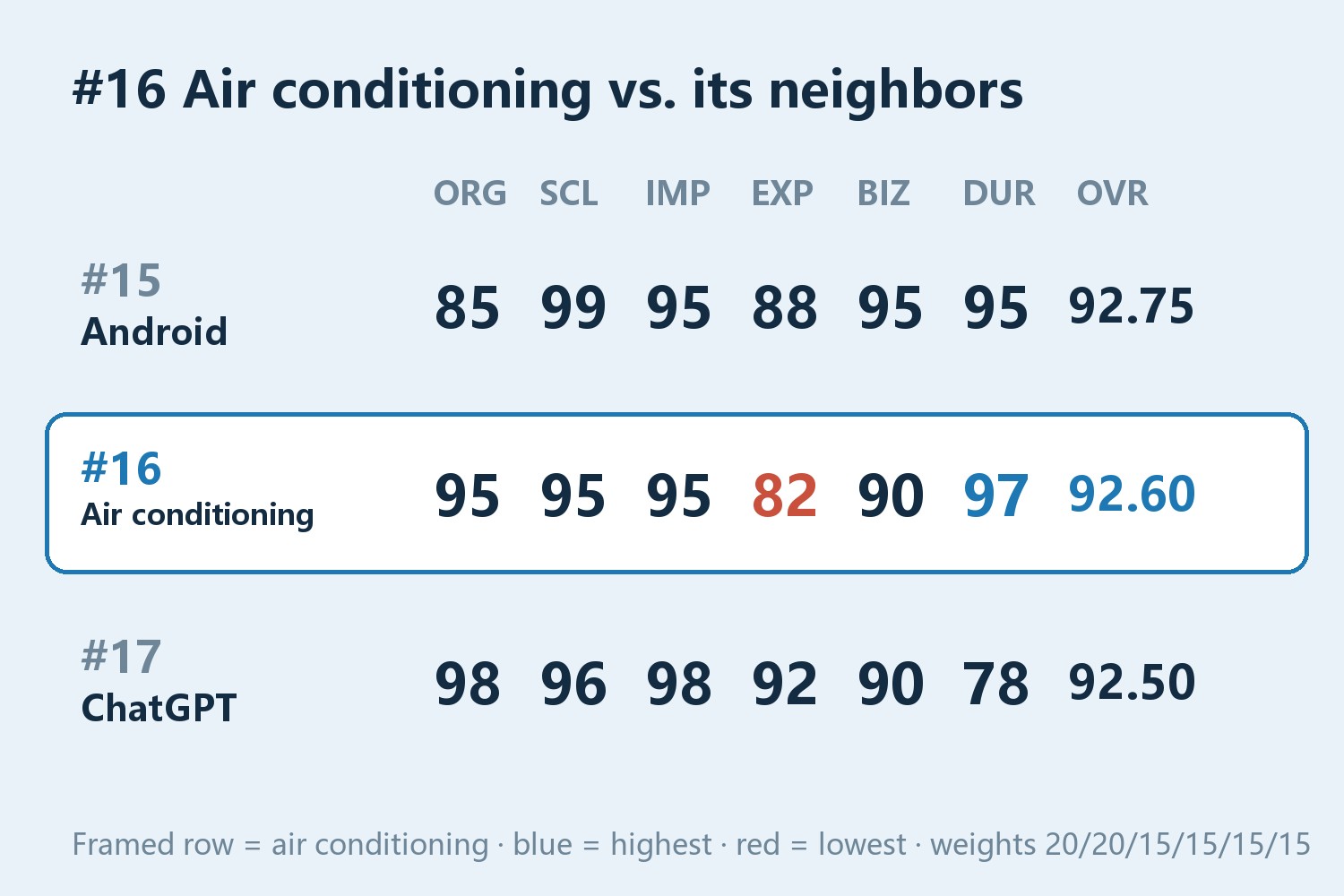
Why experience is only 82. Experience asks how it feels to use. Air conditioning solves heat, but it comes with other things: the power bill, the noise and hot air of the outdoor unit. Almost everyone depends on it, yet few people would call it a pleasure to use, and most only think about it on the day it breaks. Before it spread, it was also expensive: a window unit cost more than $10,000 in 1932.
Why durability is 97. Nothing has replaced this category since 1902. Compressors, refrigerants and efficiency have changed; the air conditioner itself is still here.
Against #15 Android, air conditioning is 10 points higher on originality and 2 higher on durability; Android is 4 higher on scale, 6 higher on experience and 5 higher on business. Net, Android leads by 0.15.
Against #17 ChatGPT, ChatGPT scores higher on originality, impact and experience, 10 points higher on experience alone. But it is three years old, and its durability is 78; air conditioning leads that dimension by 19 points. Net, air conditioning leads by 0.10.
What Carrier set out to solve in 1902 was a sheet of paper that changed shape in summer. More than 120 years later, nearly half of a city’s electricity on its hottest day goes to his invention. None of that was visible in the 1902 drawings.
All scores and rankings in this article were produced by Claude (AI).
Sources: the August 2026 national power load of 1.56 billion kilowatts is from the National Energy Administration release of September 24, 2026; Beijing’s August 6 peak load of 29.399 million kilowatts and the 45% cooling share are from CCTV and China News Service reports in August 2026. Carrier’s 1902 design for Sackett-Wilhelms, patent 808,897, the 1915 founding, the 1939 World’s Fair pavilion and the company’s 2018 sales are from the Wikipedia article “Willis Carrier”. Cramer’s 1906 coining of “air conditioning”, the 1931-1932 window unit and its price, Galson’s 1947 sales, the Sun Belt population shares, US household adoption, urban Chinese household adoption, the 2003 French heat wave, the 2020 US study, the 1.6 billion units and the IEA 2050 projection, Indian household figures, the 7% electricity and 3% emissions figures, and the effects of refrigerants are from the Wikipedia article “Air conditioning” and the sources it cites. The dates, ratification count and reduction targets of the Montreal Protocol and Kigali Amendment are from the Wikipedia article “Kigali Amendment”. The ranking scores products, not companies.
Discussion