100 Products That Changed the World · #15: Android
On June 16, 2026, Google released Android 17.
That came 18 years after the first Android phone. On September 23, 2008, T-Mobile announced the HTC Dream, also sold as the G1: a slide-out keyboard, a trackball and a 3.2-inch screen.
At Google I/O in May 2021, Google said there were more than 3 billion active Android devices in the world.
The system was not built for phones in the first place.
2003: an operating system for cameras
In October 2003, Andy Rubin founded Android Inc. in Palo Alto, California, with Chris White, Rich Miner and Nick Sears.
What they set out to build was an operating system for digital cameras. Rubin said so himself in 2013. They later moved to phones, aiming at Symbian and Microsoft’s Windows Mobile. The company was called Android because Rubin already owned the android.com domain.
In July 2005 Google bought the company, for at least $50 million according to reports. Rubin and his team moved into Google.
2007: an alliance before a phone
The iPhone was announced in January 2007.
On November 5 that year, Google did not show a phone. It showed an alliance: the Open Handset Alliance, with 34 founding members, including handset makers such as HTC, Motorola and Samsung, carriers such as T-Mobile and Sprint, and chip companies.
Symbian, Nokia, Microsoft and Apple all played it down at the time. A member of Microsoft’s Windows Mobile team said: “I don’t understand the impact that they are going to have.”
Free: the most important decision in the product
Android’s source code was released under the Apache 2.0 license. Phone makers could take it and ship it without paying Google a license fee.
Here is how that decision adds up:
| Party | What they get | What they give |
|---|---|---|
| Phone makers | A ready-made system that can compete with the iPhone | No license fee for the OS; a GMS agreement if they want Google’s apps |
| Carriers | More cheap smartphones to sell | Nothing |
| Search and the Google Play store on every phone | The cost of building and maintaining the OS |
Google does not make its money from the system. It makes it on top of the system. The Android Open Source Project (AOSP) is open to anyone, but Google’s own apps and services, called Google Mobile Services (GMS), are not part of it and can only be preinstalled under a license from Google.
That model had a cost too. In 2018 the European Commission found that Google used Android to make manufacturers bundle its search app and other apps, and fined it about 4.3 billion euros.
Versions, desserts and fragmentation
The first two Android versions were internally codenamed Astro Boy and Bender. Licensing issues ruled those names out, so later releases were named after desserts in alphabetical order: Cupcake, Donut, Eclair, Froyo, and so on, up to Android 9 Pie. On August 22, 2019, Google announced that version Q would simply be called Android 10, saying the dessert names were not familiar or easy to pronounce for many users around the world.
The other consequence of free was fragmentation. Every manufacturer modifies the system, and screens, chips and memory all differ. In 2012 one developer counted their app running on 3,997 different devices. System updates and security patches also have to be adapted by each manufacturer, so users often wait months for a new version, and some models never get it.
End of 2010: number one
Growth started in 2010.
According to Canalys, by the fourth quarter of 2010 Android’s worldwide share had reached 33%, making it the best-selling smartphone platform. Since 2011 it has been the most used mobile operating system in the world.
Active-device figures Google has announced:
| Date | Figure announced by Google |
|---|---|
| September 2015 | 1.4 billion monthly active devices |
| May 2017 | 2 billion monthly active devices |
| May 2021 | More than 3 billion active devices |
In China, phone makers use the open-source part of Android with their own interfaces and app stores; Google Mobile Services did not come in.
A lawsuit that lasted ten years
Android apps are written in Java, and the system implements a set of Java APIs. In 2010 Oracle sued Google, arguing that those APIs were copyrighted.
The case ran for a decade. On April 5, 2021, the US Supreme Court ruled 6 to 2 for Google, holding that its use of the APIs was fair use.
Why it ranks #15
| Dimension | Score | Notes |
|---|---|---|
| Originality ORG | 85 | Its lowest. The iPhone set the shape of the touchscreen smartphone, and others were building Linux-based phone systems too. What Android pioneered was not how a phone looks but a way of distributing it: open source, free, available to anyone |
| Scale SCL | 99 | Its highest. More than 3 billion active devices, the largest installed base of any operating system |
| Impact IMP | 95 | Put the same system on cheap phones as on flagships, which spread smartphones to more countries and income levels |
| Experience EXP | 88 | Fragmentation, slow updates and heavy customization mean the experience depends on whose phone you bought |
| Business BIZ | 95 | The OS is free; search and app store revenue pay for the whole model |
| Durability DUR | 95 | Eighteen years in, a major release every year, and no sign of being replaced |
Overall OVR 92.75, ranked #15.
Why originality is only 85. Originality asks whether anyone did this before. When Android shipped, the iPhone had been on sale for more than a year, and Apple had already shown the touchscreen-plus-app-store form. What was genuinely new about Android was distribution: handing every manufacturer, for free, a system that could compete with the iPhone. That matters a great deal, but it counts toward scale, impact and business, not originality.
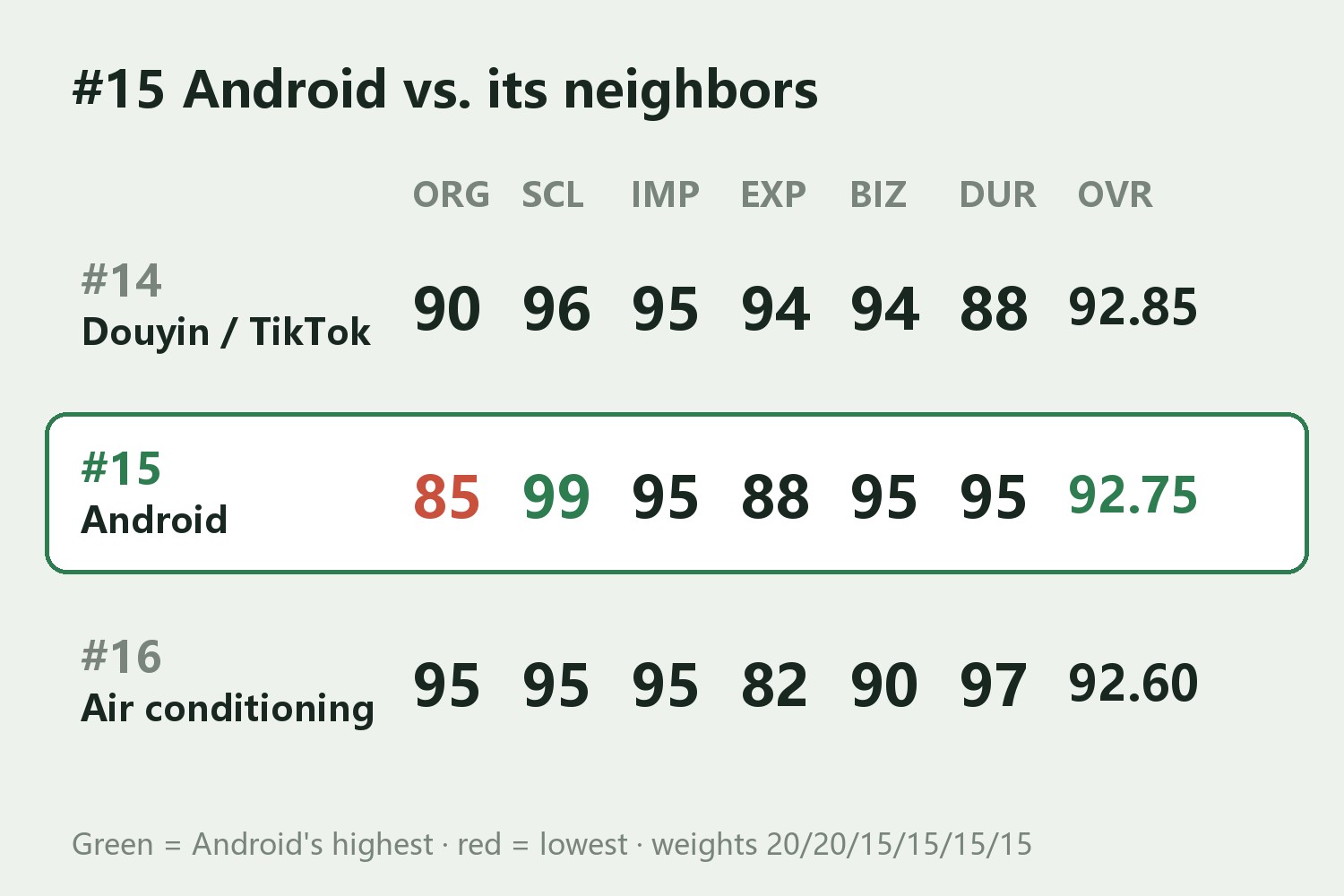
Against #14 Douyin / TikTok, Android is 3 points higher on scale, 7 higher on durability and 1 higher on business, but 5 lower on originality and 6 lower on experience. Net, the gap is just 0.10, with Douyin ahead.
Against #16 air conditioning, air conditioning scores 95 on originality, 10 points above Android, and 97 on durability; but its experience (82) and business (90) are both lower. Android leads by 0.15.
The iPhone answered the question of what a smartphone should be. Android answered a different one: how to get it to everyone. The answer was to charge nothing. The price is that Google has had to maintain, together with hundreds of manufacturers, a system that is never quite the same twice.
All scores and rankings in this article were produced by Claude (AI).
Sources: the Android 17 release date; Android Inc.’s founding in October 2003 and its founders; the camera-OS origin (Rubin, as reported by PC World on April 16, 2013); Google’s July 2005 acquisition for at least $50 million (as reported by The New York Times); the HTC Dream announcement on September 23, 2008; the Open Handset Alliance launch on November 5, 2007; the Apache 2.0 license; GMS being outside AOSP; version codenames and the end of dessert names on August 22, 2019; the developer count of 3,997 devices (Ars Technica, 2012); Canalys’s fourth-quarter 2010 share; the active-device figures Google announced in 2015, 2017 and 2021; and the 2018 EU fine are from the Wikipedia article “Android (operating system)” and the original reports it cites. The 34 founding members are from the Wikipedia article “Open Handset Alliance”. The Supreme Court’s 6-2 ruling of April 5, 2021 is from the Wikipedia article “Google LLC v. Oracle America, Inc.”. The ranking scores products, not companies.
Discussion